MCQ
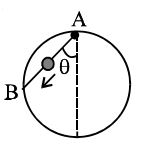
A bead is free to slide down a smooth wire tightly stretched between points $A$ and $B$ on a vertical circle. If the bead starts from rest at $A$, the highest point on the circle
  • A
    its velocity $v$ on arriving at $B$ is proportional to $cos \theta$
  • B
    time to arrive at $B$ is independent of $\theta$
  • C
    time to arrive at $B$ is proportional to $cos \theta$
  • Both $(A)$ and $(B)$

Answer

Correct option: D.
Both $(A)$ and $(B)$
d
$A B=2 R \cos \theta$

$v^{2}=u 6(2)=2 a s$ $v^{2}=2 g \cos \theta \times 2 R \cos \theta$

$v=2 \sqrt{R g} \cos \theta$

$v \propto \cos \theta$

$S=u t+\frac{1}{2} a t^{2}$

$2 R \cos \theta=g \cos \theta t^{2}$

$t=\sqrt{\frac{4 R}{g}} \Rightarrow t=2 \sqrt{\frac{R}{g}}$

Need a full question paper?

Generate a complete, print-ready paper with questions like this in minutes — across 16+ boards, with answer keys.

Start Generating Free

Similar questions

$CO_2$ gas is found in which of the following pairs of the planet
$4 eV$ is the energy of the incident photon and the work function in $2eV.$ What is the stopping potential ............. $V$ 
$80\, gm$ of water at $30°C$ are poured on a large block of ice at $0°C.$ The mass of ice that melts is ........ $gm$
A coil has $1,000$ turns and $500\, cm^2$ as its area. The plane of the coil is placed at right angles to a magnetic induction field of $2 \times {10^{ - 5}}\,Wb/{m^2}$. The coil is rotated through ${180^o}$ in $0.2$ seconds. The average $e.m.f$. induced in the coil, in milli-volts, is
Two bodies $A$and $B$ have thermal emissivities of $0.01$ and $0.81$ respectively. The outer surface areas of the two bodies are the same. The two bodies emit total radiant power at the same rate. The wavelength ${\lambda _B}$ corresponding to maximum spectral radiancy in the radiation from $B$ is shifted from the wavelength corresponding to maximum spectral radiancy in the radiation from $A$, by $1.00\mu m$. If the temperature of $A$ is $5802\;K$
For a gas $\gamma = 7/5.$ The gas may probably be
In the circuit shown in the figure, the current through
A ray passes through a prism of angle $60^o$ in minimum deviation position and suffers a deviation of $30^o $. What is the angle of incidence on the prism......$^o$
Two charged conducting spheres of radii $a$ and $b$ are connected to each other by a conducting wire. The ratio of charges of the two spheres respectively is:
A light string passes over a frictionless pulley. To one of its ends a mass of $6\, kg$ is attached. To its other end a mass of $10\, kg$ is attached. The tension in the thread will be ........ $N$