MCQ
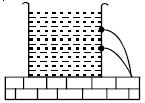
A beaker containing a liquid is kept inside a big closed jar. If the air inside the jar is continuously pumped out the pressure in the liquid near the bottom of the liquid will:
  • A
    Increase
  • Decrease
  • C
    Remain constant
  • D
    First decrease and then increase.

Answer

Correct option: B.
Decrease
As the air inside the jar is pumped out, the air pressure decreases. Thus, the pressure in the liquid near the bottom of the beaker decreases.

Need a full question paper?

Generate a complete, print-ready paper with questions like this in minutes — across 16+ boards, with answer keys.

Start Generating Free

Similar questions

The frequency of vibration $f$ of a mass $m$ suspended from a spring of spring constant $K$ is given by a relation of this type $f = C\,{m^x}{K^y}$; where $C$ is a dimensionless quantity. The value of $x$ and $y$ are
The coordinates of the positions of particles of mass $7,\,4{\rm{  and 10}}\,gm$ are ${\rm{(1,}}\,{\rm{5,}}\, - {\rm{3),}}\,\,{\rm{(2,}}\,5,7{\rm{) }}$ and ${\rm{(3, 3, }} - {\rm{1)}}\,cm$ respectively. The position of the centre of mass of the system would be
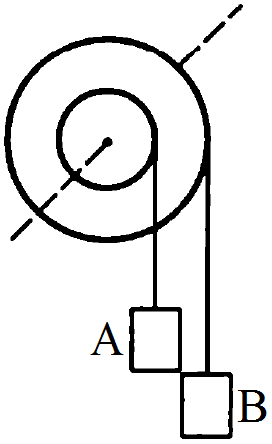
Figure shows a small wheel fixed coaxially on a bigger one of double the radius. The system rotates about the common axis. The strings supporting A and B do not slip on the wheels. If x and y be the distance travelled by A and B in the same time interval, then:
If $\vec{\text{a}}_1$ and $\vec{\text{a}}_2$ are two non collinear unit vectors and $|\vec{\text{a}}_1+\vec{\text{a}}_2|=\sqrt{3},$ then the value of $(\vec{\text{a}}_1-\vec{\text{a}}_2).(2\vec{\text{a}}_1+\vec{\text{a}}_2)$ is:
In a cylindrical vessel containing liquid of density $\rho $, there are two holes in the side walls at heights of $ h_1$  and $h_2$ respectively such that the range of efflux at the bottom of the vessel is same. The height of a hole, for which the range of efflux would be maximum, will be
If masses of two point objects are tripled and distance between them is doubled, then gravitational force of attraction between them will .......... $\%$
Three concurrent forces of the same magnitude are in equilibrium. What is the angle between the forces  Also name the triangle formed by the forces as sides
rod of $40\, cm$ in length and temperature difference of ${80^o}C$ at its two ends. $A$ nother rod $B$ of length $60\, cm$ and of temperature difference ${90^o}C$, having the same area of cross-section. If the rate of flow of heat is the same, then the ratio of their thermal conductivities will be
The quantity that is not conserved in an inelastic collision is
A simple pendulum of length $l$ and mass $m$ of the bob is suspended in a car that is travelling with a constant speed $v$ around a circular path of radius $R$. If the pendulum undergoes oscillations with small amplitude about its equilibrium position, the frequency of its oscillations will be