MCQ
If $\vec{\text{a}}_1$ and $\vec{\text{a}}_2$ are two non collinear unit vectors and $|\vec{\text{a}}_1+\vec{\text{a}}_2|=\sqrt{3},$ then the value of $(\vec{\text{a}}_1-\vec{\text{a}}_2).(2\vec{\text{a}}_1+\vec{\text{a}}_2)$ is:
  • A
    $2$
  • B
    $\frac{3}{2}$
  • $\frac{1}{2}$
  • D
    $1$

Answer

Correct option: C.
$\frac{1}{2}$

Need a full question paper?

Generate a complete, print-ready paper with questions like this in minutes — across 16+ boards, with answer keys.

Start Generating Free

Similar questions

A linear harmonic oscillator of force constant $2 \times 10^6\,Nm^{-1}$ and amplitude $0.01\, m$ has a total mechanical energy of $160\, J.$ Its
A particle is thrown with a speed $u$ at an angle $\theta$ with the horizontal. When the particle makes an angle $\phi$ with the horizontal, its speed changes to $v$, where
A spherical solid ball of $1\,kg$ mass and radius $30\,cm$ is rotating about an axis passing through its centre with an angular velocity of $50\,radian/s$ . The kinetic energy of rotation is ......... $J$.
A particle moves along a straight line such that its displacement at any time $t$ is given by $s = (t^3 -3t^2 + 2)\,m$ The displacement when the acceleration becomes zero is........$m$
Hanging in a spring m the period of oscillation of the mass is T. Oscillations are made by cutting the spring in half and hanging double the mass on it. Now the period of oscillation will be :
A ball of mass m falls vertically to the ground from a height$ h_1$ and rebound to a height ${h_2}$. The change in momentum of the ball on striking the ground is
The maximum wavelength of radiation emitted at $2000\;K$is $4\mu m$. What will be the maximum wavelength of radiation emitted at $2400\,K$ is ...... $\mu m$
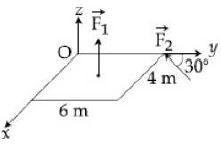
A slab is subjected to the two forces ${\vec F_1}$ and ${\vec F_2}$ of same magnitude $F$ as shown in the figure. Force  ${\vec F_2}$ is in $XY -$ plane while force $F_1$ acts along $z -$ axis at the point $(2\vec i + 3\vec j)$.  The moment of these forces about point $O$ will be
A ball is thrown vertically downwards from a height of  $20\, m$ with an initial velocity $v_0$, It collides with the ground, loses $50$ percent of its energy in collision and rebounds same height. The initial velocity $v_0$ .................... $\mathrm{ms}^{-2}$ (Take $g=10 \,ms^{-2}$)
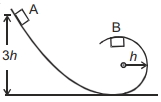
In the figure shown, a particle is released from the position $A$ on a smooth track. When the particle reaches at $B$, then normal reaction on it by the track is .........