MCQ
A beam consisting of protons and electrons moving at the same speed goes through a thin region in which there is a magnetic field perpendicular to the beam. The protons and the electrons:
  • A
    Will go undeviated.
  • B
    Will be deviated by the same angle and will not separate.
  • Will be deviated by different angles and hence separate.
  • D
    Will be deviated by the same angle but will separate.
Answer

Correct option: C.
Will be deviated by different angles and hence separate.
c. Will be deviated by different angles and hence separate.
Explanation:
$\overrightarrow{ F }= q ( V \times B )$
Charge proton is poritive $= e$
$F_p=e v B$
Charge of electron is negative $=-e$
$F_e=-e v B$
They will be deviated by different angles and Hence separate.

Need a full question paper?

Generate a complete, print-ready paper with questions like this in minutes — across 16+ boards, with answer keys.

Start Generating Free

Similar questions

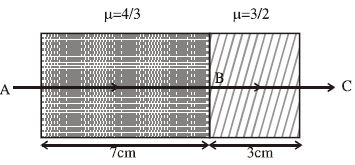
The given figure shows a ray of light passing through two media having refractive indices $4/3$ and $3/2$ respectively. The ratio of times taken by the ray in traversing the distances $AB$ and $BC$ is
Two nucleons are at a separation of $1 \times 10^{-15} m$. The net force between them is $F_1$, if both are neutrons, $F_2$ if both are protons and $F_3$ if one is a proton and other is a neutron. In such a case
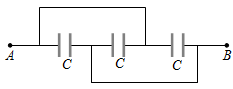
Three equal capacitors, each with capacitance $C$ are connected as shown in figure. Then the equivalent capacitance between $A$ and $B$ is
The capacity of a parallel plate air condenser is $2 \mu F.$ If a dielectric of dielectric constant $4$ is introduced between the plates, its new capacity is:
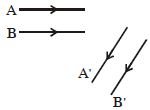
Figure shows two rays $A$ and $B$ being reflected by a mirror and going as $A'$ and $B'$. The mirror
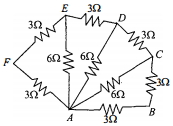
Six resistors of $3 \;\Omega$ each are connected along the sides of a hexagon and three resistors of $6\; \Omega$ each are connected along $A C, A D$ and $A E$ as shown in the figure. The equivalent resistance between $A$ and $B$ is equal to
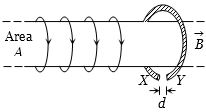
A highly conducting ring of radius $R$ is perpendicular to and concentric with the axis of a long solenoid as shown in fig. The ring has a narrow gap of width d in its circumference. The solenoid has cross sectional area A and a uniform internal field of magnitude $B_0$. Now beginning at $t = 0$, the solenoid current is steadily increased to so that the field magnitude at any time t is given by $B(t)$ = $B_0$ + $\alpha$t where $\alpha > 0$. Assuming that no charge can flow across the gap, the end of ring which has excess of positive charge and the magnitude of induced $e.m.f$. in the ring are respectively
Assertion : Electric lines of force never cross each other.

Reason : Electric field at a point superimpose to give one resultant electric field.

Resolving power of an electron microscope is greater than resolving power of an optical microscope because
The drift velocity does not depend upon