MCQ 11 Mark
Consider a wire carrying a steady current, I placed in a uniform magnetic field B perpendicular to its length. Consider the charges inside the wire. It is known that magnetic forces do no work. This implies that:
- A
Motion of charges inside the conductor is unaffected by B since they do not absorb energy.
- B
Some charges inside the wire move to the surface as a result of B.
- C
If the wire moves under the influence of B, no work is done by the magnetic force on the ions, assumed fixed within the wire.
- ✓
AnswerSolution:
Magnetic force on a conductor of length l carrying a current I placed in a uniform magnetic field B is given by, $\text{F}=\text{I}(\text{l}\times\text{B})\text{ or }|\text{F}|=\text{I }|\text{l}| \ \ |\text{B}|\sin\theta$.
The direction of force is given by Fleming's left hand rule & F is perpendicular to the direction of magnetic field B, Therefore, work done by the magnetic force on the ions is zero.
View full question & answer→MCQ 21 Mark
A charged particle moves through a magnetic field perpendicular to its direction. Then:
- A
Kinetic energy changes, but the momentum is constant.
- ✓
The momentum changes, but the kinetic energy is constant.
- C
Both momentum and kinetic energy of the particle are not constant.
- D
Both momentum and kinetic energy of the particle are constant.
AnswerCorrect option: B. The momentum changes, but the kinetic energy is constant.
View full question & answer→MCQ 31 Mark
A particle of mass $m$ and charge $q$ enters a magnetic field $B$ perpendicularly with $a$ velocity $v$. The radius of the circular path described by it will be:
- A
$Bq/mv.$
- B
$mq/Bv.$
- C
$mB/qv.$
- ✓
$mv/Bq.$
AnswerCorrect option: D. $mv/Bq.$
View full question & answer→MCQ 41 Mark
An electron having a charge e moves with a velocity v in $X-$direction. An electric field acts on it in $Y-$direction? The force on the electron acts in:
- A
Positive direction of $Y-$axis.
- ✓
Negative direction of $Y-$axis.
- C
Positive direction of $Z-$axis.
- D
Negative direction of $Z-$axis.
AnswerCorrect option: B. Negative direction of $Y-$axis.
View full question & answer→MCQ 51 Mark
When a charged particle moves through a magnetic field, the quantity which is not affected in the magnetic field is:
- A
- B
- C
Linear momentum of the particle
- ✓
Kinetic energy of the particle
AnswerCorrect option: D. Kinetic energy of the particle
Magnetic field does zero work on moving charged particles. Therefore, kinetic energy of particle remains constant.
View full question & answer→MCQ 61 Mark
Two parallel, long wires carry currents $i_1$ and $i_2$ with $i_1>i_2$. When the currents are in the same direction, the magnetic field at a point midway between the wires is $10 \mu T$. If the direction of $i _2$ is reversed, the field becomes $30 \mu T$. The ratio $\frac{i_1}{i_2}$ is:
AnswerThe magnetic field due to the current$-$carrying long, straight wire at point a is given by,
$B =\frac{\mu_0 i }{2 \pi d }$
When both the wires carry currents $i _1$ and $i _2$ in the same direction, they produce magnetic fields in opposite directions at any point in between the wires.
$B ^{\prime}=\frac{\mu_0 i _1}{2 \pi a }-\frac{\mu_0 i _2}{2 \pi a }=10 \mu T \ldots$
Here, $a$ is the distance of the midpoint from both the wires.
When both the wires carry currents in opposite directions, they produce fields in the same direction at the midpoint of the two wires.
$B ^{\prime \prime}=\frac{\mu_0 i _1}{2 \pi a }+\frac{\mu_0 i _2}{2 \pi a }=30 \mu T \ldots$
On solving eqs. $(1)$ and $(2)$, we get
$i_1-i_2=10$
$i_1+i_2=30$
$\Rightarrow i_1=20$
$i_2=10$
$\frac{i_1}{i_2}=\frac{20}{10}$
$\frac{i_1}{1_2}=\frac{2}{1}$
$\Rightarrow \frac{i_1}{i_2}=2$
View full question & answer→MCQ 71 Mark
A moving charge produces:
AnswerBecause of the presence of a charge, a particle produces an electric field. Also, because of its motion, that is, the flow of charge or current, there is generation of a magnetic field.
View full question & answer→MCQ 81 Mark
A positively charged particle projected towards east is deflected towards north by a magnetic field. The field may be:
Answer$\text{F}=\text{q}\big(\overrightarrow{\text{V}}\times\overrightarrow{\text{B}}\big)$
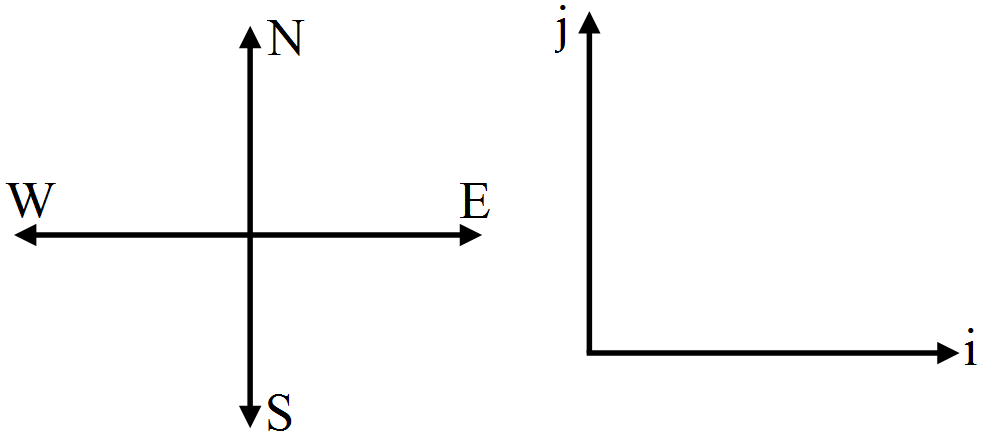
$\text{j}=\text{q}\big(\overrightarrow{\text{i}}\times\overrightarrow{\text{B}}\big)$
$\Rightarrow\text{B}\otimes$
$\Rightarrow $ The magnetic field may be down ward direction. View full question & answer→MCQ 91 Mark
Let $\overrightarrow{\text{E}}$ and $\overrightarrow{\text{B}}$ denote electric and magnetic fields in a frame S and $\overrightarrow{\text{E}}$ and $\overrightarrow{\text{B}}$ in another frame S moving with respect to S at a velocity $\overrightarrow{\text{v}}.$ Two of the following equations are wrong. Identify them.
- A
$\text{B}_\text{y},=\text{B}_\text{y}+\frac{\text{vE}_\text{z}}{\text{c}^2}$
- B
$\text{E}_\text{y},=\text{E}_\text{y}+\frac{\text{vB}_\text{z}}{\text{c}^2}$
- C
$\text{B}'_\text{y}=\text{B}_\text{y}+\text{v}\text{E}_\text{z}$
- ✓
AnswerExplanation:
$\text{qE}=\text{qvB}$
$\Rightarrow\text{e}=\text{vB}$ By dimensionally b & care wrong
$\Rightarrow\text{v}\text{E}=\text{v}^2\text{B}$
$\Rightarrow\text{B}=\frac{\text{vE}}{\text{v} ^2}$
View full question & answer→MCQ 101 Mark
A long solenoid has a radius a and number of turns per unit length n. If it carries a current i, then the magnetic field on its axis is directly proportional to:
AnswerCorrect option: B. $\text{ni}$
View full question & answer→MCQ 111 Mark
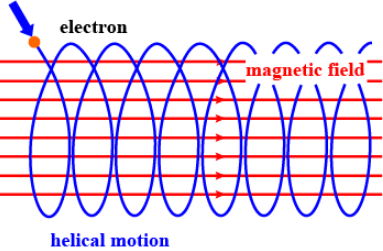
If the direction of the initial velocity of a charged particle is neither along nor perpendicular to that of the magnetic field, then the orbit will be:
AnswerThe perpendicular component will be responsible for circular motion and parallel component will take it along the magnetic field.
Considering both the phenomena, the resultant motion will be helical.
View full question & answer→MCQ 121 Mark
What is the space around a current$-$carrying conductor, in which its magnetic effect can be experienced called?
AnswerThe space around a current$-$carrying conductor, in which its magnetic effect can be experienced is called the magnetic field.
When a current is passed through a conductor, it modifies the space around the conductor and forms a magnetic field.
View full question & answer→MCQ 131 Mark
Earth’s magnetism was discovered by:
MCQ 141 Mark
The magnetic field produced by a current $-$ carrying wire at a given point depends on:
- ✓
The current passing through it
- B
- C
- D
AnswerCorrect option: A. The current passing through it
The magnetic field produced by a current $-$ carrying wire at a given point depends directly on the current passing through it.
Therefore, if there is a circular coil having n turns, the field produced is n times as large as that produced by a single turn.
This is because the current in each circular turn has the same direction, and the field due to each turn then just adds up.
View full question & answer→MCQ 151 Mark
A positive charge is moving vertically upwards in the magnetic field towards the south. In which direction will it be deflected?
AnswerIf the positive charge is moving upwards the corresponding current is also upwards, the magnetic field is towards the south.
Using Flemings left-hand rule force is towards east and deflection towards east.
View full question & answer→MCQ 161 Mark
Cyclotron is a device used to $.......$
- A
Slow down charged particles
- ✓
Accelerate the positively charged particles
- C
Stop the charged particles
- D
AnswerCorrect option: B. Accelerate the positively charged particles
A cyclotron is a device used to accelerate positively charged particles.
View full question & answer→MCQ 171 Mark
Identify the quantity which changes when a charged particle moves through a magnetic field?
AnswerWhen a charged particle moves through a magnetic field it suffers a change in its direction of motion.
View full question & answer→MCQ 181 Mark
A long, straight wire of radius R carries a current distributed uniformly over its cross section. T he magnitude of the magnetic field is:
- A
Maximum at the axis of the wire.
- B
Minimum at the axis of the wire.
- C
Maximum at the surface of the wire.
- ✓
AnswerExplanation:
A long, straight wire of radius $R$ is carrying current $i$, which is uniformly distributed over its cross section. According to Ampere's law,
$\oint \overrightarrow{ B } \cdot d \overrightarrow{ l }=\mu_0 i _{\text {inside }}$
At surface,
$B \times 2 \pi R =\mu_0 i$
$\Rightarrow B _{\text {surface }}=\frac{\mu_0 i }{2 \pi R }$
Inside, $B \times 2 \pi r =\mu_0 i$ for $r < R$
Here $i$ is the current enclosed by the amperian loop drawn inside the wire.
$B _{\text {inside }}$ will be proportional to the distance from the axis.
On the axis
$B=0$
The magnetic fields from points on the cross section will point in opposite directions and will cancel each other at the centre.
Outside, $B \times 2 \pi r =\mu_0 i$
$\Rightarrow B _{\text {outside }}=\frac{\mu_0 i }{2 \pi I }, r > R$
Therefore, the magnitude of the magnetic field is maximum at the surface of the wire and minimum at the axis of the wire.
View full question & answer→MCQ 191 Mark
Ampere’s circuital law states that:
- A
The surface integral of magnetic field over the open surface is equal to $\mu 0$ times the total current passing through the surface.
- B
The surface integral of magnetic field over the open surface is equal to $\mu 0$ times the total current passing near the surface.
- C
The line integral of magnetic field along the boundary of the open surface is equal to $\mu 0$ times the total current passing near the surface.
- ✓
The line integral of magnetic field along the boundary of the open surface is equal to $\mu 0$ times the total current passing through the surface.
AnswerCorrect option: D. The line integral of magnetic field along the boundary of the open surface is equal to $\mu 0$ times the total current passing through the surface.
View full question & answer→MCQ 201 Mark
The current sensitivity of a galvanometer is defined as:
- A
The current flowing through the galvanometer when a unit voltage is applied across its terminals.
- B
Current per unit deflection.
- ✓
Deflection per unit current.
- D
Dflection per unit current when a unit voltage is applied across its terminals.
AnswerCorrect option: C. Deflection per unit current.
View full question & answer→MCQ 211 Mark
The permeability of a paramagnetic substance is:
- A
- ✓
Small but more than unity
- C
- D
AnswerCorrect option: B. Small but more than unity
View full question & answer→MCQ 221 Mark
If a copper rod carries a direct current, the magnetic field associated with the current will be:
- A
- B
- ✓
Both inside and outside the rod.
- D
Neither inside nor outside the rod.
AnswerCorrect option: C. Both inside and outside the rod.
View full question & answer→MCQ 231 Mark
A current carrying loop is placed in a uniform magnetic field. The torque acting on it does not depend upon:
MCQ 241 Mark
A current carrying power line carries current from west to east. Then the direction of the magnetic field $2m$ above it is:
View full question & answer→MCQ 251 Mark
$A$ rod $AB$ moves with a uniform velocity $v$ in a uniform magnetic field as shown in figure.
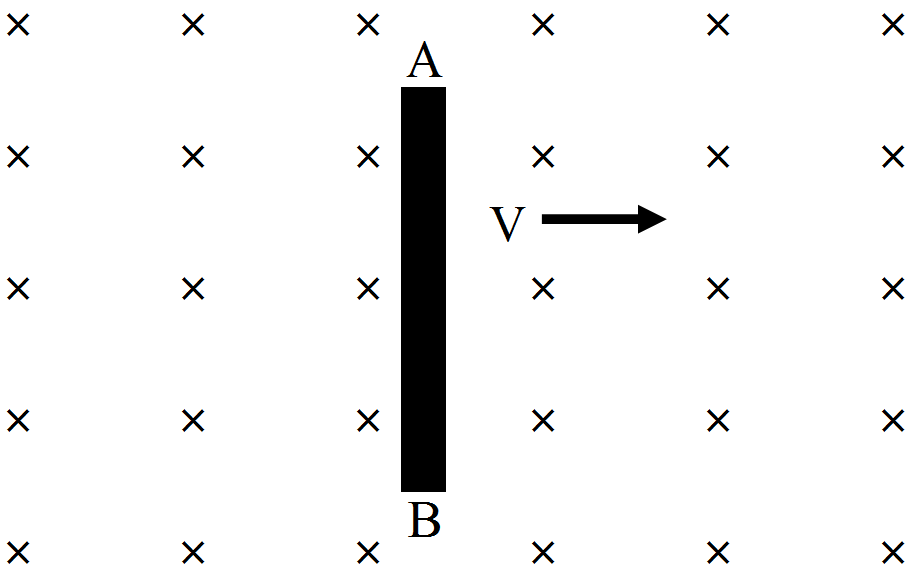
- A
The rod becomes electrically charged.
- ✓
The end A becomes positively charged.
- C
The end B becomes positively charged.
- D
The rod becomes hot because of Joule heating.
AnswerCorrect option: B. The end A becomes positively charged.
The end $'A'$ becomes, positively charged. Because magnetic field exerts an average Force $\vec{F}_0=q \vec{v} \times \vec{B} n$ each free electron where $q =1.6 \times 10^{19} C$ is the charge on the electron. This Force is towards $AB$ and hence the free electrons will move towareds $B$. Negative charge is accumulated at ' $B$ ' and positive charge appears at $A$.
View full question & answer→MCQ 261 Mark
Consider three quantities $\text{x}=\frac{\text{E}}{\text{B}},\ \text{y}=\sqrt{\frac{1}{\mu_0\in_0}}$ and $\text{z}=\frac{1}{\text{CR}}.$ Here, l is the length of a wire, C is a capacitance and R is a resistance. All other symbols have standard meanings.
- A
x, y have the same dimensions.
- B
y, z have the same dimensions.
- C
z, x have the same dimensions.
- ✓
AnswerExplanation:
Lorentz Force:
$\text{qvB}=\text{qE}$
⇒ Dimensions of $\text{x}=[\text{v}]=\Big[\frac{\text{E}}{\text{B}}\Big]=\big[\text{LT}^{-1}\big]$
$\text{y}=\frac{1}{\sqrt{\mu_0\in_0}}=\sqrt{\frac{4\pi}{\mu_0}\times\frac{1}{4\pi\in_0}}=\sqrt{\frac{9\times10^9}{10^{-7}}}=3\times10^8=\text{c}$
⇒ Dimensions of $\text{y}=[\text{c}]=\big[\text{LT}^{-1}\big]$
Time constant of RC circuit = RC so dimensionally [RC] = [T]
$\Rightarrow\text{z}=\Big[\frac{\text{l}}{\text{RC}}\Rightarrow[\text{z}]=[\text{LT}^{-1}]$
Therefore, x, y and z have the same dimensions.
View full question & answer→MCQ 271 Mark
The strength of the magnetic field around an infinite current carrying conductor is:
- A
- ✓
Inversely proportional to the distance
- C
Directly proportional to the distance
- D
AnswerCorrect option: B. Inversely proportional to the distance
View full question & answer→MCQ 281 Mark
$SI$ unit of the magnetic field is $.......$.
AnswerThe $SI$ unit of the magnetic field is Tesla.
View full question & answer→MCQ 291 Mark
What is the work done by the magnetic field on the moving charge?
- ✓
No work is done by the magnetic field on the moving charge.
- B
Work done will be maximum.
- C
Work done will be minimum.
- D
Both $A$ and $B$
AnswerCorrect option: A. No work is done by the magnetic field on the moving charge.
The magnetic force acts in such a way that the direction of the magnetic force and velocity are always perpendicular to each other. If force and velocity are perpendicular force and displacement are also perpendicular, thus $W = FS$ cos $q$, if $q = 90$, work done will be zero.
View full question & answer→MCQ 301 Mark
A vertical straight conductor carries a current vertically upwards. $A$ point $P$ lies to the east of it at a small distance and another point $Q$ lies to the west at the same distance the magnetic field at $P$ is:
AnswerCorrect option: B. Same as at $Q.$
As per Biot Savart Law, Magnetic field at a point is inversely proportional to square of distance from the current carrying conductor.
Therefore magnitude of magnetic field is same at both points $P$ and $Q,$ irrespective of their position from the conductor.
View full question & answer→MCQ 311 Mark
If a current is passed through a spring then the spring will:
MCQ 321 Mark
A charged particle goes undeflected in a region containing an electric and a magnetic field. It is possible that
- A
$\overrightarrow{\text{E}}||\overrightarrow{\text{B}},\ \overrightarrow{\text{v}}||\overrightarrow{\text{E}}$
- B
$\overrightarrow{\text{E}}$ is not parallel to $\overrightarrow{\text{B}}$
- ✓
- D
$\overrightarrow{\text{E}}||\overrightarrow{\text{B}}$ but $\overrightarrow{\text{v}}$ is not parallel to $\overrightarrow{\text{E}}$
AnswerExplanation:
$\Rightarrow\overrightarrow{\text{V}}\overrightarrow{\text{E}},\ \overrightarrow{\text{B}}\overrightarrow{\text{E}}$
In this case Magnetic force on the particle is zero & $\overrightarrow{\text{V}}$ is paralle to $\overrightarrow{\text{E}}.$ So charged particle goes undeflected in a region.
$\overrightarrow{\text{E}}$ is not parallel to $\overrightarrow{\text{B}},$ But $\overrightarrow{\text{V}}$ is parallel to $\overrightarrow{\text{E}}.$
View full question & answer→MCQ 331 Mark
What is the magnetic field inside a pipe?
AnswerThe magnetic field inside a pipe, i.e. inside a hollow cylindrical wire is zero.
This is due to the symmetry of the situation $($pipe$).$
The pipe can be considered as a series of thin wires arranged in a circle.
View full question & answer→MCQ 341 Mark
When the free ends of a tester are dipped into a solution, the magnetic needle shows deflection.
AnswerThe deflection in the compass needle shows that current is flowing through the wounded wire and hence, through the circuit.
The circuit is complete since free ends of the tester are dipped in a solution.
The solution is certainly a conducting solution. That is the reason why the compass needle shows a deflection.
View full question & answer→MCQ 351 Mark
A charged particle moves through a magnetic field in a direction perpendicular to it. Then the:
- A
Velocity remains unchanged.
- ✓
Speed of the particle remains unchanged.
- C
Direction of the particle remains unchanged.
- D
Acceleration remains unchanged.
AnswerCorrect option: B. Speed of the particle remains unchanged.
View full question & answer→MCQ 361 Mark
In a coaxial, straight cable, the central conductor and the outer conductor carry equal currents in opposite directions. The magnetic field is zero:
- A
- B
Inside the inner conductor.
- ✓
Inside the outer conductor.
- D
AnswerCorrect option: C. Inside the outer conductor.
Explanation:
According to Ampere's law, in a coaxial, straight cable carrying currents i in the inner conductor and -i (equally in the opposite direction) in the outside conductor.
Inside the inner conductor
$\oint\overrightarrow{\text{B}}.\text{d}\overrightarrow{\text{l}}=\mu_0\text{i}_\text{inside}$
$\oint\overrightarrow{\text{B}}.\text{d}\overrightarrow{\text{l}}=0$
$\Rightarrow\text{b.l}=0$
$\Rightarrow\text{B}=0$
In between the 2 conductors
$\oint\overrightarrow{\text{B}}.\text{d}\overrightarrow{\text{l}}=\mu_0\text{i}$
$\Rightarrow\text{B}=\frac{\mu_0\text{i}}{2\pi\text{r}}$
Outside the outer conductor
$\oint\overrightarrow{\text{B}}.\text{d}\overrightarrow{\text{l}}=\mu_0\text{i}$
$\Rightarrow\text{B}=0$
Therefore, the magnetic field is zero outside the cable.
View full question & answer→MCQ 371 Mark
Two particles $X$ and $Y$ having equal charge, after being accelerated through the same potential difference enter a region of uniform magnetic field and describe circular paths of radii $R_1$ and $R_2$ respectively. The ratio of the mass of $X$ to that of $Y$ is:
- A
$\Big(\frac{\text{R}_1}{\text{R}_2}\Big)^{\frac{1}{2}}$
- B
$\frac{\text{R}_1}{\text{R}_2}$
- ✓
$\Big(\frac{\text{R}_1}{\text{R}_2}\Big)^2$
- D
$\text{R}_1\text{R}_2.$
AnswerCorrect option: C. $\Big(\frac{\text{R}_1}{\text{R}_2}\Big)^2$
Particles $X$ and $Y$ of respective masses $m_1$ and $m_2$ are carrying charge q describing circular paths with respective radii $R_1$ and $R_2$ such that,
$\text{R}_1=\frac{\text{m}_1\text{v}_1}{\text{qB}}$
$\text{R}_1=\frac{\text{m}_2\text{v}_2}{\text{qB}}$
Since both the particles are accelerated through the same potential difference, both will have the same kinetic energy.
$\therefore\frac{1}{2}\text{m}_1\text{v}_1^2=\frac{1}{2}\text{m}_2\text{v}_2^2$
$\because\text{R}_1=\frac{\text{m}_1\text{v}_1}{\text{qB}}\Rightarrow\text{v}_1=\frac{\text{R}_1\text{qB}}{\text{m}_1}$
And,
$\text{R}_2=\frac{\text{m}_2\text{v}_2}{\text{qB}}\Rightarrow\text{v}_2=\frac{\text{R}_2\text{qB}}{\text{m}_2}$
$\therefore\text{m}_1\Big(\frac{\text{R}_1\text{qB}}{\text{m}_1}\Big)^2=\text{m}_2\Big(\frac{\text{R}_2\text{qB}}{\text{m}_2}\Big)^2$
$\Rightarrow\frac{\text{m}_1}{\text{m}_2}=\frac{\text{R}_1^2}{\text{R}_2^2}=\Big(\frac{\text{R}_1}{\text{R}_2}\Big)^2$
View full question & answer→MCQ 381 Mark
An electric current $i$ enters and leaves a uniform circular wire of radius a through diametrically opposite points. A charged particle $q$ moving along the axis of the circular wire passes through its centre at speed $v$. The magnetic force acting on the particle when it passes through the centre has a magnitude:
- A
$\text{qv}\frac{\mu_0\text{i}}{2\text{a}}$
- B
$\text{qv}\frac{\mu_0\text{i}}{2\pi\text{a}}$
- C
$\text{qv}\frac{\mu_0\text{i}}{\text{a}}$
- ✓
$\text{Zero}$
AnswerCorrect option: D. $\text{Zero}$
As the current is entering and exiting from two diametrically opposite points of a circular coil, the currents in the two semicircular sections are in the opposite direction.
The fields due to the two semi$-$circular sections at the centre is in the opposite direction.
Hence net feild is zero.
View full question & answer→MCQ 391 Mark
A proton and an alpha particle both enter a region of uniform magnetic field $B,$ moving at right angles to field $B$. If the radius of circular orbits for both the particles is equal and the kinetic energy acquired by proton is $1 \ MeV$ the energy acquired by the alpha particle will be:
- A
$0.5 \ MeV.$
- B
$1.5 \ MeV.$
- ✓
$1 \ MeV.$
- D
$4 \ MeV.$
AnswerCorrect option: C. $1 \ MeV.$
View full question & answer→MCQ 401 Mark
A milli voltmeter of $25$ milli volt range is to be converted into an ammeter of $25$ ampere range. The value $($in ohm$)$ of necessary shunt will be:
- ✓
$0.001.$
- B
$0.01.$
- C
$1.$
- D
$0.05.$
AnswerCorrect option: A. $0.001.$
View full question & answer→MCQ 411 Mark
A vertical wire carries a current in upward direction. An electron beam sent horizontally towards the wire will be deflected:
AnswerA vertical wire is carrying current in upward direction, so the magnetic field produced will be anticlockwise $($according to the right$-$hand thumb rule$)$. As the electron beam is sent horizontally towards the wire, the direction of the current will be horizontally away from the wire $($direction of conventional current is opposite to the direction of the negative charge$)$. According to Fleming's left$-$hand rule, the force will act in upward direction, deflecting the beam in the same direction.
View full question & answer→MCQ 421 Mark
A charged particle enters into a uniform magnetic field the parameter that remains constant is:
AnswerSince the force on the charge is always normal to the velocity of the charge so, field does not work on the particle and the magnitude of velocity remains same.
So, kinetic energy is same, whereas velocity changes direction. So, velocity, momentum and angular velocity changes.
View full question & answer→MCQ 431 Mark
A circular loop of area $1 \ cm^2$, carrying a current of $10 A$ , is placed in a magnetic field of $0.1 T$ perpendicular to the plane of the loop. The torque on the loop due to the magnetic field is:
- ✓
- B
$10^4 N- m$
- C
$10^2 N- m$
- D
$1 N- m$
Answer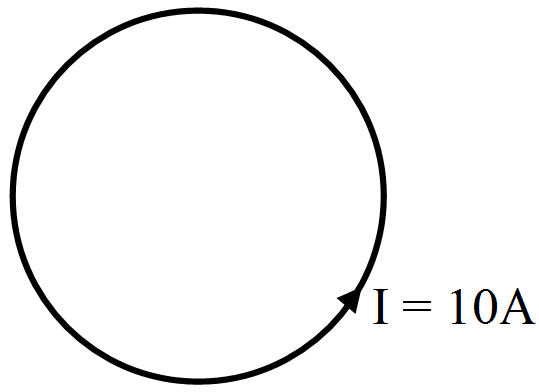
$B=0.1 T$
Area $=1 \ cm^2$
Net torque on the loop due to the uniform magnetic field is always zero. View full question & answer→MCQ 441 Mark
When the charged particles move in a combined magnetic and electric field, then the force acting is known as $.......$.
AnswerWhen the charged particles move in a combined magnetic and electric field, then the force acting is known as Lorentz force.
View full question & answer→MCQ 451 Mark
A magnetic field exerts no force on:
AnswerMoving charge can develop magnetic field and also experience the magnetic field.
But stationary charge do no have the ability to develop or experience magnetic field from the other magnetic fields.
Because moving charge gives rise to current which is responsible for the magnetic effects.
View full question & answer→MCQ 461 Mark
The gyro-magnetic ratio of an electron in an H-atom, according to Bohr model, is:
- A
Independent of which orbit it is in.
- B
- ✓
- D
AnswerSolution:
The gyro-magnetic ratio of an electron in an H-atom is equal to the ratio of the magnetic moment and the angular momentum of the electron. Both are related as,
$\mu_\text{l}=\Big(\frac{\text{e}}{2\text{m}_\text{e}}\Big)\text{l}$
The negative sign indicates that the angular momentum of the electron is opposite in direction to the magnetic moment.
View full question & answer→MCQ 471 Mark
A charge $q$ is moving with a velocity v parallel to a magnetic field $B$. Force on the charge due to magnetic field is:
- A
$q v B.$
- B
$q B/v.$
- ✓
- D
$B v/q.$
View full question & answer→MCQ 481 Mark
In ballistic galvanometer, the frame on which the coil is wound is non $-$ metallic to:
- A
Avoid the production of induced emf.
- ✓
Avoid the production of eddy currents.
- C
Increase the production of eddy currents.
- D
Increase the production of induced emf.
AnswerCorrect option: B. Avoid the production of eddy currents.
The moving coil galvanometer have their coil wound on a 'metallic $($copper or aluminum$)$ frame, so as to make the motion dead beat due to the production of eddy currents.
In the ballistic galvanometer, on the other hand, the damping is to be reduced to the minimum aand hence the frame is of a non$-$conducting material eg, paper or bamboo.
View full question & answer→MCQ 491 Mark
Which of the following particles will describe the smallest circle when projected with the same velocity perpendicular to a magnetic field?
Answera. Electron
Explanation:
$F = qVB =\frac{ mv ^2}{ r }$
$r =\frac{ mV }{ qB }$
charqe electron $=$ charqe of proton $=$ charqe of $He ^{+}=$charqe of $Li ^{+}$But mass of electron is Lowest.
$\therefore$ (the electron so smallest + circle made by)
View full question & answer→MCQ 501 Mark
In an electric motor, wires carrying a current of $5A$ are placed at right angles to a magnetic field of induction $0.8T.$ If each wire has length of $20\ cm$, then the force acting on each wire is:
- A
$0.2N$
- B
$0.4N$
- C
$0.6N$
- ✓
$0.8N$
AnswerCorrect option: D. $0.8N$
$F = Bil = 0.8 \times 5 \times 20 \times 10 − 2 = 0.8N$
View full question & answer→