Question
A beam consisting of protons and electrons moving at the same speed goes through a thin region in which there is a magnetic field perpendicular to the beam. The protons and the electrons:
  1. Will go undeviated.
  2. Will be deviated by the same angle and will not separate.
  3. Will be deviated by different angles and hence separate.
  4. Will be deviated by the same angle but will separate.

Answer

  1. Will be deviated by different angles and hence separate.

Explanation:

$\vec{\text{F}}=\text{q}(\text{V}\times\text{B})$

Charge proton is poritive = e

Fp = evB

Charge of electron is negative = -e

Fe = -evB

They will be deviated by different angles and Hence separate.

Need a full question paper?

Generate a complete, print-ready paper with questions like this in minutes — across 16+ boards, with answer keys.

Start Generating Free

Similar questions

A battery of e.m.f. 10 V and internal resistance 0.5 ohm is connected across a variable resistance R. The value of R for which the power delivered in it is maximum is given by

(a) 2.0 ohm

(b) 0.25 ohm

(c) 1.0 ohm

(d) 0.5 ohm

The dimension of (1/2)  : permittivity of free space; E : electric field) is

(a)  

(b)  

(c)  

(d)  

A freshly prepared radioactive source of half-life 2h emits radiation of intensity which is 64 times the permissible safe level. The minimum time after which it would be possible to work safely with this source is:
The graph of ln$\Big(\frac{\text{R}}{\text{R}_{\text{0}}}\Big)$ versus In A (R = radius of a nucleus and A - its mass number) is:
Which error is removed when the known and unknown resistances are interchanged in a Meter Bridge?
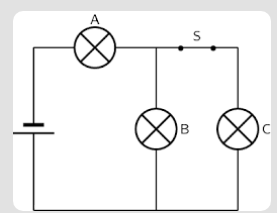
Which of the following is not a correct statement with respect to the given circuit?

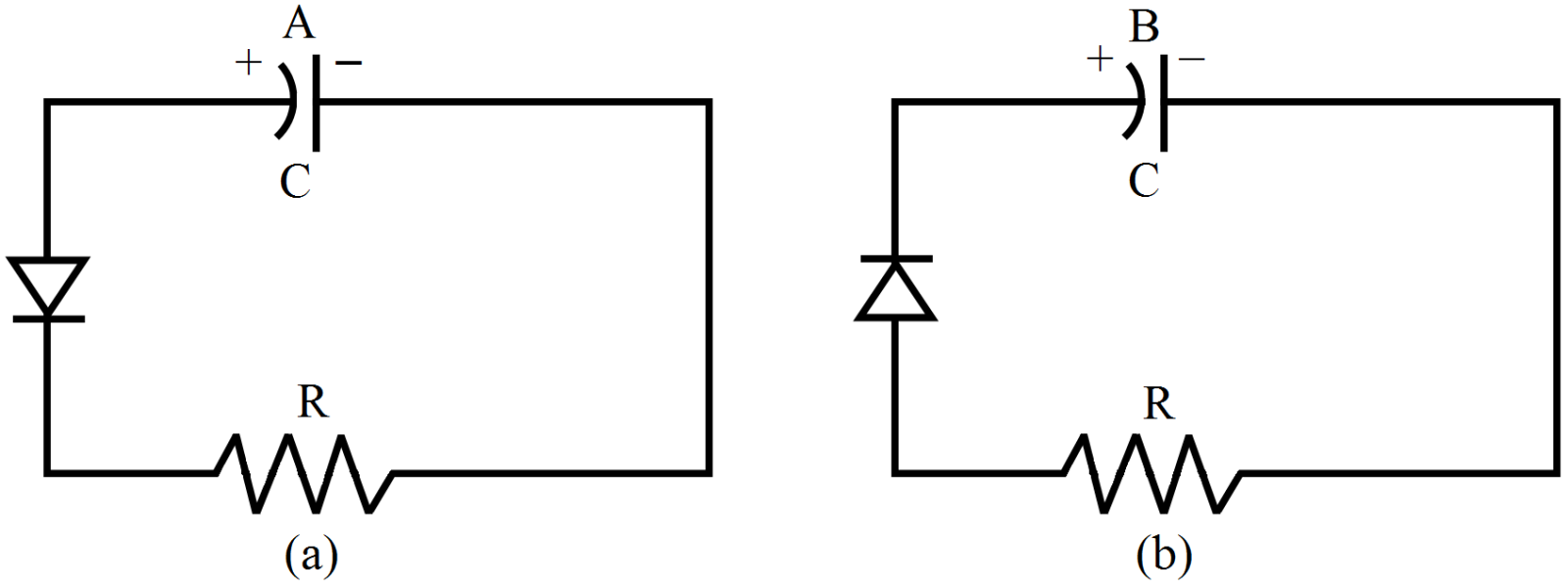
Two identical capacitors A and B are charged to the same potential V and are connected in two circuits at t = 0 as shown in figure. The charges on the capahltors at a time t = CR are, respectively:

  1. $\text{VC}, \text{VC}$
  2. $\frac{\text{VC}}{\text{e}}, \text{VC}$
  3. $\text{VC}, \frac{\text{VC}}{\text{e}}$
  4. $\frac{\text{VC}}{\text{e}}, \frac{\text{VC}}{\text{e}}$
The minimum amount of energy required to emit electrons from a metal surface is called:
What is the angle between the electric dipole moment $\vec{p}$ and the electric field strength $\vec{E}$ when the dipole is in a stable equilibrium ?

The forbidden energy band gap in conductors, semiconductors and insulators are  and   respectively. The relation among them is

(a) 

(b)  

(c) 

(d)