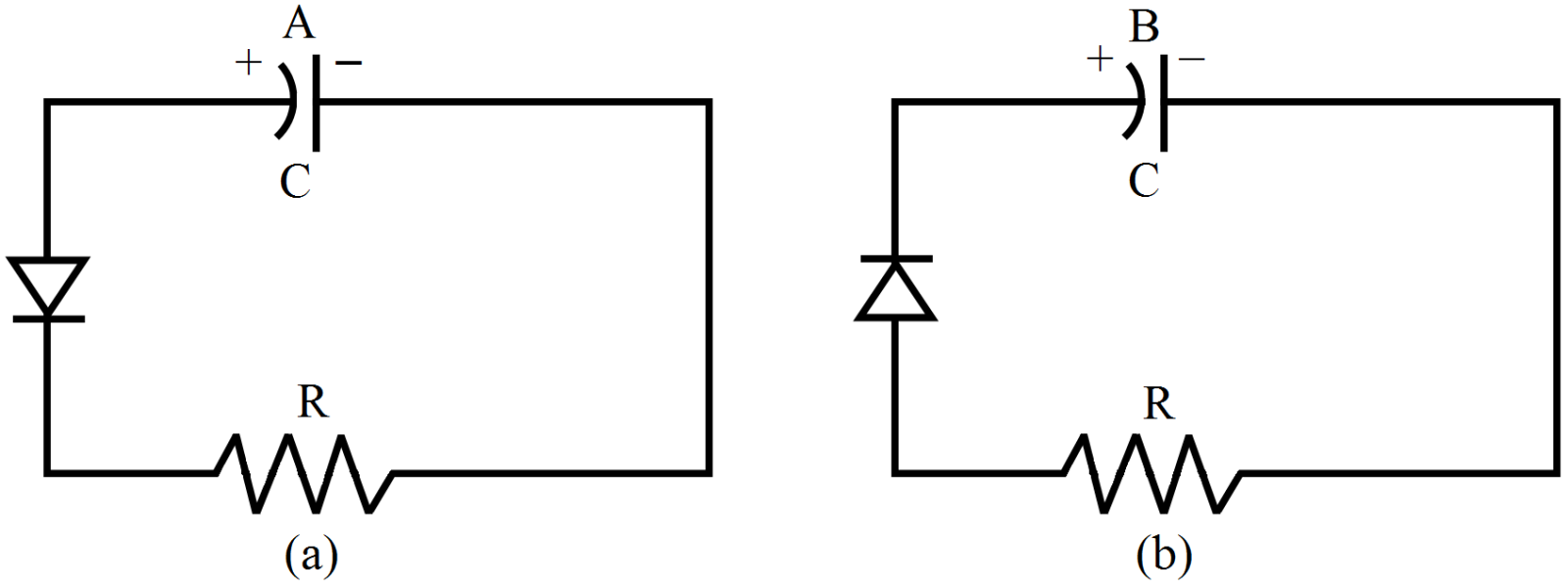
- $\text{VC}, \text{VC}$
- $\frac{\text{VC}}{\text{e}}, \text{VC}$
- $\text{VC}, \frac{\text{VC}}{\text{e}}$
- $\frac{\text{VC}}{\text{e}}, \frac{\text{VC}}{\text{e}}$

Explanation:
In circuit (a), the diode is forward biassed. So, it offers negligible resistance to the flow of current and can thus be replaced by a short circuit. Now, the capacitor charge will leak through the resistance and decay exponentially with time.
Capacitor charge $=\frac{\text{VC}}{\text{e}}$
In circuit (b), the diode is reverse biassed. So, it offers infinite resistance to the current flow and can thus be replaced by an open circuit. As the circuit is open now, no current can flow across the resistance. So, the charge in the capacitor cannot leak through the resistor.
Capacitor charge = VC
Generate a complete, print-ready paper with questions like this in minutes — across 16+ boards, with answer keys.
There is a current of 20 amperes in a copper wire of square metre area of cross-section. If the number of free electrons per cubic metre is
, then the drift velocity is
|
(a) 125 |
(b) 12.5 |
(c) 1.25 |
(d) 1.25 |
An electromagnetic wave of frequency v = 3.0MHz passes from vacuum into a dielectric medium with permittivity ε = 4.0 . Then
|
(a) Wavelength is doubled and the frequency remains unchanged |
|
(b) Wavelength is doubled and frequency becomes half |
|
(c) Wavelength is halved and frequency remains unchanged |
|
(d) Wavelength and frequency both remain unchanged |
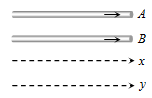
A and B are two conductors carrying a current i in the same direction. x and y are two electron beams moving in the same direction

|
(a) There will be repulsion between A and B attraction between x and y |
|
(b) There will be attraction between A and B, repulsion between x and y |
|
(c) There will be repulsion between A and B and also x and y |
|
(d) There will be attraction between A and B and also x and y |
$\text{3V}\cos\theta$
$2\text{V}\cos\theta$
$\frac{3}{2}\text{V}\cos\theta$
$\text{V}\cos\theta$
The maximum efficiency of full wave rectifier is
|
(a) 100% |
(b) 25.20% |
(c) 40.2% |
(d) 81.2% |
The drift velocity of free electrons in a conductor is ‘v’ when a current ‘i’ is flowing in it. If both the radius and current are doubled, then drift velocity will be
|
(a) v |
(b) |
(c) |
(d) |