MCQ
A beam of electrons passes undeflected through mutually perpendicular electric and magnetic fields. It the electric field is switched off, and the same magnetic field is maintained, the electrons move
  • A
    in an elliptical orbit
  • in a circular orbit
  • C
    along a parabolic path
  • D
    along a straight line

Answer

Correct option: B.
in a circular orbit
b
Electron travelling in a magnetic field perpendicular to its velocity - circular path.

Need a full question paper?

Generate a complete, print-ready paper with questions like this in minutes — across 16+ boards, with answer keys.

Start Generating Free

Similar questions

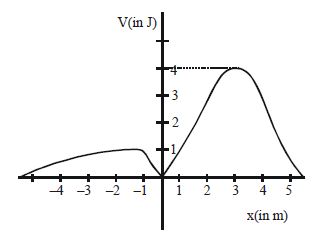
A point particle of mass $0.\ 5 kg$ is moving along the $x-$ axis under a force described by the potential energy $V$ shown below. It is projected towards the right from the origin with a speed $v$ . What is the minimum value of $v$ for which the particle will escape infinitely far away from the origin ? ............... $\ ms^{-1}$
In hydrogen and hydrogen like atoms, the ratio of difference of energies $E_{4n}-E_{2n}$ and $E_{2n}-E_{n}$ varies with its atomic number $z$ and $n$ as:
In $CGS$ system, the Young's modulus of a steel wire is $2 \times {10^{12}}$. To double the length of a wire of unit cross-section area, the force required is
A soft ferromagnetic material is placed in an external magnetic field. The magnetic domains:
An electron is projected with velocity $v_0$ in a uniform electric field $E$ perpendicular to the field. Again it is projetced with velocity $v_0$ perpendicular to a uniform magnetic field $B/$ If $r_1$ is initial radius of curvature just after entering in the electric field and $r_2$ is initial radius of curvature just after entering in magnetic field then the ratio $r_1:r_2$ is equal to 
A body falls freely under gravity. Its speed is $v$ when it has lost an amount $U$ of the gravitational energy. Then its mass is
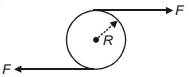
Two equal and opposite forces are applied tangentially to a uniform disc of mass $M$ and radius $R$ as shown in the figure. If the disc is pivoted at its centre and free to rotate in its plane, the angular acceleration of the disc is ............
What will be the most suitable combination of three resistors $A =2\, \Omega, B =4\, \Omega, C =6\, \Omega$ so that $\left(\frac{22}{3}\right)\Omega$ is equivalent resistance of combination$?$
A 1$\mu$ $A$ beam of protons with a cross-sectional area of $0.5$ sq. mm is moving with a velocity of $3 \times {10^4}m{s^{ - 1}}$. Then charge density of beam is
Three concentric conducting spherical shells have radius $ r, 2r$ and $3r$ and $Q_1, Q_2$ and $Q_3$ are final charges respectively. Innermost and outermost shells are already earthed as shown in figure. Choose the wrong statement.