What will be the most suitable combination of three resistors $A =2\, \Omega, B =4\, \Omega, C =6\, \Omega$ so that $\left(\frac{22}{3}\right)\Omega$ is equivalent resistance of combination$?$
JEE MAIN 2022, Medium


Download our appand get started for free
Experience the future of education. Simply download our apps or reach out to us for more information. Let's shape the future of learning together!No signup needed.*
Similar Questions
- 1Two sources of equal $emf$ are connected to an external resistance $R$. The internal resistances of the two sources are ${R_1}$ and ${R_2}\,({R_2} > {R_1})$. If the potential difference across the source having internal resistance ${R_2}$ is zero, thenView Solution
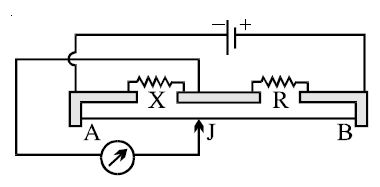
- 2The figure shows a meter-bridge circuit, with $AB = 100\, cm$,$ X = 12\,\Omega$ and $R = 18\,\Omega$ , and the jockey $J$ in the position of balance. If $R$ is now made $8\,\Omega$ , through what distance will $J$ have to be moved to obtain balance? .............. $cm$View Solution
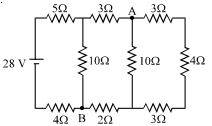
- 3View SolutionConsider the circuit shown in the figure
- 4An electric kettle has two heating coils. When one of the coils is connected to an a.c. sotuce, the water in the kettle boils in $10$ minutes. When the other coil is used the w’ater boils in $40$ minutes. If both the coils are connected in parallel, the time taken by the same quantity of water to boil will be ...... $min$View Solution
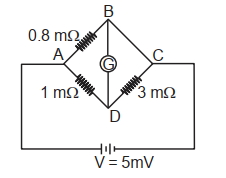
- 5To measure the temperature coefficient of resistivity $\alpha$ of a semiconductor, an electrical arrangement shown in the figure is prepared. The arm BC is made up of the semiconductor. The experiment is being conducted at $25^{\circ} \mathrm{C}$ and resistance of the semiconductor arm is $3 \mathrm{~m} \Omega$. Arm BC is cooled at a constant rate of $2^{\circ} \mathrm{C} / \mathrm{s}$. If the galvanometer $\mathrm{G}$ shows no deflection after $10 \mathrm{~s}$, then $\alpha$ is :View Solution
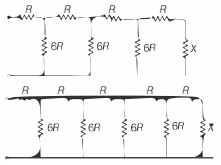
- 6For what value of the resistor $X$ will the equivalent resistance of the two circuits shown be the same?View Solution
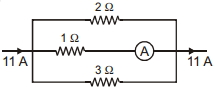
- 7The ammeter reading in the circuit below is .............. $A$View Solution
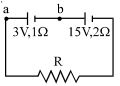
- 8Two batteries one of the $\mathrm{emf}$ $3\,V$, internal resistance $1$ ohm and the other of $\mathrm{emf}$ $15\, V$, internal resistance $2$ $\mathrm{ohm}$ are connected in series with a resistance $R$ as shown. If the potential difference between $a$ and $b$ is zero the resistance of $R$ in $\mathrm{ohm}$ isView Solution
- 9A charged particle having drift velocity of $7.5 \times 10^{-4}\, ms ^{-1}$ is an electric field of $3 \times 10^{-10}\, Vm ^{-1}$ has a mobility in $m ^{2} V ^{-1} s ^{-1}$ ofView Solution
- 10In $a$ wire of cross-section radius $r$, free electrons travel with drift velocity $v$ when a current $I$ flows through the wire. What is the current in another wire of half the radius and of the same material when the drift velocity is $2v$?View Solution