MCQ
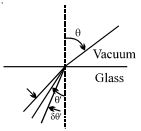
$A$ beam of light has a small wavelength spread $\delta \,\lambda$ about a central wavelength $\lambda$ . The beam travels in vaccum until it enters a glass plate at an angle $\theta$ relative to the normal to the plate, as shown in figure. The index of refraction of the glass is given by $n(\lambda )$. The angular spread $\delta \theta '$ of the refracted beam is given by
  • A
    $\delta \theta ' = \left| {\frac{1}{n}\delta \lambda } \right|$
  • B
    $\delta \theta ' = \left| {\frac{{dn\left( \lambda  \right)}}{{d\lambda }}\delta \lambda } \right|$
  • $\delta \theta ' = \left| {\frac{{\tan \theta '}}{n}\frac{{dn\left( \lambda  \right)}}{{d\lambda }}\delta \lambda } \right|$
  • D
    $\delta \theta ' = \left| {\frac{{\sin \theta }}{{\sin \theta '}}\frac{{\delta \lambda }}{\lambda }} \right|$

Answer

Correct option: C.
$\delta \theta ' = \left| {\frac{{\tan \theta '}}{n}\frac{{dn\left( \lambda  \right)}}{{d\lambda }}\delta \lambda } \right|$
c

Need a full question paper?

Generate a complete, print-ready paper with questions like this in minutes — across 16+ boards, with answer keys.

Start Generating Free

Similar questions

Which of the following statements is correct
White light is used to illuminate two slits in a $YDSE$. The separation between the slits is $d$ and the screen is at a distance $D (D > > b)$ from the slits. At a point on the screen directly in front of one of the slits, which of the following wavelengths are missing.
An infinitely long rod lies along the axis of a concave mirror of focal length $f$. The near end of the rod is at a distance $u >f$ from the mirror. Its image will have a length 
Which of the following statement$(s)$ is/are correct?

$(A)$ If the electric field due to a point charge varies as $r^{-25}$ instead of $r^{-2}$, then the Gauss law will still be valid.

$(B)$ The Gauss law can be used to calculate the field distribution around an electric dipole.

$(C)$ If the electric field between two point charges is zero somewhere, then the sign of the two charges is the same.

$(D)$ The work done by the external force in moving a unit positive charge from point $A$ at potential $V_A$ to point $B$ at potential $V_B$ is $\left(V_B-V_A\right)$.

Which of the following has a negative temperature coefficient
If wire of length $L$ form a loop of radius $R$ and have $n$ turn. Find magnetic field at centre of loop if current flowing in loop is $I$
A long conducting wire having a current $I$ flowing through it, is bent into a circular coil of $N$ turns.Then it is bent into a circular coil of $n$ tums. The magnetic field is calculated at the centre of coils in both the cases. The ratio of the magnetic field in first case to that of second case is:
If $r$ denotes the distance between the sun and the earth, then the angular momentum of the earth around the sun is proportional to
If three resistors of resistance $2  \,\Omega$, $4  \,\Omega$ and $5  \,\Omega$ are connected in parallel then the total resistance of the combination will be
The kinetic energy possessed by a body of mass $m$  moving with a velocity $ v$  is equal to $\frac{1}{2}m{v^2}$, provided