Question
A bird while flying takes a left turn, where does it get the centripetal force from?

Answer

The centripetal wings of bird w.r.t to air and thus the bird turns toward left.

Need a full question paper?

Generate a complete, print-ready paper with questions like this in minutes — across 16+ boards, with answer keys.

Start Generating Free

Similar questions

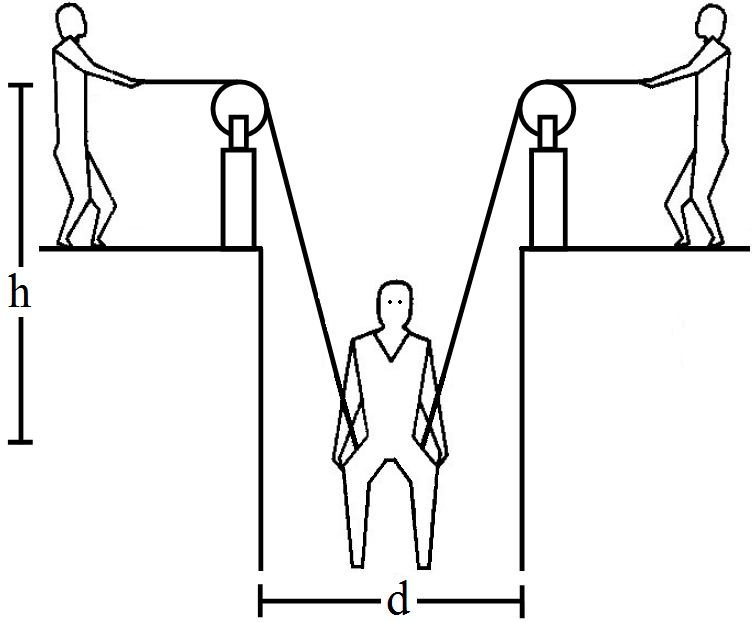
A man has fallen into a ditch of width d and two of his friends are slowly pulling him out using a light rope and two fixed pulleys as shown in figure. Show that the force (assumed equal for both the friends) exerted by each friend on the road increases as the man moves up. Find the force when the man is at a depth h.

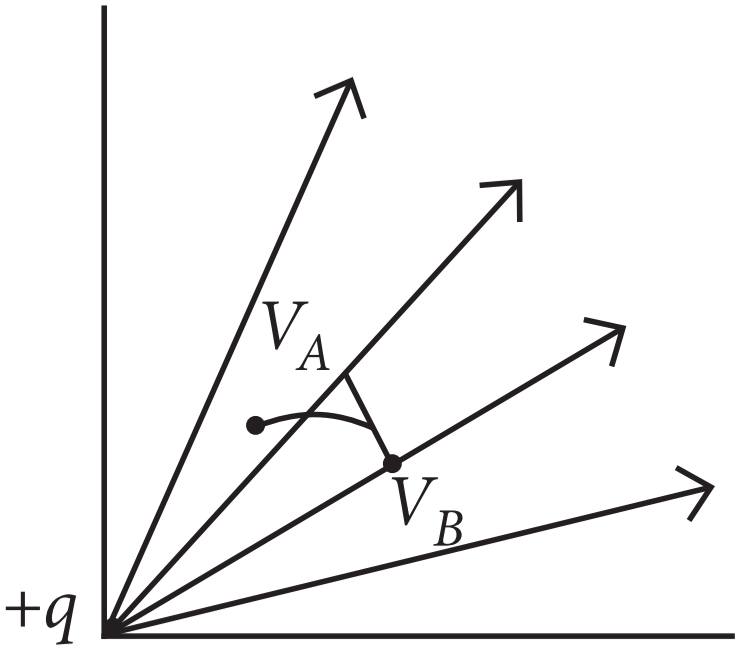
Electrostatic potential energy of a system of point charges is defined as the total amount of work done in bringing the different charges to their respective positions from infinitely charge mutual separations. The work is stored in the system of two point charges in the form of electrostatic potential energy U of the system. Electric potential difference between any points A and B in an electric field is the amount of work done in moving a unit positive test charge from A to B along any path agents the electrostatic force $\text{V}_\text{B}-\text{V}_\text{A}=\frac{\text{W}_\text{AB}}{\text{q}_\text{o}}=\int\vec{\text{E}}.\text{dl}.$

  1. A test charge is moved from lower potential point to a higher potential point. The potential energy of test charge wiII.
  1. Remain the same.
  2. Increase.
  3. Decrease.
  4. Become zero.
  1. Which of the following statement is not true?
  1. Electrostatic force is a conservative force.
  2. Potential energy of charge q at a point is the work done per unit charge in bringing a charge from any point to infinity.
  3. Spring force and gravitational force are conservative force.
  4. Both (a) and (c).
  1. Work done in moving a charge from one point to another inside a uniformly charged conducting sphere is:
  1. Always zero.
  2. Non-zero.
  3. May be zero.
  4. None of these.
  1. The work done in bringing a unit positive charge from infinite distance to a point at distance x from a positive charge Q is W. Then the potential $\phi$ at that point is:
  1. $\frac{\text{WQ}}{\text{x}}$

  2. W

  3. $\frac{\text{W}}{\text{x}}$

  4. WQ

  1. If $1\mu\text{C}$ charge is shifted from A to B and it is found that work done by an external force is $40\mu\text{J}.$ ln doing so against electrostatics force, the potential difference VA - VB is:
  1. 40V
  2. -40V
  3. 20V
  4. -60V
A charge of $1.6 \times 10^{-7} C$ is uniformly distributed on the surface of a spherical conductor of radius 12 cm . What will be the electric field?(a) Inside the sphere(b) Just outside the sphere(c) At any point located 18 cm from the centre of the sphere.
The friction coefficient between an athelete's shoes and the ground is 0.90. Suppose a superman wears these shoes and races for 50m. There is no upper limit on his capacity of running at high speeds.
  1. Find the minimum time that he will have to take in completing the 50m starting from rest.
  2. Suppose he takes exactly this minimum time to complete the 50m, what minimum time will he take to stop?

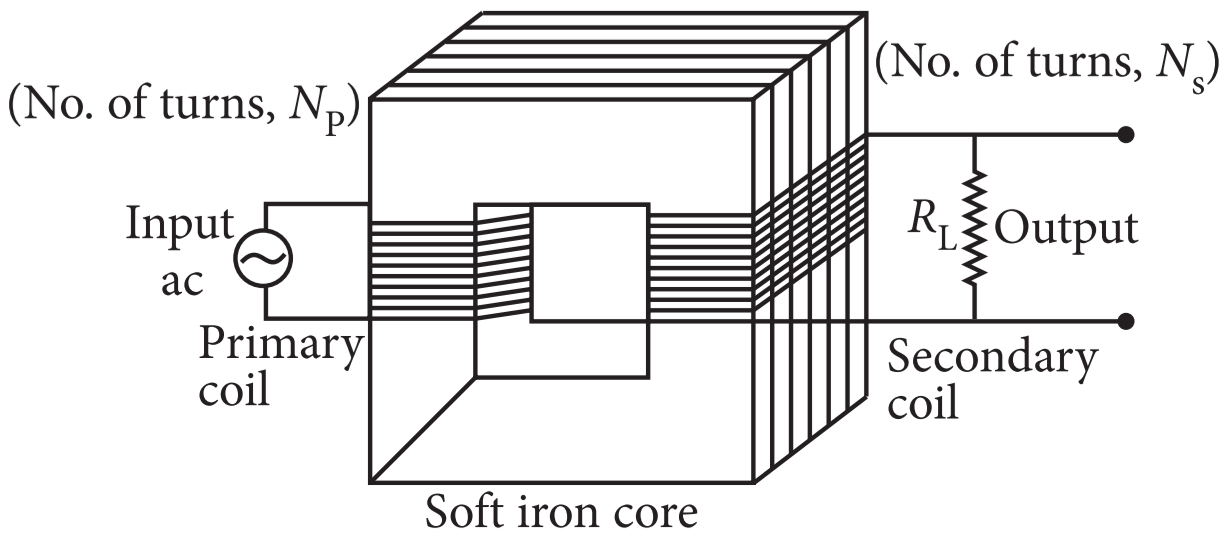
A transformer is an electrical device which is used for changing the a.c. voltages. It is based on the phenomenon of mutual induction i.e. whenever the amount of magnetic flux linked with a coil changes, an e.m.f. is induced in the neighbouring coil. For an ideal transformer, the resistances of the primary and secondary windings are negligible.

It can be shown that $\frac{\text{E}_\text{S}}{\text{E}_\text{P}}=\frac{\text{I}_\text{P}}{\text{I}_\text{S}}=\frac{\text{n}_\text{S}}{\text{n}_\text{P}}=\text{K}$

where the symbols have their standard meanings.

For a step up transformer, $\text{n}_\text{S} > \text{n}_\text{P}; \text{E}_\text{S} > \text{E}_\text{P}; \text{k} > \text{I}; \therefore \text{I}_\text{S} < \text{I}_\text{P}$

For a step down transformer, $\text{n}_\text{S} > \text{n}_\text{P}; \text{E}_\text{S} > \text{E}_\text{P}; \text{k} > \text{I};$

The above relations are on the assumptions that efficiency of transfonner is 100%.

lnfact, efficiency $\eta=\frac{\text{output power}}{\text{intput power }}=\frac{\text{E}_\text{S}\text{I}_\text{S}}{\text{E}_\text{P}\text{I}_\text{P}}$

  1. Which of the following quantity remains constant in an ideal transformer?
  1. Current.
  2. Voltage.
  3. Power.
  4. All of these.
  1. Transformer is used to.
  1. Convert ac to de voltage.
  2. Convert de to ac voltage.
  3. Obtain desired de power.
  4. Obtain desired ac voltage and current.
  1. The number of tums in primary coil of a transformer is 20 and the number of turns in a secondary is 10. If the voltage across the primary is ac 220V, what is the voltage across the secondary?
  1. ac 100V
  2. ac 120V
  3. ac 110V
  4. ac 220V
  1. In a transformer the number of primary turns is four times that of the secondary turns. Its primary is connected to an a.c. source of voltage V. Then,
  1. Current through its secondary is about four times that of the current through its primary.
  2. Voltage across its secondary is about four times that of the voltage across its primary.
  3. Voltage across its secondary is about two times that of the voltage across its primary.
  4. voltage across its secondary is about $\frac{1}{2\sqrt{2}}$ times that of the voltage across its primary.
  1. A transformer is used to light 100W-110V lamp from 220V mains. If the main current is 0.5A, the efficiency of the transformer is:
  1. 95%
  2. 99%
  3. 90%
  4. 96%
The reduction factor K of a tangent galvanometer is written on the instrument. The manual says that the current is obtained by multiplying this factor to tane. The procedure works well at Bhuwaneshwar. Will the procedure work if the instrument is taken to Nepal? If there is some error, can it be corrected by correcting the manual or the instrument will have to be taken back to the factory?
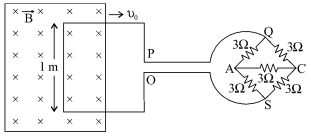
A square loop of a metallic wire of side 10 cm whose resistance is 1 ohm is moving with a constant velocity of as shown in the figure in a uniform magnetic field of $200 Wb / m ^2$. The magnetic field is normal to the plane of paper inwards. This loop is connected to a network of resistors of magnitude 3 ohms. Resistance of wire OS and PQ are negligible. What will be the magnitude of velocity, $v_0$ to flow one ampere of direct current in the loop? Also, what will be the direction of current?
Image
A heavy nucleus breaks into comparatively lighter nuclei, which are more stable compared to the original heavy nucleus. When a heavy nucleus like uranium is bombarded by slow moving neutrons, it splits into two parts, releasing large amount of energy. The typical fission reaction of $_{92}\text{U}^{235}$.
$_{92}\text{U}^{235}+\ _0\text{n}^1\rightarrow\ _{56}\text{Ba}^{141}+\ _{36}\text{kr}^{92}+\ 3_0\text{n}^1+\ 200\text{ MeV}$
The fission of $_{92}\text{U}^{235}$ approximately released 200 MeV of energy.
  1. If 200 MeV energy is released in the fission of a single nucleus of $_{92}^{235}\text{U}$, the fissions which are required to produce a power of 1kW is.
  1. 3.125 × 10¹³
  2. 1.52 × 106
  3. 3.125 × 1012
  4. 3.125 × 10¹⁴
  1. The release in energy in nuclear fission is consistent with the fact that uranium has
  1. More mass per nucleon than either of the two fragments.
  2. More mass per nucleon as the two fragment.
  3. Exactly the same mass per nucleon as the two fragments.
  4. Less mass per nucleon than either of two fragments.
  1. When $_{92}\text{U}^{235}$ undergoes fission, about 0.1% of the original mass is converted into energy. The energy released when 1kg of $_{92}\text{U}^{235}$ undergoes fission is.
  1. 9 × 1011J
  2. 9 × 1013J
  3. 9 × 1015J
  4. 9 × 1018J
  1. A nuclear fission is said to be critical when multiplication factor or K.
  1. K = 1
  2. K > 1
  3. K < 1
  4. K = 0
  1. Einstein's mass-energy conversion relation E = mc2 is illustrated by.
  1. Nuclear fission
  2. $\beta-\text{decay}$
  3. Rocket propulsion
  4. Steam engine
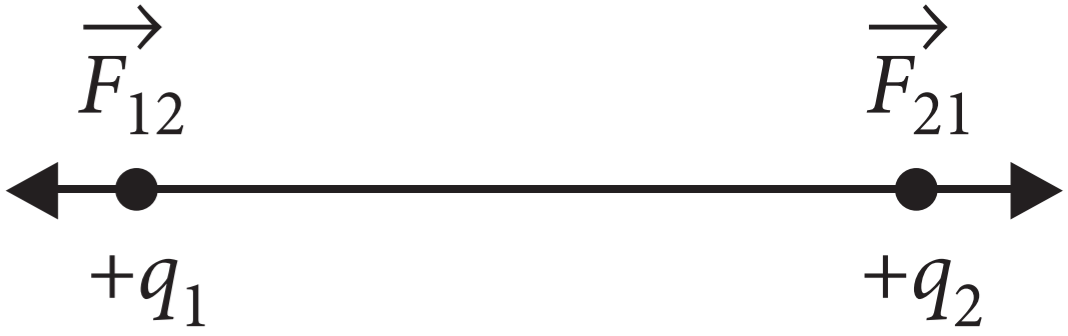
Coulomb's law states that the electrostatic force of attraction or repulsion acting between two stationary point charges is given by:

$\text{F}=\frac{1}{4\pi\in_0}\frac{\text{q}_1\text{q}_2}{\text{r}^2}$

Where F denotes the force between two charges q1 and q2 separated by a distance r in free space, $\in_0$ is a constant known as permittivity of free space. Free space is vacuum and may be taken to be air practically. If free space is replaced by a medium, then $\in_0$ is replaced by $(\in_0\text{k})$ or $(\in_0\in_\text{r})$ where k is known as dielectric constant or relative permittivity.

  1. In coulomb's law, $\text{F}=\text{k}\frac{\text{q}_1\text{q}_2}{\text{r}^2}$ then on which of the following factors does the proportionality constant k depends?
  1. Electrostatic force acting between the two charges.
  2. Nature of the medium between the two charges.
  3. Magnitude of the two charges.
  4. Distance between the two charges.
  1. Dimensional formula for the permittivity constant $\in_0$ of free space is:
  1. [ML-3 T4 A2]
  2. [M-1 L3 T2 A2]
  3. [M-1 L-3 T4 A2]
  4. ML-3 T4 A-2]
  1. The force of repulsion between two charges of 1C each, kept 1m apart in vaccum is:
  1. $\frac{1}{9\times10^9}\text{N}$

  2. 9 × 109N
  3. 9 × 107N
  4. $\frac{1}{9\times10^{12}}\text{N}$

  1. Two identical charges repel each other with a force equal to 10 mgwt when they are 0.6m apart in air.(g = 10m s-2). The value of each charge is:
  1. 2mC
  2. 2 × 10-7mC
  3. 2 nC
  4. $2\mu\text{C}$
  1. Coulomb's law for the force between electric charges most closely resembles with:
  1. Law of conservation of energy.
  2. Newton's law of gravitation.
  3. Newton's 2nd law of motion.
  4. Law of conservation of charge.