MCQ
A black body is heated from ${27^o}C$ to ${127^o}C$. The ratio of their energies of radiations emitted will be
  • A
    $3:4$
  • B
    $9:16$
  • C
    $27 : 64$
  • $81: 256$

Answer

Correct option: D.
$81: 256$
d
(d) $\frac{{{Q_1}}}{{{Q_2}}} = \frac{{T_1^4}}{{T_2^4}} = {\left( {\frac{{273 + 27}}{{273 + 127}}} \right)^4} = {\left( {\frac{{300}}{{400}}} \right)^4} = \frac{{81}}{{256}}$

Need a full question paper?

Generate a complete, print-ready paper with questions like this in minutes — across 16+ boards, with answer keys.
Start Generating Free

Similar questions

A body of mass $2\ kg$ makes an elastic collision with another body at rest and comes to rest. The mass of the second body which collides with the first body is:
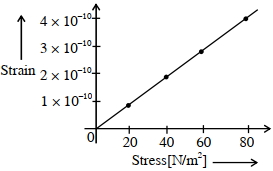
The elastic behaviour of material for linear streass and linear strain, is shown in the figure. The energy density for a linear strain of $5 \times 10^{-4}$ is $\dots \; kJ / m ^{3}$. Assume that material is elastic upto the linear strain of $5 \times 10^{-4}$.
Two bodies are projected with the same velocity. If one is projected at an angle of ${30^o}$ and the other at an angle of ${60^o}$ to the horizontal, the ratio of the maximum heights reached is
Two particles are simultaneously projected in opposite directions horizontally from a given point in space, where gravity $g$ is uniform. If $u_1$ and $u_2$ be their initial speeds, then the time $t$ after which their velocities are mutually perpendicular is given by
If $x = at + b{t^2}$, where $x$ is the distance travelled by the body in kilometres while $t$ is the time in seconds, then the units of $b$ are
If $< E >$ and $< U >$  denote the average kinetic and the average potential energies respectively of mass describing a simple harmonic motion, over one period, then the correct relation is
$(i)$ What is the work done by the porter when he climbs up a height of $10m (g = 10\ ms^{-2})?$
$Assertion :$ Adiabatic expansion is always accompanied by fall in temperature.
$Reason :$ In adiabatic process, volume is inversely proportional to temperature.
What is the dimension of Luminous flux
For a solid with a small expansion coefficient: