MCQ
$(i)$ What is the work done by the porter when he climbs up a height of $10m (g = 10\ ms^{-2})?$
  • A
    $5\ kJ^2$
  • B
    $50\ kJ$
  • C
    $100\ kJ^2$
  • $5\ kJ$

Answer

Correct option: D.
$5\ kJ$
The work done by the potter is defined as the product of the force and the displacement.
Work done $=$ force $\times$ displacement
$= m \times g \times 10 ($ Since force $=$ mass $\times$ gravity$)$
$= 50 \times 10 \times 10$
$= 5KJ$

Need a full question paper?

Generate a complete, print-ready paper with questions like this in minutes — across 16+ boards, with answer keys.
Start Generating Free

Similar questions

The potential energy of a particle varies with distance $x$ from a fixed origin as $U\, = \,\frac{{A\sqrt x }}{{{x^2} + B}}$ Where $A$ and $B$ are dimensional constants then find the dimensional formula for $A/B$
A child is standing at one end of a long trolley moving with a speed $v$ on a smooth horizontal track. If the child starts running towards the other end of the trolley with a speed $u$, the centre of mass of the system (trolley + child) will move with a speed
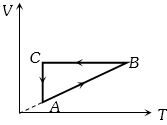
A cyclic process $ABCA$ is shown in the $V-T $ diagram. Process on the $P-V$ diagram is
A cart is moving with a velocity $20\,m/s$. Sand is being dropped into the cart at the rate of $50\, kg/min$. The force required to move the cart with constant velocity will be ............ $N$
A rocket is ejecting $50\,g$ of gases per sec at a speed of $500\,m/s.$ The accelerating force on the rocket will be ............ $N$
The period of oscillation of a simple pendulum is $T =2 \pi \sqrt{\frac{ L }{ g }} .$ Measured value of $ L $ is $1.0\, m$ from meter scale having a minimum division of $1 \,mm$ and time of one complete oscillation is $1.95\, s$ measured from stopwatch of $0.01 \,s$ resolution. The percentage error in the determination of $g$ will be ..... $\%.$
A particle undergoes uniform circular motion.  About which point on the plane of the circle, will the angular momentum of the particle remain conserved
The maximum and minimum distances of a comet from the sun are $8 \times {10^{12}}\,m$ and $1.6 \times {10^{12}}\,m$. If its velocity when nearest to the sun is $60\, m/s$, what will be its velocity in $m/s$ when it is farthest 
For a particle in a uniformly accelerated circular motion
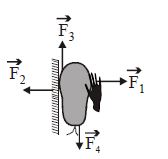
In the figure shown, a balloon is pressed against a wall. It is in equilibrium and maximum compresed state.$\vec F_1\,=$ force of balloon on hand of man $;$  $\vec F_2\,=$  force of balloon on wall $;$  $\vec F_3\,=$ friction $;$ $\vec F_4=$  weight of balloon. Choose the correct statement.