MCQ
A black hole is an object whose gravitational field is so strong that even light cannot escape from it. To what approximate radius would earth $($ mass $= 5 .98 \times \,10^{24}\, kg)$ have to be compressed to be a black hole?
  • A
    $10^{-9} \,\,m$
  • B
    $10^{-6}\,\,m$
  • $10^{-2} \,\,m$
  • D
    $100 \,\,m$

Answer

Correct option: C.
$10^{-2} \,\,m$
c
       Light cannot escape from a black hole, 

${v_{esc}} = c$

$\sqrt {\frac{{2GM}}{R}}  = c\,\,\,\,\,or\,\,\,\,\,\,\,R = \frac{{2GM}}{{{c^2}}}$

$R = \frac{{2 \times 6.67 \times {{10}^{ - 11}}N{m^2}k{g^{ - 2}} \times 5.98 \times {{10}^{24}}kg}}{{{{\left( {3 \times {{10}^8}\,m\,{s^{ - 1}}} \right)}^2}}}$

$ = 8.86 \times {10^{ - 3}}m \approx {10^{ - 2}}\,m$

Need a full question paper?

Generate a complete, print-ready paper with questions like this in minutes — across 16+ boards, with answer keys.

Start Generating Free

Similar questions

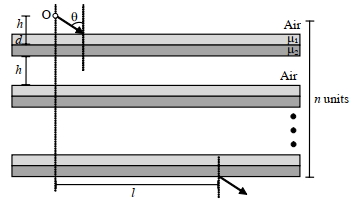
Consider a configuration of $n$ identical units, each consisting of three layers. The first layer is a column of air of height $h=\frac{1}{3} cm$, and the second and third layers are of equal thickness $d=\frac{\sqrt{3}-1}{2} cm$, and refractive indices $\mu_1=\sqrt{\frac{3}{2}}$ and $\mu_2=\sqrt{3}$, respectively. A light source $O$ is placed on the top of the first unit, as shown in the figure. A ray of light from $O$ is incident on the second layer of the first unit at an angle of $\theta=60^{\circ}$ to the normal. For a specific value of $n$, the ray of light emerges from the bottom of the configuration at a distance $l=\frac{8}{\sqrt{3}} cm$, as shown in the figure. The value of $n$ is. . . . . 
Two spherical nuclei have mass numbers $216$ and $64$ with their radii $R_1$ and $R _2$ respectively. The ratio, $\frac{R_1}{R_2}$ is equal to
In a photoelectric experiment for $4000\, Å$ incident radiation, the potential difference to stop the ejection is $2 V$. If the incident light is changed to $3000\, Å$, then the potential required to stop the ejection of electrons will be
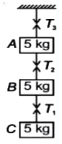
The value of $\frac{T_3}{T_1}$ is .............
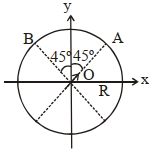
An electric dipole with dipole moment $\frac{p_0}{\sqrt{2}}(\hat{i}+\hat{j})$ is held fixed at the origin $O$ in the presence of an uniform electric field of magnitude $E_0$. If the potential is constant on a circle of radius $R$ centered at the origin as shown in figure, then the correct statement($s$) is/are:

( $\varepsilon_0$ is permittivity of free space, $R \gg$ dipole size)

$(1)$ $R =\left(\frac{ p _0}{4 \pi \varepsilon_0 E _0}\right)^{1 / 3}$

$(2)$ The magnitude of total electric field on any two points of the circle will be same

$(3)$ Total electric field at point $A$ is $\vec{E}_A=\sqrt{2} E_0(\hat{i}+\hat{j})$

$(4)$ Total electric field at point $B$ is $\vec{E}_B=0$

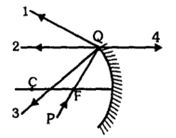
The direction of a ray of light incident on a concave mirror is shown by $PQ$ while directions in which the ray would travel after reflection is shown by four rays marked $1,2,3$ and $4$. Which of the four rays correctly shows the direction of reflected ray ?
A common emitter transistor amplifier has a current gain of $50$ . If the load resistance is $9 \,k \Omega$ and the input resistance is $500 \,\Omega$, the voltage gain of the amplifier will be
An electron having mass $m$ and kinetic energy $K$ enter in uniform magnetic field $B$ perpendicularly, then its frequency will be
A circular coil of $500$ turns encloses an area of $0.04 \,m^2.$ A uniform magnetic field of induction $0.25\, Wb/m^2$ is applied perpendicular to the plane of the coil. The coil is rotated by $90^o$ in $0.1$ second at a constant angular velocity about one of its diameters. A galvanometer of resistance $25\Omega$ was connected in series with the the coil. The total charge that will pass through the galvanometer is.......$C$
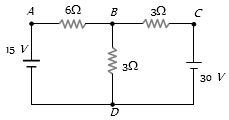
In the circuit shown in figure, find the current through the branch $BD$ ............. $A$