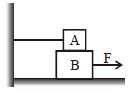
A block $A$ of mass $100\, kg$ rests on another block $B$ of mass $200\, kg$ and is tied to a wall as shown in the figure. The coefficient of friction between $A$ and $B$ is $0.2$ and that between $B$ and the ground is $0.3$. The minimum force $F$ required to move the block $B$ is........ $N$ . $(g = 10\, m/s^2)$
Medium
Download our app for free and get started
Friction between block $A$ and block $B$ and between block $\mathrm{B}$ and surface will oppose the
$F$
$\therefore \mathrm{F}=\mathrm{F}_{\mathrm{AB}}+\mathrm{F}_{\mathrm{BS}}$
$=\mu_{\mathrm{AB}} \mathrm{m}_{\mathrm{A}} \mathrm{g}+\mu_{\mathrm{BS}}\left(\mathrm{m}_{\mathrm{A}}+\mathrm{m}_{\mathrm{B}}\right) \mathrm{g}$
${=0.2 \times 100 \times 10+0.3(100+200) 10}$
${=200+900=1100 \mathrm{N}}$

Download our appand get started for free
Experience the future of education. Simply download our apps or reach out to us for more information. Let's shape the future of learning together!No signup needed.*
Similar Questions
- 1A block weighs $W$ is held against a vertical wall by applying a horizontal force $F$. The minimum value of $F$ needed to hold the block is $[\mu < 1]$View Solution
- 2View SolutionWhen a bicycle is in motion, the force of friction exerted by the ground on the two wheels is such that it acts
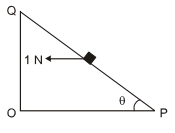
- 3A small block of mass of $0.1 \ kg$ lies on a fixed inclined plane $P Q$ which makes an angle $\theta$ with the horizontal. A horizontal force of $1 \ N$ on the block through its center of mass as shown in the figure. The block remains stationary if (take $g =10 \ m / s ^2$ ) $Image$View Solution
$(A)$ $\theta=45^{\circ}$
$(B)$ $\theta>45^{\circ}$ and a frictional force acts on the block towards $P$.
$(C)$ $\theta>45^{\circ}$ and a frictional force acts on the block towards $Q$.
$(D)$ $\theta<45^{\circ}$ and a frictional force acts on the block towards $Q$.
- 4The coefficient of static friction between a wooden block of mass $0.5\, kg$ and a vertical rough wall is $0.2$ The magnitude of horizontal force that should be applied on the block to keep it adhere to the wall will be $N$ $\left[ g =10\, ms ^{-2}\right]$View Solution
- 5The minimum force required to start pushing a body up a rough (frictional coefficient $\mu$) inclined plane is $F _{1}$ while the minimum force needed to prevent it from sliding down is $F _{2}$. If the inclined plane makes an angle $\theta$ from the horizontal such that $\tan \theta=2 \mu$, then the ratio $\frac{F_{1}}{F_{2}}$ isView Solution
- 6$A$ block placed on a rough inclined plane of inclination $(\theta =30^o)$ can just be pushed upwards by applying $a$ force $"F"$ as shown. If the angle of inclination of the inclined plane is increased to $(\theta = 60^o)$, the same block can just be prevented from sliding down by application of a force of same magnitude. Thecoefficient of friction between the block and the inclined plane isView Solution

- 7A car is moving on a horizontal circular track of radius $0.2 \,km$ with a constant speed. If coefficient of friction between tyres of car and road is $0.45$, then speed of car may be ........ $m / s$ [Take $g=10 \,m / s ^2$ ]View Solution
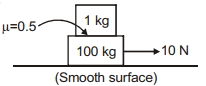
- 8The frictional force acting on $1 \,kg$ block is .................. $N$View Solution
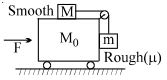
- 9Imagine $a$ situation in which the horizontal surface of block $M_0$ is smooth and its vertical surface is rough with $a$ coefficient of friction $\mu$ In above problem, choose the correct value $(s)$ of F which the blocks $M$ and $m$ remain stationary with respect to $M_0$View Solution
- 10A road is $10\, m$ wide. Its radius of curvature is $50\, m$. The outer edge is above the lower edge by a distance of $1.5\, m$. This road is most suited for the velocity .......... $m/\sec$View Solution