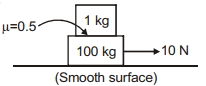
The frictional force acting on $1 \,kg$ block is .................. $N$
Medium


Download our appand get started for free
Experience the future of education. Simply download our apps or reach out to us for more information. Let's shape the future of learning together!No signup needed.*
Similar Questions
- 1Two stones of masses $m$ and $2\,m$ are whirled in horizontal circles, the heavier one in a radius $\frac{r}{2}$ and the lighter one in radius $r.$ The tangential speed of lighter stone is $n$ times that of the value of heavier stone when they experience same centripetal forces. The value of $n$ isView Solution
- 2A fireman of mass $60\, kg$ slides down a pole. He is pressing the pole with a force of $600 \,N$. The coefficient of friction between the hands and the pole is $0.5$, with what acceleration will the fireman slide down ........ $m/s^2$View Solution
- 3View SolutionWhich one of the following statements is correct
- 4A curved in a level road has a radius $75\, m$. The maximum speed of a car turning this curved road can be $30 \,m / s$ without skidding. If radius of curved road is changed to $48\, m$ and the coefficient of friction between the tyres and the road remains same, then maximum allowed speed would be .........$m / s$.View Solution
- 5View SolutionChoose the correct statement.
- 6If a ladder weighing $250\,N$ is placed against a smooth vertical wall having coefficient of friction between it and floor is $0.3$, then what is the maximum force of friction available at the point of contact between the ladder and the floor ........ $N$View Solution
- 7View SolutionA car is moving with uniform velocity on a rough horizontal road. Therefore, according to Newton's first law of motion
- 8A block of mass $M$ rests on a rough horizontal table. A steadily increasing horizontal force is applied such that the block starts to slide on the table without toppling. The force is continued even after sliding has started. Assume the coefficients of static and kinetic friction between the table and the block to be equal. The correct representation of the variation of the frictional force $f$, exerted by the table on the block with time $t$ is given byView Solution
- 9A block is projected upwards on an inclined plane of inclination $37^o$ along the line of greatest slope of $\mu = 0.5$ with velocity of $5 m/s$. The block $1^{st}$ stops at $a$ distance of .......... $m$ from starting pointView Solution
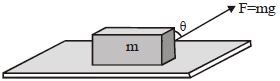
- 10A force $f$ is acting on a block of mass $m$. Coefficient of friction between block and surface is $\mu$. The block can be pulled along the surface if :-View Solution