MCQ
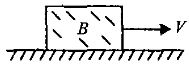
A block $B$ is pushed momentarily along a horizontal surface with an initial velocity $V.$ If $\mu $ is the coefficient of sliding friction between $B$ and the surface, block $B$ will come to rest after a time
  • A
    $\frac{{g{\mu _k}}}{V}$
  • B
    $\;\frac{g}{V}$
  • C
    $\;\frac{V}{g}$
  • $\;\frac{V}{{g{\mu _k}}}$

Answer

Correct option: D.
$\;\frac{V}{{g{\mu _k}}}$
d
Given $u = V$, final velocity $= 0$.
Using $v = u + at$

$\begin{array}{l}
\therefore \,0 = V - at\,\,or,\,\, - a = \frac{{0 - V}}{t} =  - \frac{V}{t}\\
\,\,\,\,f = \mu R = \mu mg\,\left( {f\,is\,the\,force\,of\,friction} \right)\\
\therefore {\rm{Retardation,}}\,{\rm{a}}\,{\rm{ = }}\mu {\rm{g}}\,\therefore {\rm{t}}\, = \frac{V}{a} = \frac{V}{{\mu g}}.
\end{array}$

Need a full question paper?

Generate a complete, print-ready paper with questions like this in minutes — across 16+ boards, with answer keys.

Start Generating Free

Similar questions

A uniform thick string of length $5\,m$ is resting on a horizontal frictionless surface. It is pulled by a horizontal force of $5\,N$ from one end. The tension in the string at $1\,m$ from the force applied is ......... $N$
A graph is shown between stress and strain for a metal. The part in which Hooke's law holds good is
An insulator container contains $4\, moles$ of an ideal diatomic gas at temperature $T.$ Heat $Q$ is supplied to this gas, due to which $2 \,moles$ of the gas are dissociated into atoms but temperature of the gas remains constant. Then
On suspending a weight Mg, the length l of elastic wire having area of cross-section A, becomes double the initial length. The instantaneous stress action on the wire is:
A ring of mass $M$ and radius $R$ is rotating about its axis with angular velocity $\omega $. Two identical bodies each of mass $m$ are now gently attached at the two ends of a diameter of the ring. Because of this, the kinetic energy loss will be
A ball $P$  collides with another identical ball  $Q$  at rest. For what value of coefficient of restitution $e$ , the  velocity of ball  $Q$  become two times that of ball  $P$  after collision
An ideal gas is filled in a vessel, then
A damped harmonic oscillator has a frequency of $5$ oscillations per second. The amplitude drops to half its value for every $10$ oscillations. The time it will take to drop to $\frac{1}{1000}$ of the original amplitude is close to .... $s$
Which of the following speed-time $(v-t)$ graphs is physically not possible?
The second's hand of a watch has length $6\,\, cm$. Speed of end point and magnitude of difference of velocities at two perpendicular positions will be