MCQ 11 Mark
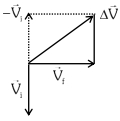
A football player is moving southward and suddenly turns eastward with the same speed to avoid an opponent. The force that acts on the player while turning is :
Answerd
$\overrightarrow{ V }_{ i }=( V ) \text { southward }$
$\overrightarrow{ V }_{ F }=( V ) \text { Eastward }$
$\overrightarrow{\Delta V }=\overrightarrow{ V }_{ F }-\overrightarrow{ V }_{ i }$
$=\text { Along North - East }$
View full question & answer→MCQ 21 Mark
Calculate the maximum acceleration (in $m s ^{-2}$) of a moving car so that a body lying on the floor of the car remains stationary. The coefficient of static friction between the body and the floor is $0.15$ $\left( g =10 m s ^{-2}\right)$.
Answerd
$F _{ s }= ma$
$f _{ L }= ma a _{\max }$
$\mu mg = ma _{\max }$
$a _{\text {max }}=\mu g$
$=0.15(10)$
$=1.5\,m / s ^2$
View full question & answer→MCQ 31 Mark
Calculate the acceleration (In $m/s^{2}$) of the block and trolly system shown in the figure. The coefficient of kinetic friction between the trolly and the surface is $0.05 .\left( g =10\; m / s ^{2},\right.$ mass of the string is negligible and no other friction exists).
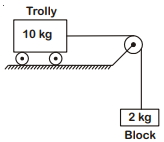
AnswerCorrect option: B. $1.25$
b
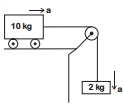
F. B. D. of trolly
$T - f = m _{ T } a$
$f=\mu m_{T} g$
$f=0.05 \times 10 \times 10$
$f=5 N$
$T -5=10 a$
F.B.D. of block
$m_{b} g-T=m_{b} a$
$2 \times 10-T=2 a$
$20- T =2 a$
Equation (i) $+$ (ii)
$15=12 a$
$a =\frac{15}{12} \Rightarrow a =1.25 m / s ^{2}$
View full question & answer→MCQ 41 Mark
A body of mass $\mathrm{m}$ is kept on a rough horizontal surface (coefficient of friction $=\mu$ ) A horizontal force is applied on the body, but it does not move. The resultant of normal reaction and the frictional force acting on the object is given by $\mathrm{F},$ where $\mathrm{F}$ is
- A
$|\overrightarrow{\mathrm{F}}|=\mathrm{mg}+\mu \mathrm{mg}$
- B
$|\overrightarrow{\mathrm{F}}|=\mu \mathrm{mg}$
- ✓
$|\overrightarrow{\mathrm{F}}| \leq \mathrm{mg} \sqrt{1+\mu^{2}} $
- D
$|\overrightarrow{\mathrm{F}}|=\mathrm{mg}$
AnswerCorrect option: C. $|\overrightarrow{\mathrm{F}}| \leq \mathrm{mg} \sqrt{1+\mu^{2}} $
c
$\mathrm{N}=\mathrm{mg}, \mathrm{F}=\mathrm{f}$
Resultant $=\sqrt{\mathrm{N}^{2} +\mathrm{f}^{2}} =\sqrt{(\mathrm{mg})^{2}+\mathrm{f}^{2}} \leq \mathrm{mg} \sqrt{1+\mu^{2}}$
View full question & answer→MCQ 51 Mark
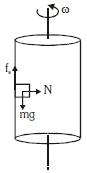
A block of mass $10\; \mathrm{kg}$ is in contact against the inner wall of a hollow cylindow cylindrical drum of radius $1 \;\mathrm{m}$. The coeffident of friction between the block and the inner wall of the cylinder is $0.1$. The minimum angular velocity needed for the cylinder to keep the block stationary when the cylinder is vertical and rotating about its axis, will be: ......$rad/s$ $\left(g-10 m / s^{2}\right)$
- A
$\sqrt{10}$
- B
$\frac{10}{2 \pi}$
- ✓
$10$
- D
$10 \pi $
Answerc
$f_{L}=\mu N=\mu m r \omega^{2}$
$\mathrm{f}_{\mathrm{s}}=\mathrm{mg}$
As $\mathrm{f}_{\mathrm{s}} \leq \mathrm{f}_{\mathrm{L}}$
$\Rightarrow \mathrm{mg} \leq \mu \mathrm{mr} \mathrm{ \omega}^{2}$
$\Rightarrow \omega \geq \sqrt{\frac{g}{\mu r}}$
$\Rightarrow \omega_{\min }=10\; \mathrm{rad} / \mathrm{s}$
View full question & answer→MCQ 61 Mark
Which one of the following statements is incorrect?
- A
Rolling friction is smaller than sliding friction.
- B
Limiting value of static friction is directly proportional to normal reaction.
- ✓
Coefficient of sliding friction has dimensions of length.
- D
Frictional force opposes the relative motion.
AnswerCorrect option: C. Coefficient of sliding friction has dimensions of length.
c
Coefficint of sliding friction has no dimention
$f=\mu_s N $
$\mu_s=\frac{f}{N}$
View full question & answer→MCQ 71 Mark
A cyclist on a level road takes a sharp circular turn of radius $3 \;m \;\left( g =10 \;ms ^{-2}\right)$. If the coefficient of static friction between the cycle tyres and the road is $0.2$, at which of the following speeds will the cyclist not skid while taking the turn?
- A
$9\;kmh^{-1}$
- ✓
$7.2\;kmh^{-1}$
- C
$10.8\;kmh^{-1}$
- D
$14.4\;kmh^{-1}$
AnswerCorrect option: B. $7.2\;kmh^{-1}$
b
The maximum speed at which the cyclist will not skid is,
$v_{m}=\sqrt{\mu r g}=\sqrt{0.2 \times 3 \times 10}=2.45 m / s$
$=\frac{2.45 \times 60 \times 60}{1000} km / h =8.82 km \cdot h^{-1}$
Among the given options $7.2\; km \cdot h^{-1}$ is less than this.
View full question & answer→MCQ 81 Mark
One end of string of length $l$ is connected to a particle of mass $'m'$ and the other end is connected to a small peg on a smooth horizontal table. If the particle moves in circle with speed $'v',$ the net force on the particle (directed towards centre) will be ($T$ represents the tension in the string)
AnswerCorrect option: C. $\;T\;\;\;\;\;\;\;\;\;\;\;\;\;\;\;\;\;\;$
c
Centripetal force $\frac{mv^2}{l}$ is provided by tension so net force on the particle will be equal to tension $T$
View full question & answer→MCQ 91 Mark
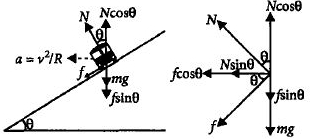
A car is negotiating a curved road of radius $R$. The road is banked at an angle $\theta .$ The coefficient of friction between the tyres of the car and the road is $\mu _s.$ The maximum safe velocity on this road is
- ✓
$\sqrt {gR\frac{{{\mu _s} + tan\theta }}{{1 - {\mu _s}tan\theta }}} \;\;\;\;$
- B
$\;\sqrt {\frac{g}{R}\frac{{{\mu _s} + tan\theta }}{{1 - {\mu _s}tan\theta }}} $
- C
$\;\frac{g}{{{R^2}}}\frac{{{\mu _s} + tan\theta }}{{1 - {\mu _s}tan\theta }}$
- D
$\;\sqrt {g{R^2}\frac{{{\mu _s} + tan\theta }}{{1 - {\mu _s}tan\theta }}} $
AnswerCorrect option: A. $\sqrt {gR\frac{{{\mu _s} + tan\theta }}{{1 - {\mu _s}tan\theta }}} \;\;\;\;$
a
$\begin{array}{l}
For\,vertical\,equilibrium\,on\,the\,road,\\
N\cos \theta = mg + f\sin \theta \\
mg = N\cos \theta - f\sin \theta \,\,\,\,\,\,\,\,\,\,\,\,\,\,\,\,\,\,\,...\left( i \right)\\
Centripetal\,force\,for\,safe\,turning\,,\\
\,\,\,\,\,\,\,\,\,\,\,\,\,\,\,N\sin \theta + f\cos \theta = \frac{{m{v^2}}}{R}\,\,\,\,\,\,...\left( {ii} \right)\\
From\,eqns.\,\left( i \right)\,and\,\left( {ii} \right),\,we\,get\\
\,\,\,\,\,\,\,\,\,\,\,\frac{{{v^2}}}{{Rg}} = \frac{{N\sin \theta + f\cos \theta }}{{N\cos \theta - f\sin \theta }}
\end{array}$
$\begin{array}{l}
\Rightarrow \,\frac{{{v^2}_{\max }}}{{Rg}} = \frac{{N\sin \theta + {\mu _s}N\cos \theta }}{{N\cos \theta - {\mu _s}N\sin \theta }}\\
\,\,\,\,\,\,{v_{\max }} = \sqrt {Rg\left( {\frac{{{\mu _s} + \tan \theta }}{{1 - {\mu _s}\tan \theta }}} \right)}
\end{array}$
View full question & answer→MCQ 101 Mark
A $1\,kg$ block is being pushed against a wall by a force $F = 75\,N$ as shown in the Figure. The coefficient of friction is $0.25.$ The magnitude of acceleration of the block is ........ $m/s^2$

Answerb
$\mathrm{F} \sin 37^{\circ}-\mathrm{mg}-\mu \mathrm{F} \cos 37^{\circ}=\mathrm{ma}$
$\Rightarrow \mathrm{a}=20 \mathrm{m} / \mathrm{s}^{2}$
View full question & answer→MCQ 111 Mark
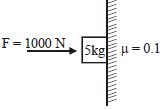
For the given figure, if block remains in equilibrium position then find frictional force between block and wall ........ $N$
Answerb
$f_{max}=\mu N$
$f_{max}=0.1\times 1000=100\,N$
$mg=50\,N$
$f=50\,N$
View full question & answer→MCQ 121 Mark
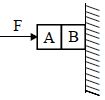
Given in the figure are two blocks $A$ and $B$ of weight $20\, N$ and $100\, N$, respectively. These are being pressed against a wall by a force $F$ such that the system does not slide as shown. If the coefficient of friction between the blocks is $0.1$ and between block $B$ and the wall is $0.15$, the frictional force applied by the wall on block $B$ is ........ $N$
Answera
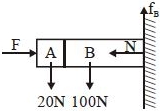
Various forces acting on the system are shown in the figure. For vertical equilibrium of the system,
$\mathrm{f}_{\mathrm{B}}=100 \mathrm{N}+20 \mathrm{N}=120 \mathrm{N}$
i.e., frictional force applied by the wall on the block $B$ is $120 N$
View full question & answer→MCQ 131 Mark
A block of wood resting on an inclined plane of angle $30^o$, just starts moving down. If the coefficient of friction is $0.2$, its velocity (in $ms^{-1}$) after $5\, seconds$ is : $(g = 10\, ms^{-2})$
- A
$12.75$
- ✓
$16.34$
- C
$18.25$
- D
$20$
AnswerCorrect option: B. $16.34$
b
$\mathrm{v}= \mathrm{g}(\sin \theta-\mu \cos \theta) \mathrm{t} $
$=10\left[\frac{1}{2}-(0.2) \frac{\sqrt{3}}{2}\right] 5=16.34 \mathrm{ms}^{-1} $
View full question & answer→MCQ 141 Mark
A block of mass $4\,kg$ is placed on a rough horizontal plane A time dependent force $F = kt^2$ acts on the block, where $k = 2\,N/s^2$. Coefficient of friction $\mu = 0.8$. Force of friction between block and the plane at $t = 2\,s$ is ....... $N$
Answera
$\mathrm{F}_{\mathrm{max}}=\mu \mathrm{mg}=32 \mathrm{N}$
$F(t=2)=8 N$
as $\mathrm{F}<\mathrm{F}_{\max } \Rightarrow$ friction $=8 \mathrm{N}$
View full question & answer→MCQ 151 Mark
A block of mass $m$ is moving with a constant acceleration a on a rough plane. If the coefficient of friction between the block and ground is $\mu $, the power delivered by the external agent after a time $t$ from the beginning is equal to
- A
$ma^2t$
- B
$\mu mgat$
- C
$\mu m(a + \mu g)\, gt$
- ✓
$m(a + \mu g)\, at$
AnswerCorrect option: D. $m(a + \mu g)\, at$
d
$F-f=\mathrm{ma}$
$F=f+\mathrm{ma}$
Power $(\mathrm{P})=\mathrm{Fv}=(\mathrm{f}+\mathrm{ma}) \mathrm{v}=(\mu \mathrm{mg}+\mathrm{ma})$ at
View full question & answer→MCQ 161 Mark
A body takes $1\frac{1}{3}$ times as much time to slide down a rough identical but smooth inclined plane. If the angle of inclined plane is $45^o$, the coefficient of friction is
- ✓
$\frac{7}{16}$
- B
$\frac{9}{16}$
- C
$\frac{7}{9}$
- D
$\frac{3}{4}$
AnswerCorrect option: A. $\frac{7}{16}$
a
$\mu=\tan \theta\left(1-\frac{1}{\mathrm{n}^{2}}\right)$
$t'=nt$ $\mathrm{n}=1 \frac{1}{3}=\frac{4}{3}$
$\mu=\tan 45\left[1-\frac{1}{(4 / 3)^{2}}\right]$
$\mu=\frac{7}{16}$
View full question & answer→MCQ 171 Mark
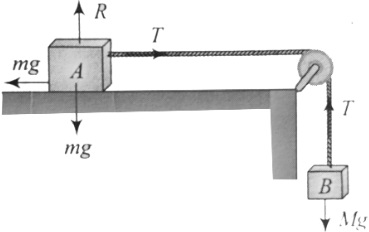
The coefficient of static friction, $\mu _s$ between block $A$ of mass $2\,kg$ and the table as shown in the figure is $0.2$. What would be the maximum mass value of block $B$ so that the two blocks $B$ so that the two blocks do not move? The string and the pulley are assumed to be smooth and masseless ....... $kg$ $(g = 10\,m/s^2)$
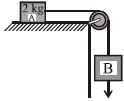
Answerd
Let the mass of the block $B$ is $M$.
In equilibrium of block $B$ implies $T=M g \ldots(i)$
If block $A$ does not move, then $T=f_{s}$
where $f_{s}=$ frictional force $=\mu_{S} N=\mu_{s} m g$
implies $T=\mu_{s} m g \ldots(i i)$
Thus, from Eqs. $( i )$ and $(ii),$ we have
$M=\mu_{s} m g$ or $M=\mu_{s} m$
Given: $\mu_{s}=0.2, m=2 k g$
$\therefore M=0.2 \times 2=0.4 k g$
View full question & answer→MCQ 181 Mark
A uniform rope lies on a horizontal table so that a part of it hangs over the edge. The rope begins to slide down when the length of the hanging part is $25\%$ of the entire length. The coefficient of friction between the rope and the table is
- A
$0.25$
- B
$0.75$
- ✓
$0.33$
- D
$0.67$
AnswerCorrect option: C. $0.33$
c
$\frac{3}{4} \mu_{3} m g=\frac{1}{4} m g$
$\therefore \mu_{s}=\frac{1}{3}=0.33$
View full question & answer→MCQ 191 Mark
A conveyor belt is moving at a constant speed of $2\, ms^{-1}$. A box is gently dropped on it. The coefficient of friction between them is $\mu = 0.5$. The distance that the box will move relative to belt before coming to rest on it, (taking $g = 10\, ms^{-2}$) is ........ $m$.
Answera
Force of friction, $f=\mu m g$
$\therefore a=\frac{\mathrm{f}}{\mathrm{m}}=\frac{\mu \mathrm{mg}}{\mathrm{m}}=\mu \mathrm{g}=0.5 \times 10=5 \mathrm{ms}^{-2}$
Using, $\mathrm{v}^{2}-\mathrm{u}^{2}=2 \mathrm{aS}$
${0^{2}-2^{2}=2(-5) \times 5} $
${\mathrm{S}=0.4 \mathrm{m}}$
View full question & answer→MCQ 201 Mark
In the figure, a block of weight $60\, N$ is placed on a rough surface. The coefficient of friction between the block and the surfaces is $0.5$. ........ $N$ should be the maximum weight $W$ such that the block does not slip on the surface .
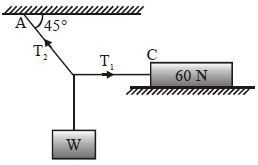
Answerc
Frictional force,
${F=\mu R=0.5 \times m g=0.5 \times 60=30 \mathrm{N}}$
$\mathrm{Now}$ $\mathrm{F}=\mathrm{T}_{1}=\mathrm{T}_{2} \cos 45^{\circ}$
$\text { or } \quad 30=\mathrm{T}_{2} \cos 45^{\circ}$
${\text { and }} {W=T_{2} \sin 45^{\circ}} $
${\therefore \quad} {W=30 \mathrm{N}}$
View full question & answer→MCQ 211 Mark
For the given figure, if block remains in equilibrium position then find frictional force between block and wall ........ $N$
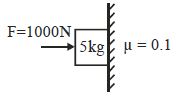
Answerb
$\begin{array}{rl}{\mathrm{F}=\mathrm{N}=1000 \mathrm{N}} & {\mathrm{f}_{\mathrm{L}}=1000 \times 0.1=100 \mathrm{N}} \\ {\mathrm{F}_{\mathrm{req}}=50 \mathrm{N}(\mathrm{mg})} & {\because \mathrm{f}_{\mathrm{req}}<\mathrm{f}_{\mathrm{L}}} \\ {\therefore} & {\mathrm{f}_{\mathrm{req}}=50 \mathrm{N}}\end{array}$
View full question & answer→MCQ 221 Mark
The retarding acceleration of $7.35\, ms^{-2}$ due to frictional force stops the car of mass $400\, kg$ travelling on a road. The coefficient of friction between the tyre of the car and the road is
- A
$0.55$
- ✓
$0.75$
- C
$6.70$
- D
$0.65$
AnswerCorrect option: B. $0.75$
b
$\begin{array}{l}
As\,we\,know,coefficient\,of\,friction\,\mu = \frac{F}{N}\\
\Rightarrow \mu = \frac{{ma}}{{mg}} = \frac{a}{g}\left( {a = 7.35m{s^{ - 2}}\,given} \right)\\
\therefore \mu = \frac{{7.35}}{{9.8}} = 0.75
\end{array}$
View full question & answer→MCQ 231 Mark
In the given arrangement the maximum value of $F$ for which there is no relative motion between the blocks
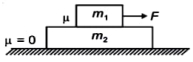
AnswerCorrect option: C. $\mu m_1 g\left(\frac{m_1}{m_2}+1\right)$
c
(c)
$\left(m_1+m_2\right) a_{\text {max }}=f$
$\rightarrow F=\mu N$
$N=m_1 g$
$m_2 a_{\text {max }}=\mu m_1 g$
$a_{\text {max }}=\mu \frac{m_1}{m_2} g$
$F=\left(m_1+m_2\right) \mu \frac{m_1}{m_2} g$
$= m_2\left(\frac{m_1}{m_2}+1\right) \mu \frac{m_1}{m_2} g$
$F =\mu m_1\left(\frac{m_1}{m_2}+1\right)$
View full question & answer→MCQ 241 Mark
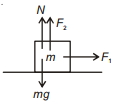
In the figure shown, horizontal force $F_1$ is applied on a block but the block does not slide. Then as the magnitude of vertical force $F_2$ is increased from zero the block begins to slide; the correct statement is
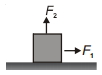
- A
The magnitude of normal reaction on block increases
- B
Static frictional force acting on the block increases
- ✓
Maximum value of static frictional force decreases
- D
AnswerCorrect option: C. Maximum value of static frictional force decreases
c
(c)
$N+F_2=m g$
$N=m g-F_2$
As $F_2$ increases $N$ will decrease
Static friction $f_{ s }=\mu_s N=\mu_s\left(m g-F_2\right)$
$\Rightarrow$ By increasing $F_2, f_s$ will decrease hence the block will slide
View full question & answer→MCQ 251 Mark
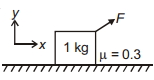
A force $\vec{F}=\hat{i}+4 \hat{j}$ acts on the block shown. The force of friction acting on the block is
- ✓
$-\hat{i}$
- B
$-18 \hat{i}$
- C
$-2.4 \hat{i}$
- D
$-3 \hat{i}$
AnswerCorrect option: A. $-\hat{i}$
a
(a)
Limiting friction $F_L=(0.3)(1)(g)$
$=3 \,N$
$x$-component or horizontal component of force is $=1 \,N$
hence this much of magnitude will act in backward direction due to friction.
View full question & answer→MCQ 261 Mark
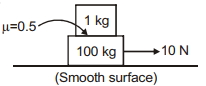
The frictional force acting on $1 \,kg$ block is .................. $N$
Answera
(a)
If both move together $a=\frac{10}{101} \simeq 0.1 \,m / s ^2$
Now, $F_{\text {net }}=1(0.1)=0.1 \,N$
$f_L=(0.5)(1)(g)=5 \,N$
So, $f=0.1 \,N$
View full question & answer→MCQ 271 Mark
On a rough horizontal surface, a body of mass $2 \,kg$ is given a velocity of $10 \,m/s$. If the coefficient of friction is $0.2$ and $g = 10\, m/{s^2}$, the body will stop after covering a distance of ........ $m$
Answerb
(b)$S = \frac{{{u^2}}}{{2\mu g}} = \frac{{{{(10)}^2}}}{{2 \times 0.2 \times 10}} = 25\;m$
View full question & answer→MCQ 281 Mark
A body of $10\, kg$ is acted by a force of $129.4\, N$ if $g = 9.8\,m/{\sec ^2}$. The acceleration of the block is $10\,m/{s^2}$. What is the coefficient of kinetic friction
- A
$0.03$
- B
$0.01$
- ✓
$0.3$
- D
$0.25$
Answerc
(c) Net force on the body = Applied force -Friction
$ma = F - {\mu _k}mg$
${\mu _k} = \frac{{F - ma}}{{mg}} = \frac{{129.4 - 10 \times 10}}{{10 \times 9.8}} = 0.3$
View full question & answer→MCQ 291 Mark
A $500 \,kg$ horse pulls a cart of mass $1500\, kg $ along a level road with an acceleration of $1\,m{s^{ - 2}}$. If the coefficient of sliding friction is $0.2$, then the force exerted by the horse in forward direction is ......... $N$
- A
$3000 $
- B
$4000$
- C
$5000$
- ✓
$6000$
AnswerCorrect option: D. $6000$
d
(d) Net force in forward direction = Accelerating force + Friction
$ = ma + \mu \;mg = m(a + \mu \;g) = (1500 + 500)(1 + 0.2 \times 10)$
$ = 2000 \times 3 = 6000\;N$
View full question & answer→MCQ 301 Mark
A body of weight $64\, N$ is pushed with just enough force to start it moving across a horizontal floor and the same force continues to act afterwards. If the coefficients of static and dynamic friction are $0.6$ and $0.4$ respectively, the acceleration of the body will be (Acceleration due to gravity $= g$)
- A
$\frac{g}{{6.4}}$
- B
$0.64\, g$
- C
$\frac{g}{{32}}$
- ✓
$0.2\, g$
AnswerCorrect option: D. $0.2\, g$
d
(d) Weight of the body $= 64\,N$
so mass of the body $m = 6.4\;kg$, ${\mu _s} = 0.6$, ${\mu _k} = 0.4$
Net acceleration $ = \frac{{{\rm{Applied\, force - Kinetic\, friction}}}}{{{\rm{Mass\, of\, the \,body}}}}$
$ = \frac{{{\mu _s}mg - {\mu _k}mg}}{m} = ({\mu _s} - {\mu _k})g = (0.6 - 0.4)g = 0.2\,g$
View full question & answer→MCQ 311 Mark
A horizontal force of $129.4 \,N $ is applied on a $10\, kg$ block which rests on a horizontal surface. If the coefficient of friction is $0.3$, the acceleration should be ....... $m/s^2$
- A
$9.8$
- ✓
$10$
- C
$12.6$
- D
$19.6$
Answerb
(b) From the relation $F - \mu mg = ma$
$a = \frac{{F - \mu mg}}{m} = \frac{{129.4 - 0.3 \times 10 \times 9.8}}{{10}} = 10\;m/{s^2}$
View full question & answer→MCQ 321 Mark
A car having a mass of $1000\, kg$ is moving at a speed of $30\, metres/sec$. Brakes are applied to bring the car to rest. If the frictional force between the tyres and the road surface is $5000$ newtons, the car will come to rest in ........ $\sec$
Answerd
(d) $v = u - at \Rightarrow \;t = \frac{u}{a}$ [As $v = 0$]
$t = \frac{{u \times m}}{F}$$ = \frac{{30 \times 1000}}{{5000}} = 6\;\sec $
View full question & answer→MCQ 331 Mark
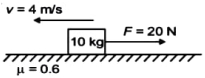
A block of mass $10 kg$ is moving on a rough surface as shown in figure. The frictional force acting on block is ...... $N$
Answerb
(b)
If body is moving on rough surface
Frictional force $=\left( f _{ s }\right)_{\max }= f _{ k }$
$=\mu mg$
$=0.6 \times 10 \times 10$
$=60\,N$
Since friction is self adjusting force maximum forc eof $60\,N$ is acting, but here only External force $=20\,N$ is acting so friction can acts is $20\,N$
If external force increases then $f$ will increase and go upto $60\,N$ beyond which object will move
View full question & answer→MCQ 341 Mark
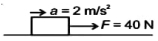
A block of mass $10 \,kg$. moving with acceleration $2 \,m / s ^2$ on horizontal rough surface is shown in figure The value of coefficient of kinetic friction is ...........
Answera
(a)
$a=2\,m / s ^2$
$g=9.8\,m / s ^2$
$Friction force = \mu g$
$=\mu \times 10 \times 9.8$
$=98\,\mu$
Net force $=$ External force $=$ friction force
$m \times a =40-98\,\mu$
$2 \times 10 =40-98\,\mu$
$98 \mu =40-20$
$=20$
$\mu=\frac{20}{98}=\frac{10}{49}=0.20$
View full question & answer→MCQ 351 Mark
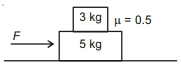
Two blocks $A$ and $B$ of masses $5 \,kg$ and $3 \,kg$ respectively rest on a smooth horizontal surface with $B$ over $A$. The coefficient of friction between $A$ and $B$ is $0.5$. The maximum horizontal force (in $kg$ wt.) that can be applied to $A$, so that there will be motion of $A$ and $B$ without relative slipping, is
Answerc
(c)
It both are moving together
$a=\frac{F}{8}$
for $3 \,kg$ block
$f=3\left(\frac{F}{8}\right)$
$(0.5 (3) g=\frac{3 F}{8}$
$F=40 \,N$
So, $m=4 \,kg$
View full question & answer→MCQ 361 Mark
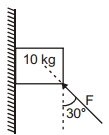
A block of mass $10 \,kg$ is held at rest against a rough vertical wall $[\mu=0.5]$ under the action a force $F$ as shown in figure. The minimum value of $F$ required for it is ............ $N$ $\left(g=10 \,m / s ^2\right)$
- A
$162.6$
- ✓
$89.7$
- C
$42.7$
- D
$95.2$
AnswerCorrect option: B. $89.7$
b
(b)
$N=F \sin 30^{\circ}=F / 2$
$F \cos 30^{\circ}+\mu N=(10) g$
$\frac{F \sqrt{3}}{2}+0.5\left(\frac{F}{2}\right)=100$
$F\left(\frac{2 \sqrt{3}+1}{4}\right)=100$
$F \simeq 89.7 \,N$
View full question & answer→MCQ 371 Mark
The coefficient of friction between a body and the surface of an inclined plane at $45^°$ is $0.5.$ If $g = 9.8\,m/{s^2}$, the acceleration of the body downwards in $m/{s^2}$ is
AnswerCorrect option: A. $\frac{{4.9}}{{\sqrt 2 }}$
a
(a)$a = g(\sin \theta - \mu \cos \theta ) = 9.8(\sin 4{5^o} - 0.5\cos {45^o})$
$ = \frac{{4.9}}{{\sqrt 2 }}\;m/{\sec ^2}$
View full question & answer→MCQ 381 Mark
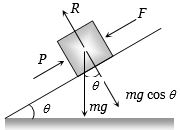
A force of $750 \,N$ is applied to a block of mass $102\, kg$ to prevent it from sliding on a plane with an inclination angle $30°$ with the horizontal. If the coefficients of static friction and kinetic friction between the block and the plane are $0.4 $ and $0.3$ respectively, then the frictional force acting on the block is...... $N$
Answerd
(d) Net force along the plane = $P - mg\sin \theta $= $750 - 500$= $250\;N$
Limiting friction = ${F_l} = {\mu _s}R = {\mu _s}mg\cos \theta $
$= 0.4 × 102 × 9.8 × cos\,30 = 346\, N$
As net external force is less than limiting friction therefore friction on the body will be $250 N.$
View full question & answer→MCQ 391 Mark
A block is lying on an inclined plane which makes $60^°$ with the horizontal. If coefficient of friction between block and plane is $0.25$ and $g = 10\,m/{s^2}$, then acceleration of the block when it moves along the plane will be ........ $m/s^2$
- A
$2.50$
- B
$5.00$
- ✓
$7.4$
- D
$8.66$
Answerc
(c) $a = g(\sin \theta - \mu \cos \theta )$ $ = 10(\sin 60^\circ - 0.25\cos 60^\circ )$
$a = 7.4\;m/{s^2}$
View full question & answer→MCQ 401 Mark
A body is sliding down an inclined plane having coefficient of friction $0.5$. If the normal reaction is twice that of the resultant downward force along the incline, the angle between the inclined plane and the horizontal is ....... $^o$
Answerc
(c) Resultant downward force along the incline $ = mg(\sin \theta - \mu \cos \theta )$
Normal reaction $ = mg\cos \theta $
Given : $mg\cos \theta = 2mg(\sin \theta - \mu \cos \theta )$
By solving $\theta = {45^o}$.
View full question & answer→MCQ 411 Mark
A body of mass $10\, kg$ is lying on a rough plane inclined at an angle of $30^o$ to the horizontal and the coefficient of friction is $0.5$. the minimum force required to pull the body up the plane is ........ $N$
- A
$914$
- ✓
$91.4$
- C
$9.14$
- D
$0.914$
AnswerCorrect option: B. $91.4$
b
(b) $F = mg(\sin \theta + \mu \cos \theta )$
$ = 10 \times 9.8(\sin 30^\circ + 0.5\cos 30^\circ ) = 91.4\;N$.
View full question & answer→MCQ 421 Mark
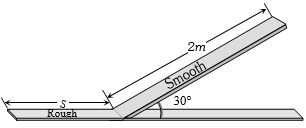
A $2 \,kg$ mass starts from rest on an inclined smooth surface with inclination $30^°$ and length $2\, m$. ...... $m$ will it travel before coming to rest on a frictional surface with frictional coefficient of $0.25$
Answera
(a)${v^2} = {u^2} + 2as = 0 + 2 \times g\sin 30$$ \times 2$ $⇒$ $v = \sqrt {20} $
Let it travel distance ‘S’ before coming to rest
$S = \frac{{{v^2}}}{{2\mu g}} = \frac{{20}}{{2 \times 0.25 \times 10}} = 4\,m$
View full question & answer→MCQ 431 Mark
A body takes time $t$ to reach the bottom of an inclined plane of angle $\theta$ with the horizontal. If the plane is made rough, time taken now is $2t$. The coefficient of friction of the rough surface is
- ✓
$\frac{3}{4}\tan \theta $
- B
$\frac{2}{3}\tan \theta $
- C
$\frac{1}{4}\tan \theta $
- D
$\frac{1}{2}\tan \theta $
AnswerCorrect option: A. $\frac{3}{4}\tan \theta $
a
(a)$\mu = \tan \theta \left( {1 - \frac{1}{{{n^2}}}} \right)$$ = \tan \theta \left( {1 - \frac{1}{{{2^2}}}} \right) = \frac{3}{4}\tan \theta $
View full question & answer→MCQ 441 Mark
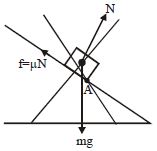
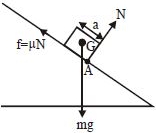
When a cube is in limiting equilibrium on an inclined plane and it is about to topple. The coefficient of friction between cube and plane is:-
- ✓
$1$
- B
$1/2$
- C
$1/ \sqrt 2$
- D
$1/ \sqrt 3$
Answera
If block is about to topple normal reaction will
act at $A.$
about $G$
$\mathrm{N} \times \frac{\mathrm{a}}{2}=\mu \mathrm{N} \times \frac{\mathrm{a}}{2}$
$\mu=1$
View full question & answer→MCQ 451 Mark
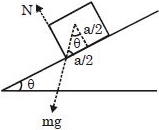
A cube is resting on an inclined plane. What must be the value of coefficient of friction between cube and plane so that cube topples before sliding
- A
$\mu = \frac{1}{2}$
- B
$\mu < 1$
- ✓
$\mu > 1$
- D
$\mu > \frac{1}{2}$
AnswerCorrect option: C. $\mu > 1$
c
The given condition takes place when line of force of mg passes through
$\theta=45^{\circ}$ $...(i)$
and $\operatorname{mg} \sin \theta \leq f_{\mathrm{r} \max }=\mu \mathrm{mg} \cos \theta$
$\Rightarrow \mu \geq \tan \theta$
$\Rightarrow \mu \geq 1$
View full question & answer→MCQ 461 Mark
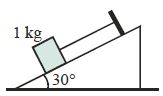
The coefficient of friction between two surfaces is $\mu = 0.8$.The tension in the string shown in the figure is ........ $N$
Answera
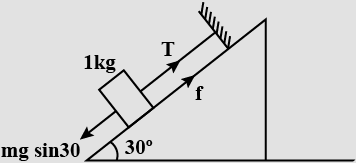
Maximum frictional force acting on the block $f=\mu m g \cos 30^{\circ}$ $f=0.8 \times 1 \times 9.8 \times 0.866=6.8 N$
Downward force $=m g \sin 30=1 \times 9.8 \times 0.5=4.9 \mathrm{N}$
since downward force is less than maximum frictional force, thus the tension in the string is zero.
View full question & answer→MCQ 471 Mark
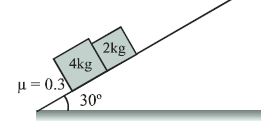
Two blocks, $4\, kg$ and $2\, kg$ are sliding down an inclined plane as shown in figure. The acceleration of $2\, kg$ block is ........ $m/s^2$
- A
$1.66$
- ✓
$2.4$
- C
$3.66$
- D
$4.66$
Answerb
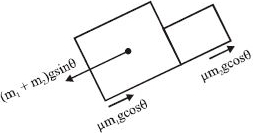
$\therefore$ Net force $=\left(\mathrm{m}_{1}+\mathrm{m}_{2}\right)$ a $_{\mathrm{net}}$
$\therefore \quad\left(\mathrm{m}_{1}+\mathrm{m}_{2}\right) \mathrm{g} \sin \theta-\left(\mu \mathrm{m}_{1} \mathrm{g} \cos \theta+\mu \mathrm{m}_{2} \underline{\mathrm{g}} \cos \theta\right)$
$=\left(\mathrm{m}_{1}+\mathrm{m}_{2}\right) \mathrm{a}_{\mathrm{net}}$
$\therefore a_{n e t}=g\left(\sin \theta-\frac{\left(\mu m_{1}+\mu m_{2}\right) \cos \theta}{m_{1}+m_{2}}\right)$
Here, $m_{1}=4 \mathrm{kg}, \mathrm{m}_{2}=2 \mathrm{kg}, \theta=30^{\circ} ; \mu=0.3$
View full question & answer→MCQ 481 Mark
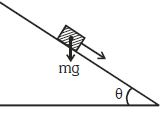
A plank with a box on it at one end is gradually raised about the other end. As the angle of inclination with the horizontal reaches $30^o$, the box starts to slip and slides $4.0\, m$ down the plank in $4.0\,s$. The coefficients of static and kinetic friction between the box and the plank will be, respectively
- A
$0.4$ and $0.3$
- B
$0.6$ and $0.6$
- ✓
$0.6$ and $0.5$
- D
$0.5$ and $0.6$
AnswerCorrect option: C. $0.6$ and $0.5$
c
Coefficient of static friction.
$\mu_{s}=\tan 30^{\circ}=\frac{1}{\sqrt{3}}=0.6$
$a=g \sin 30^{\circ}-\mu_{k} g \cos 30^{\circ}$
$S=u t+\frac{1}{2} a t^{2}$
$\Rightarrow 4=\frac{1}{2}\left[\frac{\mathrm{g}}{2}-\frac{\mu_{\mathrm{k}} \mathrm{g} \sqrt{3}}{2}\right] \times 16 \Rightarrow \mu_{\mathrm{k}}=0.5$
View full question & answer→MCQ 491 Mark
A body is sliding down an inclined plane (angle of inclination $45^o$). If the coefficient of friction is $0.5$ and $g = 9.8\, m/s^2$. then the acceleration of the body downwards in $m/s^2$ is
AnswerCorrect option: A. $\frac{{4.9}}{{\sqrt 2 }}$
a
$ a =g \sin \theta-\mu g \cos \theta$
$=g\left[\sin 45^{\circ}-0.5 \times \cos 45^{\circ}\right]$
$=\frac{4.9}{\sqrt{2}} \mathrm{m} / \mathrm{s}^{2} 1 $
View full question & answer→MCQ 501 Mark
Block of mass $10 \,kg$ is moving on inclined plane with constant velocity $10 \,m / s$. The coefficient of kinetic friction between incline plane and block is ...........

AnswerCorrect option: B. $0.75$
b
(b)
$\sum F y=0$
$\Rightarrow N - mg \cos \theta=0$
$\Rightarrow N = mg \cos \theta----(1)$
$Fx =0$ (as constant velocity $\Rightarrow$ No acceleration)
$\Rightarrow mg \sin \theta-\mu_{ k } N =0$
$\Rightarrow mg \sin \theta-\mu_{ k } mg \cos \theta=0$
$\Rightarrow \cos \theta\left(\tan \theta-\mu_{ k }\right)=0$
$\Rightarrow \mu_{ k }=\tan \theta=\tan 37^{\circ}=\frac{3}{4}=0.75$
View full question & answer→