Question
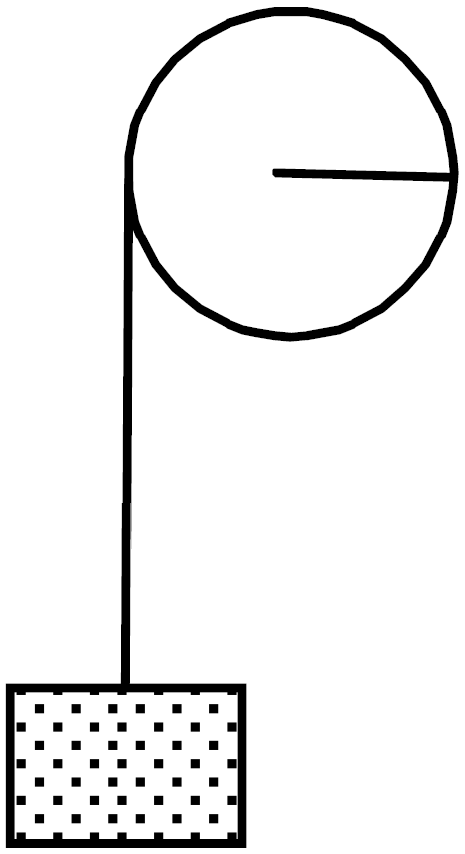
A block hangs from a string wrapped on a disc of radius 20cm free to rotate about its axis which is fixed in a horizontal position. If the angular speed of the disc is 10rad/s at some instant, with what speed is the block going down at that instant?
Answer

The Block is moving the rim of the pulley The pulley is moving at a $\omega=10\text{rad/s}$ Therefore the radius of the pulley = 20cm Therefore linear velocity on the rim = tangential velocity $=\text{r}_{\omega}=20\times20=200\text{cm/s}=2\text{m/s}.$

Need a full question paper?

Generate a complete, print-ready paper with questions like this in minutes — across 16+ boards, with answer keys.

Start Generating Free

Similar questions

Suppose, one wishes to construct a 1.0 farad capacitor using circular discs. If the separation between the discs be kept at 1.0mm, what would be the radius of the discs?
A calorie is a unit of heat (energy in transit) and it equals about $4.2 J$ where $1J = 1kg m^2 s^{–2}$. Suppose we employ a system of units in which the unit of mass equals $\alpha\text{ kg},$ the unit of length equals $\beta\text{ m},$ the unit of time is $\gamma\text{ s}.$ Show that a calorie has a magnitude $4.2\ \alpha^{-1}\ \beta^{-2}\ \gamma^2$ in terms of the new units.
The speed of a bus is 35 km per hour, it increases to $80 km / hr$ in 5 sec . Find the mean acceleration of the bus.
Explain the difference between beats and interfrence.
A large conducting plane has a surface charge density $1.0\times10^{-4}\text{Cm}^{-2}.$ Find the electrostatic energy stored in a cubical volume of edge 1.0cm in front of the plane.
Just as precise measurements are necessary in science, it is equally important to be able to make rough estimates of quantities using rudimentary ideas and common observations. Think of ways by which you can estimate the following (where an estimate is difficult to obtain, try to get an upper bound on the quantity): The total mass of rain-bearing clouds over India during the Monsoon.
By what fraction does the mass of a boy increase when he starts running at a speed of 12km/h?
The displacement of a particle having $\text{S.H.M}$. is $x = 10\sin\Big[10\pi\text{t}+\frac{\pi}{4}\Big]\text{m}.$
  1. Amplitude.
  2. Angular frequency.
  3. Epoch.
  4. Time period.
  5. Frequency.
  6. Maximum velocity.
A rod of mass m and length L, lying horizontally, is free to rotate about a vertical axis through its centre. A horizontal force of constant magnitude F acts on the rod at a distance of $\frac{\text{L}}{4}$ from the centre. The force is always perpendicular to the rod. Find the angle rotated by the rod during the time (t) after the motion starts.
Slowing down of neutrons: In a nuclear reactor a neutron of high speed (typically $10^7 m s ^{-1}$ ) must be slowed to $10^3 m s ^{-1}$ so that it can have a high probability of interacting with isotope ${ }_{92}^{235} U$ and causing it to fission. Show that a neutron can lose most of its kinetic energy in an elastic collision with a light nuclei like deuterium or carbon which has a mass of only a few times the neutron mass. The material making up the light nuclei, usually heavy water $\left( D _2 O \right)$ or graphite, is called a moderator.