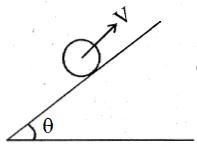
A block is kept on an inclined plane of inclination $\theta$ of length l. The velocity of particle at the bottom of inclined is (the coefficient of friction is $\mu$)
Medium


Download our appand get started for free
Experience the future of education. Simply download our apps or reach out to us for more information. Let's shape the future of learning together!No signup needed.*
Similar Questions
- 1A body of $5 \,kg$ weight kept on a rough inclined plane of angle $30^{\circ}$ starts sliding with a constant velocity. Then the coefficient of friction is (assume $g=10 \,ms ^{-2}$ )View Solution
- 2A car is moving along a straight horizontal road with a speed ${v_0}$. If the coefficient of friction between the tyres and the road is $\mu $, the shortest distance in which the car can be stopped isView Solution
- 3A particle moves in a horizontal circle on the smooth inner surface of a hemispherical bowl of radius $R$. The plane of motion is at a depth $d$ below the centre of the hemisphere. The speed of the particle is :-View Solution
- 4View SolutionWhich of the following is self adjusting in nature?
- 5A uniform rope of length l lies on a table. If the coefficient of friction is $\mu $, then the maximum length ${l_1}$ of the part of this rope which can overhang from the edge of the table without sliding down isView Solution
- 6View SolutionThe sphere is performing rolling up an inclined plane, the frictional force is
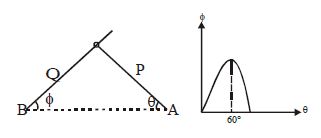
- 7A rod $P$ of length $1\ m$ is hinged at one end $A$ and there is a ring attached to the other end. Another long rod $Q$ is hinged at $B$ and it passes through the ring. The rod $P$ is rotated about an axis which is perpendicular to plane in which both the rods are present and the variation between the angles $\theta$ and $\phi $ are plotted as shown. The distance between the hinges $A$ and $B$ is ....... $m$.View Solution
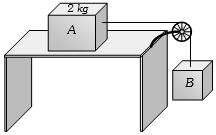
- 8The coefficient of static friction, ${\mu _s},$ between block $A$ of mass $2\, kg$ and the table as shown in the figure is $0.2$. ........ $kg$ would be the maximum mass value of block $B$ so that the two blocks do not move. The string and the pulley are assumed to be smooth and massless. $(g = 10\,m/{s^2})$View Solution
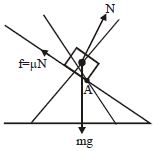
- 9View SolutionWhen a cube is in limiting equilibrium on an inclined plane and it is about to topple. The coefficient of friction between cube and plane is:-
- 10A block of mass $2\,kg$ moving on a horizontal surface with speed of $4\,ms ^{-1}$ enters a rough surface ranging from $x =0.5\,m$ to $x =1.5\,m$. The retarding force in this range of rough surface is related to distance by $F =- kx$ where $k =12\,Nm ^{-1}$. The speed of the block as it just crosses the rough surface will be ........... $\,ms ^{-1}$View Solution