MCQ
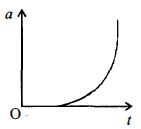
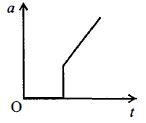
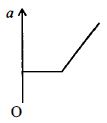
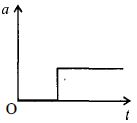
A block is placed on a rough horizontal plane. A time dependent horizontal force $F = kt$ acts on the block, where $k$ is a positive constant. The acceleration - time graph of the block is
  • A


  • C

  • D

Answer

Correct option: B.

b
Graph $(b)$ correctly dipicts the acceleration-time graph of the block

Need a full question paper?

Generate a complete, print-ready paper with questions like this in minutes — across 16+ boards, with answer keys.
Start Generating Free

Similar questions

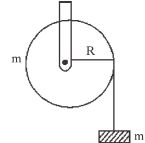
A mass $'m'$ is supported by a massless string wound around a uniform hollow cylinder of mass $m$ and radius $R$. If the string does not slip on the cylinder, with what acceleration will the mass fall on release?
An aeroplane is flying horizontally with a velocity of $600\, km/h$ at a height of $1960\, m$. When it is vertically at a point $A$ on the ground, a bomb is released from it. The bomb strikes the ground at point $B$. The distance $AB$ is
An air column, closed at one end and open at the other, resonates with a tuning fork when the smallest length of the column is $50\, cm.$ The next larger length of the column resonating with the same tuning fork is .... $cm$
Two balls are dropped from heights $h$ and $2h$ respectively from the earth surface. The ratio of time of these balls to reach the earth is
Two cars are moving in the same direction with the same speed $30 \,km/hr$. They are separated by a distance of $5\, km$, the speed of a car moving in the opposite direction if it meets these two cars at an interval of $4$ minutes, will be.......$km/hr$
Some physical quantities are given in Column $I$ and some possible $SI$ units in which these quantities may be expressed are given in Column $II$. Match the physical quantities in Column $I$ with the units in Column $II$ and indicate your answer by darkening appropriate bubbles in the $4 \times 4$ matrix given in the $ORS$.

Column $I$ Column $II$

$(A)$ $\mathrm{GM}_e \mathrm{M}_5$

$\mathrm{G} \rightarrow$ universal gravitational constant, $\mathrm{M}_{\mathrm{e}} \rightarrow$ mass of the earth,

$\mathrm{M}_5 \rightarrow$ mass of the Sun

$(p)$ (volt) (coulomb) (metre)

$(B)$ $\frac{3 \mathrm{RT}}{\mathrm{M}} ; \mathrm{R} \rightarrow$ universal gas constant, $\mathrm{T} \rightarrow$ absolute temperature,

$\mathrm{M} \rightarrow$ molar mass

$(q)$ (kilogram) $(\text { metre) })^3$ (second) $)^{-2}$
$(C)$ $\frac{F^2}{q^2 B^2}$ ;$\quad F \rightarrow$ force, $q \rightarrow$ charge, $B \rightarrow$ magnetic field  $(r)$ $(\text { meter })^2$ (second) $)^{-2}$

$(D)$ $\frac{\mathrm{GM}_e}{\mathrm{R}_{\mathrm{e}}}, G \rightarrow$ universal gravitational constant,

$\mathrm{M}_{\mathrm{e}} \rightarrow$ mass of the earth, $\mathrm{R}_{\mathrm{e}} \rightarrow$ radius of the earth

$(s)$ (farad) $(\text { volt) })^2(\mathrm{~kg})^{-1}$
Which of the following is the unit vector perpendicular to $\overrightarrow A $ and $\overrightarrow B $
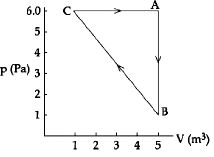
For the given cyclic process $CAB$ as shown for a gas, the work done is ..... $J$
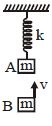
Block $A$ is hanging from a vertical spring and it is at rest. Block $'B'$ strikes the block $'A'$ with velocity $v$ and stick to it. Then the velocity $v$ for which the spring just attains natural length is:
Water falls from a height of $60\,m$ at the rate of $15\,kg/s$ to operate a turbine. The losses due to frictional forces are $10\%$ of energy. How much power is generated by the turbine ....... $kW$ $(g = 10\,m/s^2)$