MCQ
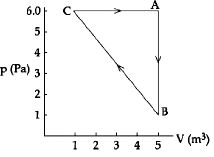
For the given cyclic process $CAB$ as shown for a gas, the work done is ..... $J$
  • A
    $30$
  • $10$
  • C
    $1$
  • D
    $5$

Answer

Correct option: B.
$10$
b
Work done $=$ Area of loop
                   $= \frac{1}{2} (4) (5)$
                   $= 10\, J$

Need a full question paper?

Generate a complete, print-ready paper with questions like this in minutes — across 16+ boards, with answer keys.

Start Generating Free

Similar questions

What is the pressure in $atm$ on a swimmer $10\; m$ below the surface of a lake?
A string of length $0.1\,m$ cannot bear a tension more than $100\,N$. It is tied to a body of mass $100\,g$ and rotated in a horizontal circle. The maximum angular velocity can be .......... $rad/sec$
The specific heat of a gas in an isothermal process is
Two vectors $\vec A\,{\rm{ and }}\vec B$ are such that $\vec A + \vec B = \vec A - \vec B$. Then
A process can be reversible if
In terms of basic units of mass $(M)$, length $(L)$, time $(T)$ and charge $(Q)$, the dimensions of magnetic permeability of vacuum $\left(\mu_0\right)$ would be
A source of sound of frequency $256 Hz$ is moving rapidly towards a wall with a velocity of $5m/s$. The speed of sound is $330 m/s.$ If the observer is between the wall and the source, then beats per second heard will be .... $Hz$
At $NTP$ the mass of one litre of air is $1.293\, gm.$ The value of specific gas constant will be ...... $J/K-gm$
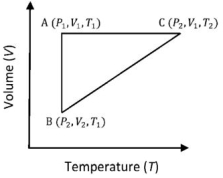
A reversible cyclic process for an ideal gas is shown below. Here, $P, V$, and $T$ are pressure, volume and temperature, respectively. The thermodynamic parameters $q, w, H$ and $U$ are heat, work, enthalpy and internal energy, respectively.

(image)

The correct option ($s$) is (are)

$(A)$ $q_{A C}=\Delta U_{B C}$ and $W_{A B}=P_2\left(V_2-V_1\right)$

$(B)$ $\mathrm{W}_{\mathrm{BC}}=\mathrm{P}_2\left(\mathrm{~V}_2-\mathrm{V}_1\right)$ and $\mathrm{q}_{\mathrm{BC}}=\mathrm{H}_{\mathrm{AC}}$

$(C)$ $\Delta \mathrm{H}_{\mathrm{CA}}<\Delta \mathrm{U}_{\mathrm{CA}}$ and $\mathrm{q}_{\mathrm{AC}}=\Delta \mathrm{U}_{\mathrm{BC}}$

$(D)$ $\mathrm{q}_{\mathrm{BC}}=\Delta \mathrm{H}_{\mathrm{AC}}$ and $\Delta \mathrm{H}_{\mathrm{CA}}>\Delta \mathrm{U}_{\mathrm{CA}}$
An engineer claims to have made an engine delivering $10 kW$ power with fuel consumption of $1 g/sec$. The calorific value of the fuel is $2 kcal/g$. Is the claim of the engineer