Question
A block is projected along a rough horizontal road with a speed of 10m/s. If the coefficient of kinetic friction is 0.10, how far will it travel before coming to rest?
Answer


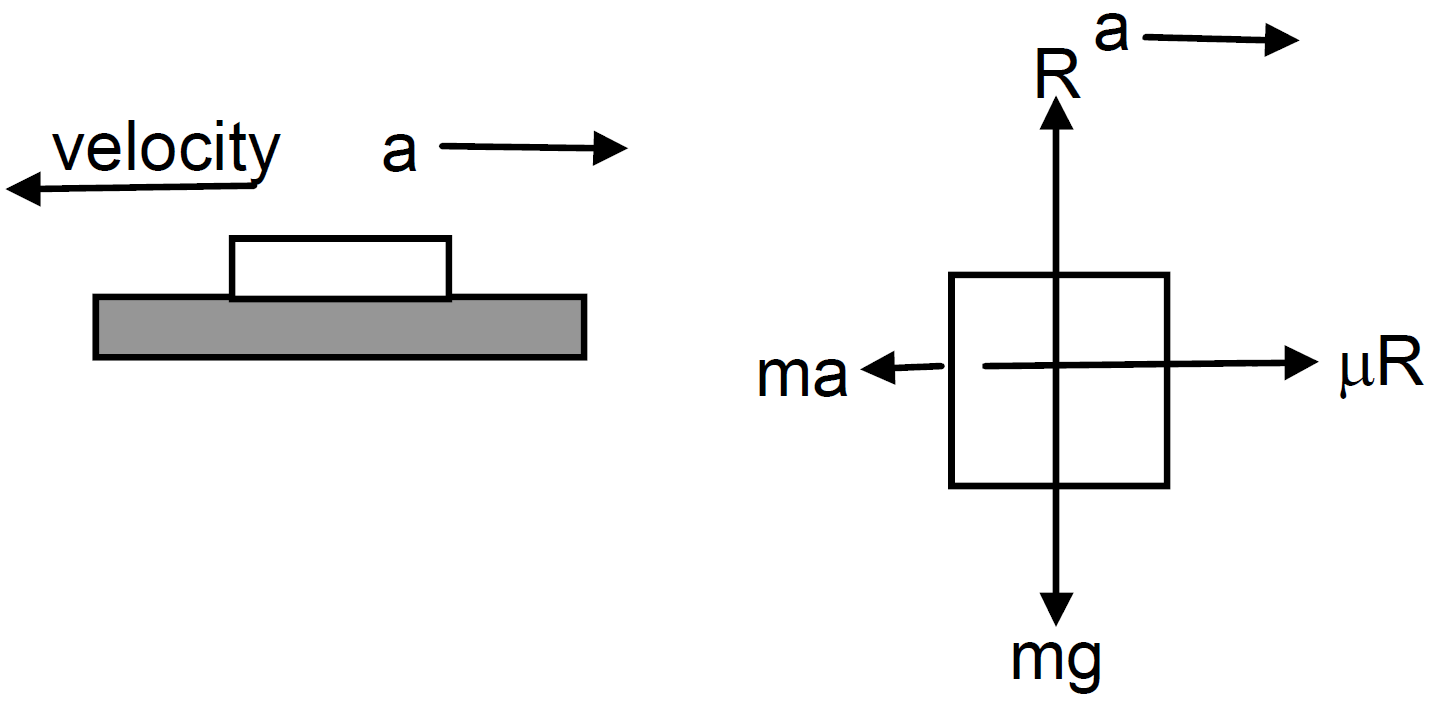
Due to friction the body will decelerate
Let the deceleration be ‘a’
$\text{R}-\text{mg}=0\Rightarrow\text{R = mg} \ ...(1)$
$\text{ma}-\mu\text{R}=0\Rightarrow\text{ma}=\mu\text{R}=\mu\text{mg}$ (from(1))
$\Rightarrow\text{a}=\mu\text{g}=0.1\times10=1\text{m/s}^2$
Initial velocity u = 10m/s
Final velocity v = 0m/s
$\text{a}=-1\text{m/s}^2$
$\text{S}=\frac{\text{v}^2-\text{u}^2}{2\text{a}}=\frac{0-10^2}{2(-1)}=\frac{100}{2}=50\text{m}$
It will travel 50m before coming to rest.

Need a full question paper?

Generate a complete, print-ready paper with questions like this in minutes — across 16+ boards, with answer keys.

Start Generating Free

Similar questions

Two principal thrusts in physics are unification and reduction. Justify by giving illustrations.
Deduce by the method of dimensions, an expression for the energy of a body executing S.H.M. assuming that the energy of the body depends upon (a) the mass m (b) the frequency v and (c) the amplitude of vibration a.
A player throws a ball upwards with an initial speed of $29.4m s^{–1}$. Choose the $x = 0m$ and $t = 0s$ to be the location and time of the ball at its highest point, vertically downward direction to be the positive direction of x-axis, and give the signs of position, velocity and acceleration of the ball during its upward, and downward motion.
Two prisms of identical geometrical shape are combined with their refracting angles oppositely directed. The materials of the prisms have refractive indices 1.52 and 1.62 for violet light. A violet ray is deviated by 1.0° when passes symmetrically through this combination. What is the angle of the prisms?
Establish a relation between linear velocity and angular velocity in a uniform circular motion and explain the direction of linear velocity.
A car of mass 1000kg travels up an incline of 1 in 25 at a constant velocity of 50km/ h. What power does the car engine have to develop if there is a resistive force of 300 N opposing the motion?
If mercury and glass had equal coefficient of volume expansion, could we make a mercury thermometer in a glass tube?
If a body is taken to a height equal to the radius of earth from its surface, how much the weight of a body will decrease?
A string of length L and mass M is lying on a horizontal table. A force F is applied at one of its end. What is the tension in string at a distance x from the end at which force is applied?
The focal lengths of a convex lens for red, yellow and violet rays are 100cm, 98cm and 96cm respectively. Find the dispersive power of the material of the lens.