Question
Two principal thrusts in physics are unification and reduction. Justify by giving illustrations.

Answer

By unification we mean explanation of diverse physical phenomena in terms of a few concepts and laws. As an example, the law of gravitation describes the motion under gravity, motion of Moon and satellites as well as motion of planets. Again, Maxwell's equations of electromagnetism govern all electric and magnetic phenomena. By reductionism approach we try to derive the properties of a bigger, more complex, system from the properties and interactions of its constituent simpler parts. As an example thermodynamics deals with bulk systems in terms of macroscopic quantities like temperature, internal energy, entropy etc. The kinetic theory and statistical mechanics interpreted these quantities in terms of the properties of the molecular constituents of the bulk system.
Need a full question paper?

Generate a complete, print-ready paper with questions like this in minutes — across 16+ boards, with answer keys.

Start Generating Free

Similar questions

Estimate the proportion of boron impurity whieh will increase the conductivity of a pure silicon sample by a factor of 100. Assume that each boron atom creates a hole and the concentration of holes in pure silicon at the same temperature is $7 \times 10^{15}$ holes per cubic metre. Density of silicon is $5 \times 10^{21}$ atoms per cubic metre.
A body falls towards earth in air. Will its total mechanical energy be conserved during the fall? Justify
What is concurrent force? What is the necessary condition for the balance of concurrent forces?
State Kepler's laws of planetary motion and deduce Newton's Law of gravitation from them.
The work function of a metal is $2.5 \times 10^{-19}J$.
  1. Find the threshold frequency for photoelectric emission.
  2. If the metal is exposed to a light beam of frequency $6.0 \times 10^{-14} Hz$, what will be the stopping potential?
A steel wire has a length of $12.0 m$ and a mass of $2.10 kg$ . What should be the tension in the wire so that speed of a transverse wave on the wire equals the speed of sound in dry air at $20^{\circ} C =343 m s ^{-1}$.
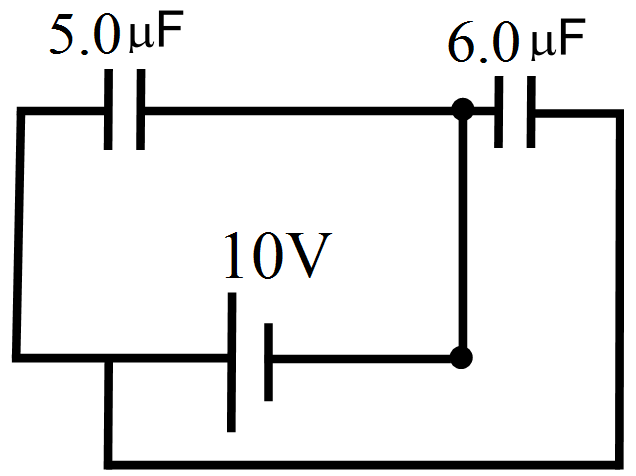
Find the charge supplied by the battery in the arrangement shown in figure.
A uniform rod of mass $300g$ and length $50\ cm$ rotates at a uniform angular speed of $2\text{rad/s}$ about an axis perpendicular to the rod through an end. Calculate:
  1. The angular momentum of the rod about the axis of rotation.
  2. The speed of the centre of the rod.
  3. Its kinetic energy.
Two sound waves originating from the same source, travel along different paths in air and then meet at a point. If the source vibrates at a frequency of 1kHz and one path is 83cm longer than the other, what will be the nature of interference? The speed of sound in air is 332m/s.
Calculate the fall in temperature when a gas initially at $72°C$ is expanded suddenly to eight times its original volume. Given y $=\frac53.(\therefore\text{V}_2=8\text{x}\text{ c.c.})$