Question
A block is resting on a piston which is moving vertically with a simple harmonic motion of period 1sec. At what amplitude of motion will the block and the piston seperate? What is the maximum velocity of the piston at this amplitude?

Answer

We know that $\text{y}=\text{a}\sin\omega\text{t}$$\therefore$ Velocity of the block $=\frac{\text{dy}}{\text{dt}}=\text{a}\omega\cos\omega\text{t}$
Acceleration of the block $=\frac{\text{d}^2\text{y}}{\text{dt}^2}=\omega^2\sin\omega\text{t}$
$=-\omega\text{y}$
For maximum acceleration y = a$\therefore\Big(\frac{\text{d}^2\text{y}}{\text{dt}^2}\Big)_\text{max}$
$=-\omega\text{a}$
The block will be separated form the piston when$\omega^2\text{a}=\text{g}$
$=\text{a}=\frac{\text{g}}{\omega}$
$=\Big(\therefore\frac{2\pi}{\text{T}}\Big)$
$=\text{a}=\frac{\text{gT}^2}{4\pi^2}$ According to the given problem T = 1sec.$\therefore\text{a}=\frac{\text{g}}{4\pi^2}$
$=\frac{9.8}{4\times(3.14)^2}$
$=0.248\text{m/ sec}^2$
At this amplitude, the maximum velocity of the block will be$\omega\text{a}=\frac{2\pi}{\text{T}}$
$\frac{2\times3.14\times.0.248}{1}$
$=1.56\text{m/ sec}$

Need a full question paper?

Generate a complete, print-ready paper with questions like this in minutes — across 16+ boards, with answer keys.
Start Generating Free

Similar questions

What will be the energy corresponding to the first excited state of a hydrogen atom if the potential energy of the atom is taken to be 10eV when the electron is widely separated from the proton? Can we still write $\text{E}_\text{n}=\frac{\text{E}_1}{\text{n}^2}?\text{ r}_\text{n}=\text{a}_0\text{n}^2?$
The speed of a train increases at a constant rate a from zero to $\nu$ and then remains constant for an interval, and finally decreases to zero at a constant rate $\beta.$ If L be the total distance described prove that the total time taken is $\frac{\text{L}}{\nu}+\frac{\nu}{2}\Big(\frac{1}{\alpha}+\frac{1}{\beta}\Big).$
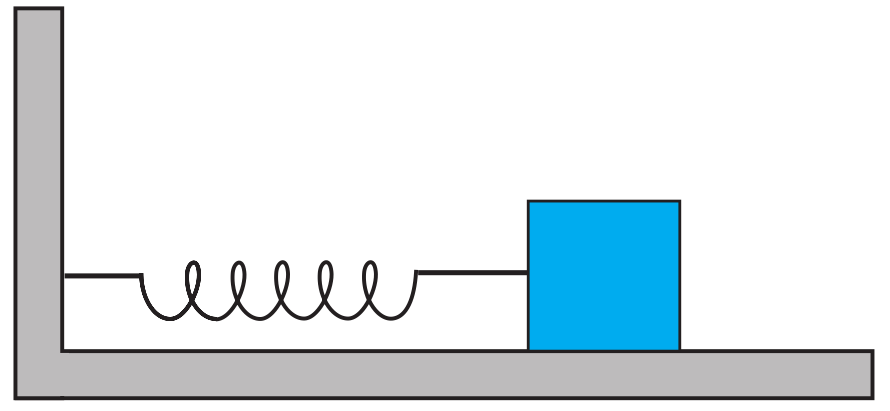
A spring having with a spring constant $1200N m^{-1}$ is mounted on a horizontal table as shown in Fig. A mass of $3kg$ is attached to the free end of the spring. The mass is then pulled sideways to a distance of $2.0cm$ and released.

Determine (i) the frequency of oscillations, (ii) maximum acceleration of the mass, and (iii) the maximum speed of the mass.
Use the formula $\text{v}=\sqrt{\frac{\gamma\text{P}}{\rho}}$ to explain why the speed of sound in air:
Increases with humidity.
A ball is thrown vertically upwards with a velocity of 20m/ s from the top of a building of height 25m from the ground,
  1. How high will the ball reach?
  2. How long will it take for the ball to reach the ground?
  3. Trace the trajectory of motion of this ball.
What do you understand by Poisson's ratio? Find the value of Poisson's ratio at which the volume of a wire does not change when the wire is subjected to a tension.
An aluminium vessel of mass 0.5kg contains 0.2kg of water at $20^\circ C$. A block of iron of mass 0.2kg at $100^\circ C$ is gently put into the water. Find the equilibrium temperature of the mixture. Specific heat capacities of aluminium, iron and water are $910\ J\ kg^{- 1}-K^{- 1}, 470\ J\ kg^{-1}-K^{-1} $ and $4200\ J\ kg^{-1}-K^{-1} $ respectively.
A body of mass m is attached to one end of a massless spring which is suspended vertically from a fixed point. The mass is held in hand so that the spring is neither stretched nor compressed. Suddenly the support of the hand is removed. The lowest position attained by the mass during oscillation is 4cm below the point, where it was held in hand.
  1. What is the amplitude of oscillation?
  2. Find the frequency of oscillation?
Establish a relationship between angular momentum (L), moment of inertia (I) and angular velocity $(\omega)$.
What are the values of the self-induced emf in the circuit of the previous problem at the times indicated therein?