Question
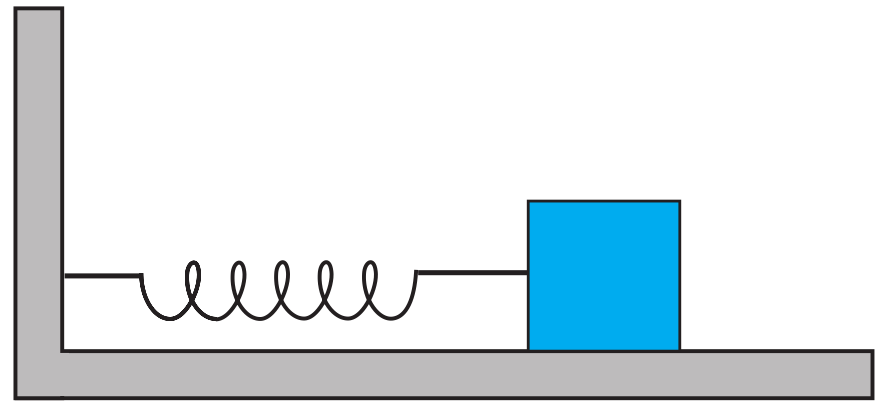
A spring having with a spring constant $1200N m^{-1}$ is mounted on a horizontal table as shown in Fig. A mass of $3kg$ is attached to the free end of the spring. The mass is then pulled sideways to a distance of $2.0cm$ and released.
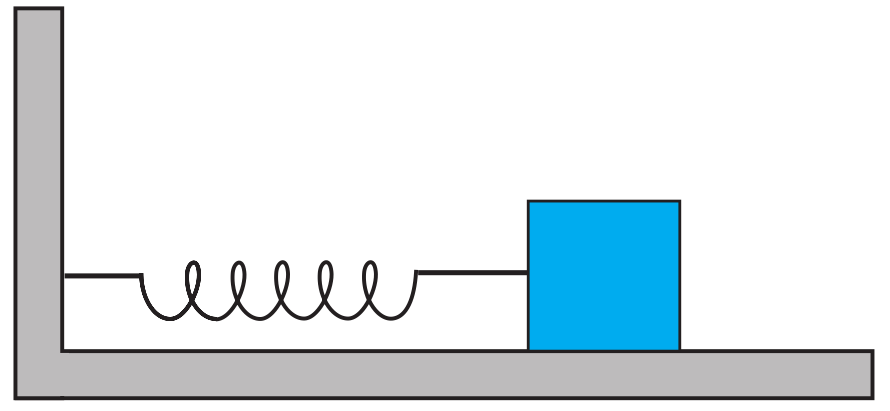
Determine (i) the frequency of oscillations, (ii) maximum acceleration of the mass, and (iii) the maximum speed of the mass.
Answer

Spring constant, $k = 1200N m^{-1}$
Mass, m = 3kg
Displacement, A = 2.0cm = 0.02cm
  1. Frequency of oscillation v, is given by the relation:
$\upsilon=\frac{1}{\text{T}}=\frac{1}{2\pi}\sqrt{\frac{\text{k}}{\text{m}}}$
where, T is time period
$\therefore\ \upsilon=\frac{1}{2\times3.14}\sqrt{\frac{1200}{3}}$
= 3.18m/s
Hence, the frequency of oscillations is 3.18 cycles per second.
  1. Maximum acceleration (a) is given by the relation:
$\text{a}=\omega^2\text{A}$
where,
$\omega=$ Angular frequency $=\sqrt{\frac{\text{k}}{\text{m}}}$
A = maximum displacement
$\therefore\ \text{a}=\frac{\text{k}}{\text{m}}\text{A}=\frac{1200\times0.02}{3}=8\text{ ms}^{-2}$
Hence, the maximum acceleration of the mass is $8.0m/s^2​​​​​​​$.
Maximum velocity, $\text{v}_\text{max}=\text{A}\omega$
$=\text{A}\sqrt{\frac{\text{k}}{\text{m}}}=0.02\times\sqrt{\frac{1200}{3}}=0.4\text{ m/s}$
Hence, the maximum velocity of the mass is 0.4m/s.

Need a full question paper?

Generate a complete, print-ready paper with questions like this in minutes — across 16+ boards, with answer keys.

Start Generating Free

Similar questions

Two tuning forks A and B give 5 beats/sec. A resounds with a closed column of air 15cm long and B with an open column 30.5cm long. Calculate their frequencies (neglect end correction).
Suppose a tunnel is dug through the earth from one side to the other side along a diameter. Show that the motion of a particle dropped into the tunnel is simple harmonic motion. Find the time period. Neglect all the frictional forces and assume that the earth has a uniform density.
$G = 6.67 \times 10^{-11}Nm^2kg^{-2};$ density of earth = $5.51 \times 10^3kg m^{-3}$
Consider the situation of the previous problem. Suppose the block of mass $m_1$ is pulled by a constant force $F_1$ and the other block is pulled by a constant force $F_2$. Find the maximum elongation that the spring will suffer.
A spring having with a spring constant $1200 N m ^{-1}$ is mounted on a horizontal table as shown in Fig. A mass of 3 kg is attached to the free end of the spring. The mass is then pulled sideways to a distance of 2.0 cm and released.
Image

Take the position of mass when the spring is unstreched as $x=0$, and the direction from left to right as the positive direction of $x$-axis. Give $x$ as a function of time $t$ for the oscillating mass if at the moment we start the stopwatch $(t=0)$, the mass is
a. at the mean position,
b. at the maximum stretched position, and
c. at the maximum compressed position.
In what way do these functions for SHM differ from each other, in frequency, in amplitude or the initial phase?
A spring having with a spring constant $1200N m^{-1}$ is mounted on a horizontal table as shown in Fig. A mass of $3kg$ is attached to the free end of the spring. The mass is then pulled sideways to a distance of $2.0cm$ and released.
Determine (i) the frequency of oscillations, (ii) maximum acceleration of the mass, and (iii) the maximum speed of the mass.
Explain cohesive and adhesive force and write their effects.
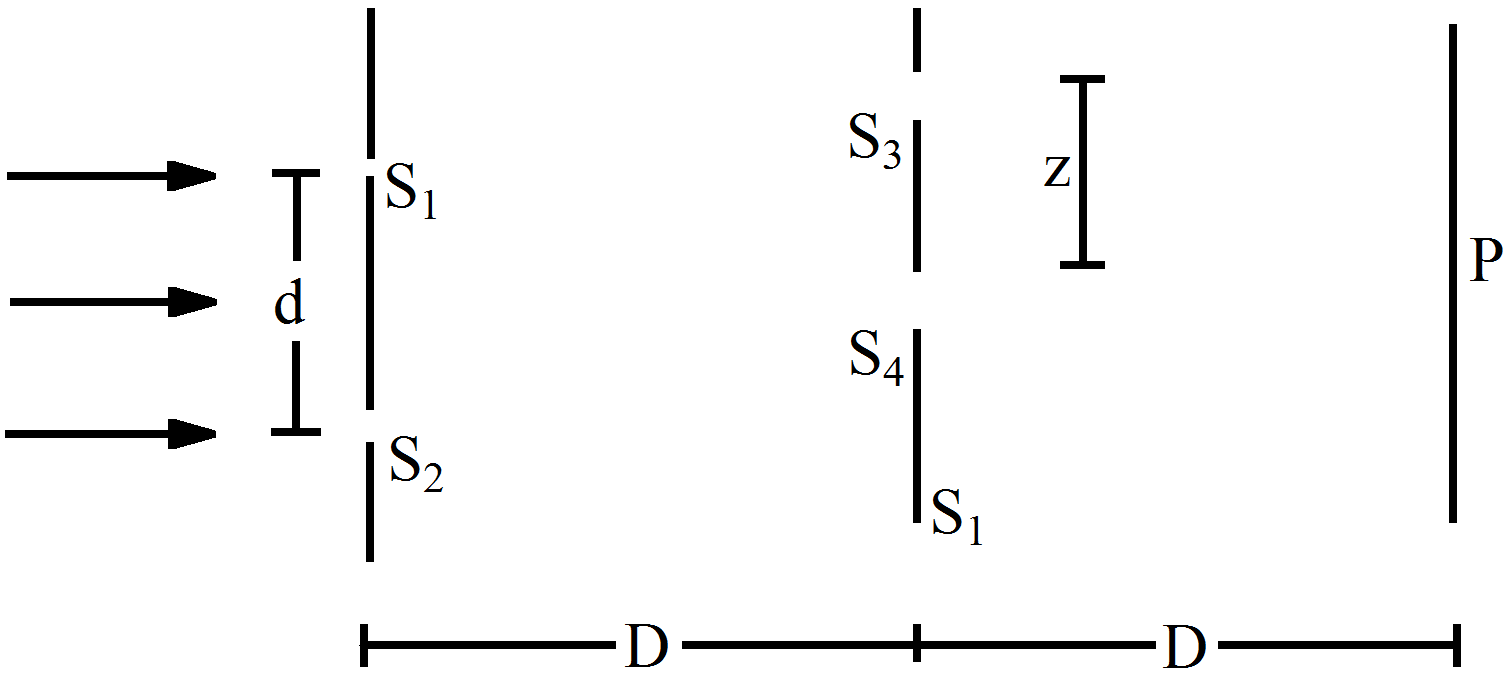
Consider the arrangement shown in figure. By some mechanism, the separation between the slits $S_3$ and $S_4$​​​​​​​ can be changed. The intensity is measured at the point P which is at the common perpendicular bisector
of $S_1S_2​​​​​​​$​​​​​​​ and $S_3S_4​​​​​​​$​​​​​​​. When $\text{z}=\frac{\text{D}\lambda}{2\text{d}},$ intensity measured at P is I. Find this intensity when z is equal to:
  1. $\frac{\text{D}\lambda}{\text{d}}$
  2. $\frac{3\text{D}\lambda}{2\text{d}}$
  3. $\frac{2\text{D}\lambda}{\text{d}}$
A vessel filled with water is kept on a weighing pan and the scale adjusted to zero. A block of mass $M$ and density $\rho$ is suspended by a massless spring of spring constant $k$. This block is submerged inside into the water in the vessel. What is the reading of the scale?
Explain the Newton's law of gravity. Write the value, unit and dimension of universal constant of gravitation. Why is it called universal? Or Write Newton's law of gravity. Define universal gravitational constant (G). Also write its units and dimensional formula.
A hammer of mass $M$ drops from a height $h.$ It strikes a nail placed vertically on the ground and drives it into the ground through a distance $D$. Calculate.
  1. The average resistance offered by the ground, assuming that the hammer and nail remain stuck together after impact.
  2. The time for which the nail is in motion and.
  3. The loss in kinetic energy in impact.