A block of mass $0.1 \,kg$ is held against a wall by applying a horizontal force of $5\, N$ on the block. If the coefficient of friction between the block and the wall is $0.5$, the magnitude of the frictional force acting on the block is ........ $N$
IIT 1994, Medium
Download our app for free and get started
(b) Limiting friction ${F_l} = {\mu _s}R = 0.5 \times (5) = 2.5\;N$
Since downward force is less than limiting friction therefore block is at rest so the static force of friction will work on it.
${F_s}$ $=$ downward force $=$ Weight
$ = 0.1 \times 9.8 = 0.98\,N$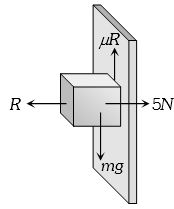

Download our appand get started for free
Experience the future of education. Simply download our apps or reach out to us for more information. Let's shape the future of learning together!No signup needed.*
Similar Questions
- 1A block of $200\, g$ mass moves with a uniform speed in a horizontal circular groove, with vertical side walls of radius $20\, cm$. If the block takes $40\, s$ to complete one round, the normal force by the side walls of the groove isView Solution
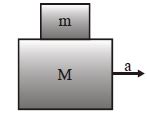
- 2A block of mass $m$ is placed on the top of another block of mass $M$ as shown in the figure. The coefficient of friction between them is $\mu $. What is the maximum acceleration with which the block $M$ may move so that m also moves along with it ?View Solution
- 3View SolutionA block is stationary on a rough inclined plane. How many forces are acting on the block?
- 4View SolutionA body is revolving with a constant speed along a circle. If its direction of motion is reversed but the speed remains the same, then which of the following statement is true
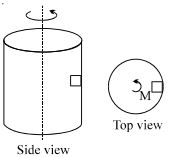
- 5A hollow vertical cylinder of radius $R$ is rotated with angular velocity $\omega$ about an axis through its center. What is the minimum coefficient of static friction necessary to keep the mass $M$ suspended on the inside of the cylinder as it rotates?View Solution
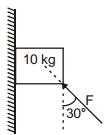
- 6A block of mass $10 \,kg$ is held at rest against a rough vertical wall $[\mu=0.5]$ under the action a force $F$ as shown in figure. The minimum value of $F$ required for it is ............ $N$ $\left(g=10 \,m / s ^2\right)$View Solution
- 7A body is sliding down an inclined plane (angle of inclination $45^o$). If the coefficient of friction is $0.5$ and $g = 9.8\, m/s^2$. then the acceleration of the body downwards in $m/s^2$ isView Solution
- 8A $2 \,kg$ mass starts from rest on an inclined smooth surface with inclination $30^°$ and length $2\, m$. ...... $m$ will it travel before coming to rest on a frictional surface with frictional coefficient of $0.25$View Solution
- 9The tension $T$ in the string shown in figure isView Solution
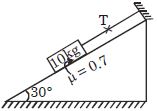
- 10A stone of mass of $16\, kg$ is attached to a string $144 \,m$ long and is whirled in a horizontal circle. The maximum tension the string can withstand is $16$ Newton. The maximum velocity of revolution that can be given to the stone without breaking it, will be ....... $ms^{-1}$View Solution