A body is sliding down an inclined plane (angle of inclination $45^o$). If the coefficient of friction is $0.5$ and $g = 9.8\, m/s^2$. then the acceleration of the body downwards in $m/s^2$ is
Medium
Download our app for free and get started
$ a =g \sin \theta-\mu g \cos \theta$
$=g\left[\sin 45^{\circ}-0.5 \times \cos 45^{\circ}\right]$
$=\frac{4.9}{\sqrt{2}} \mathrm{m} / \mathrm{s}^{2} 1 $

Download our appand get started for free
Experience the future of education. Simply download our apps or reach out to us for more information. Let's shape the future of learning together!No signup needed.*
Similar Questions
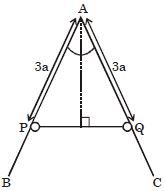
- 1In the diagram, $BAC$ is a rigid fixed rough wire and angle $BAC$ is $60^o$. $P$ and $Q$ are two identical rings of mass $m$ connected by a light elastic string of natural length $2a$ and elastic constant $\frac{mg}{a}$. If $P$ and $Q$ are in equilibrium when $PA = AQ = 3a$ then the least coefficient of friction between the ring and the wire is $\mu$. Then value of $\mu + \sqrt 3 $ is :-View Solution
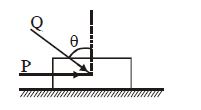
- 2A block of mass $m$ lying on a rough horizontal plane is acted upon by a horizontal force $P$ and another force $Q$ inclined an at an angle $\theta $ to the vertical. The minimum value of coefficient of friction between the block and the surface for which the block will remain in equilibrium isView Solution
- 3A cyclist riding the bicycle at a speed of $14 \sqrt{3} \,m / s$ takes a turn around a circular road of radius $20 \sqrt{3} \,m$ without skidding. What is his inclination to the vertical?View Solution
- 4View SolutionA box is placed on an inclined plane and has to be pushed down. The angle of inclination is
- 5A body of mass $'m '$ is tied to one end of a spring and whirled round in a horizontal plane with a constant angular velocity. The elongation in the spring is $1\, cm$. If the angular velocity is doubled, the elongation in the spring is $5\, cm$. The original length of the spring is ......... $cm$View Solution
- 6View SolutionIt is difficult to move a cycle with brakes on because
- 7If the radius of curvature of the path of two particles of same mass are in the ratio $3:4,$ then in order to have constant centripetal force, their velocities will be in the ratio of:View Solution
- 8A block of mass $M$ is being pulled along rough horizontal surface. The coefficient of friction between the block and the surface is $\mu $. If another block of mass $M/2$ is placed on the block and it is again pulled on the surface, the coefficient of friction between the block and the surface will beView Solution
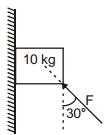
- 9A block of mass $10 \,kg$ is held at rest against a rough vertical wall $[\mu=0.5]$ under the action a force $F$ as shown in figure. The minimum value of $F$ required for it is ............ $N$ $\left(g=10 \,m / s ^2\right)$View Solution
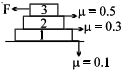
- 10If force $F$ is increasing with time and at $t = 0 , F = 0$ where will slipping first start?View Solution