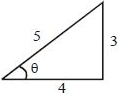
A block of mass $4\, kg$ rests on an inclined plane. The inclination of the plane is gradually increased. it is found that when the inclination is $3$ in $5\left( {\sin \theta = \frac{3}{5}} \right)$, the block just begins to slide down the plane. The coefficient of friction between the block and the plane is
Medium


Download our appand get started for free
Experience the future of education. Simply download our apps or reach out to us for more information. Let's shape the future of learning together!No signup needed.*
Similar Questions
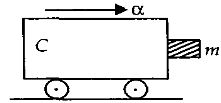
- 1A block of mass $m$ is in contact with the cart $C$ as shown in the figure. The coefficient of static friction between the block and the cart is $\mu .$ The acceleration $\alpha$ of the cart that will prevent the block from falling satisfiesView Solution
- 2A vehicle of mass $200\,kg$ is moving along a levelled curved road of radius $70\,m$ with angular velocity of $0.2\,rad / s$. The centripetal force acting on the vehicle is $.........\,N$View Solution
- 3A particle of mass $m$ is at rest at the origin at time $t = 0$. It is subjected to a force $F(t) = F_0e^{-bt}$ in the $x$ -direction. Its speed $v(t)$ is depicted by which of the following curves ?View Solution
- 4A body of $5 \,kg$ weight kept on a rough inclined plane of angle $30^{\circ}$ starts sliding with a constant velocity. Then the coefficient of friction is (assume $g=10 \,ms ^{-2}$ )View Solution
- 5View SolutionA motor cycle driver doubles its velocity when he is having a turn. The force exerted outwardly will be
- 6A person with his hand in his pocket is skating on ice at the rate of $10 m / s$ and describes a circle of radius $50 m$. What is his inclination to vertical: $\left( g =10 m / sec ^2\right)$View Solution
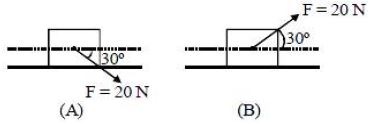
- 7A block of mass $5\, kg$ is $(i)$ pushed in case $(A)$ and $(ii)$ pulled in case $(B)$, by a force $F = 20\, N$, making an angle of $30^o$ with the horizontal, as shown in the figures. The coefficient of friction between the block and floor is $\mu = 0.2$. The difference between the accelerations of the block, in case $(B)$ and case $(A)$ will be ........ $ms^{-2}$ .$(g = 10\, ms^{-2})$View Solution
- 8View SolutionAmong the forces in nature, friction can be classified into
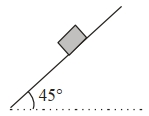
- 9Consider a block kept on an inclined plane (inclined at $45^{\circ}$ ) as shown in the figure. If the force required to just push it up the incline is $2$ times the force required to just prevent it from sliding down, the coefficient of friction between the block and inclined plane $(\mu)$ is equal toView Solution
- 10A disc with a flat small bottom beaker placed on it at a distance $R$ from its center is revolving about an axis passing through the center and perpendicular to its plane with an angular velocity $\omega$. The coefficient of static friction between the bottom of the beaker and the surface of the disc is $\mu$. The beaker will revolve with the disc ifView Solution