A block of mass $4\,kg$ is placed on a rough horizontal plane A time dependent force $F = kt^2$ acts on the block, where $k = 2\,N/s^2$. Coefficient of friction $\mu = 0.8$. Force of friction between block and the plane at $t = 2\,s$ is ....... $N$
Medium
Download our app for free and get started
$\mathrm{F}_{\mathrm{max}}=\mu \mathrm{mg}=32 \mathrm{N}$
$F(t=2)=8 N$
as $\mathrm{F}<\mathrm{F}_{\max } \Rightarrow$ friction $=8 \mathrm{N}$

Download our appand get started for free
Experience the future of education. Simply download our apps or reach out to us for more information. Let's shape the future of learning together!No signup needed.*
Similar Questions
- 1View SolutionThe force required to keep a body in uniform circular motion is
- 2The force required just to move a body up an inclined plane is double the force required just to prevent the body from sliding down. If $\mu $ is the coefficient of friction, the inclination of plane to the horizontal isView Solution
- 3A cart moves with a constant speed along $a$ horizontal circular path. From the cart, $a$ particle is thrown up vertically with respect to the cartView Solution
- 4A block weighs $W$ is held against a vertical wall by applying a horizontal force $F$. The minimum value of $F$ needed to hold the block isView Solution
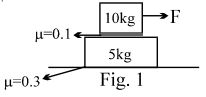
- 5The acceleration of $10\, kg$ block when $F = 30\,N$ ........ $m/s^2$View Solution
- 6A heavy uniform chain lies on a horizontal table-top. If the coefficient of friction between the chain and table surface is $0.25$, then the maximum fraction of length of the chain, that can hang over one edge of the table is ...... $\%$View Solution
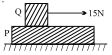
- 7$A$ long plank $P$ of the mass $5\, kg$ is placed on a smooth floor. On $P$ is placed a block $Q$ of mass $2\, kg$. The coefficient of friction between $P$ and $Q$ is $0.5$. If a horizontal force $15N$ is applied to $Q$, as shown, and you may take $g$ as $10N/kg.$View Solution
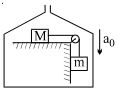
- 8In figure, two blocks $M$ and $m$ are tied together with an inextensible and light string. The mass $M$ is placed on a rough horizontal surface with coefficient of friction $\mu$ and the mass $m$ is hanging vertically against a smooth vertical wall. The pulley is frictionless. Imagine a situation in which the given arrangement is placed inside an elevator that can move only in the vertical direction and compare the situation with the case when it is placed on the ground. When the elevator accelerates downward with $a_0( < g)$, thenView Solution
- 9A particle of mass $m$ is at rest at the origin at time $t = 0$. It is subjected to a force $F(t) = F_0e^{-bt}$ in the $x$ -direction. Its speed $v(t)$ is depicted by which of the following curves ?View Solution
- 10A particle has initial velocity $10\,\, m/s$. It moves due to constant retarding force along the line of velocity which produces a retardation of $5\,\, m/s^2$. ThenView Solution