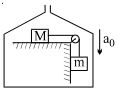
In figure, two blocks $M$ and $m$ are tied together with an inextensible and light string. The mass $M$ is placed on a rough horizontal surface with coefficient of friction $\mu$ and the mass $m$ is hanging vertically against a smooth vertical wall. The pulley is frictionless. Imagine a situation in which the given arrangement is placed inside an elevator that can move only in the vertical direction and compare the situation with the case when it is placed on the ground. When the elevator accelerates downward with $a_0( < g)$, then
Difficult
Download our app for free and get started

Download our appand get started for free
Experience the future of education. Simply download our apps or reach out to us for more information. Let's shape the future of learning together!No signup needed.*
Similar Questions
- 1View SolutionA metal block is resting on a rough wooden surface. A horizontal force applied to the block is increased uniformly. Which of the following curves correctly represents velocity of the block ?
- 2A particle of mass $m$ is at rest at the origin at time $t = 0$. It is subjected to a force $F(t) = F_0e^{-bt}$ in the $x$ -direction. Its speed $v(t)$ is depicted by which of the following curves ?View Solution
- 3A car of mass $m$ is moving on a level circular track of radius $R.$ If $\mu_s $ represents the static friction between the road and tyres of the car, the maximum speed of the car in circular motion is given byView Solution
- 4View SolutionThe limiting value of static friction between two contact surfaces is ...........
- 5A railway line is taken round a circular arc of radius $1000\ m$ , and is banked by raising the outer rail $h$ $m$ above the inner rail. If the lateral force on the inner rail when a train travels round the curve at $10\ ms^{-1}$ is equal to the lateral force on the outer rail when the train's speed is $20\ ms^{-1}$ . The value of $4g\ tan\theta $ is equal to : (The distance between the rails is $1.5\ m$ )View Solution
- 6A car of mass $m$ is moving on a level circular track of radius $R.$ If $\mu_s $ represents the static friction between the road and tyres of the car, the maximum speed of the car in circular motion is given byView Solution
- 7Starting from rest, a body slides down a $45^°$ inclined plane in twice the time it takes to slide down the same distance in the absence of friction. The coefficient of friction between the body and the inclined plane isView Solution
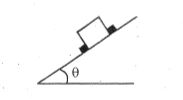
- 8View SolutionA box is placed on an inclined plane and has to be pushed down. The angle of inclination is
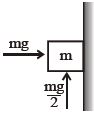
- 9View SolutionA block pressed against the vertical wall is in equilibrium. The minimum coefficient of friction is:-
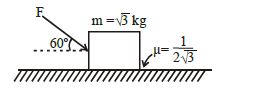
- 10What is the maximum value of the force $F$ such that the block shown in the arrangement does not move ....... $N$View Solution