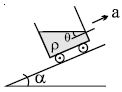
- ✓$8$
- B$4$
- C$2$
- D$32$
$F(t=2)=8 N$
as $\mathrm{F}<\mathrm{F}_{\max } \Rightarrow$ friction $=8 \mathrm{N}$
Generate a complete, print-ready paper with questions like this in minutes — across 16+ boards, with answer keys.

| List$-I$ | List$-II$ |
| $(a)$ $h$ (Planck's constant) | $(i)$ $\left[ M L T ^{-1}\right]$ |
| $(b)$ $E$ (kinetic energy) | $(ii)$ $\left[ M L ^{2} T ^{-1}\right]$ |
| $(c)$ $V$ (electric potential) | $(iii)$ $\left[ M L ^{2} T ^{-2}\right]$ |
| $(d)$ $P$ (linear momentum) | $( iv )\left[ M L ^{2} I ^{-1} T ^{-3}\right]$ |
Choose the correct answer from the options given below
$Reason :$ When a gas is heated at constant volume some extra heat is needed compared to that at constant pressure for doing work in expansion.
$(A)$ Final temperature of system will be $0^{\circ} C$.
$(B)$ Final temperature of the system will be greater than $0^{\circ} C$.
$(C)$ The final system will have a mixture of ice and water in the ratio of $5: 1$.
$(D)$ The final system will have a mixture of ice and water in the ratio of $1: 5$.
$(E)$ The final system will have water only.
Choose the correct answer from the options given below:
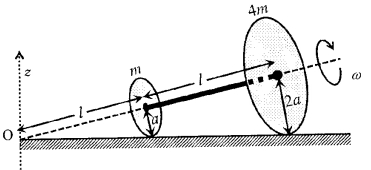
($A$) The center of mass of the assembly rotates about the $z$-axis with an angular speed of $\omega / 5$
($B$) The magnitude of angular momentum of center of mass of the assembly about the point $O$ is $81 m a^2 \omega$
($C$) The magnitude of angular momentum of the assembly about its center of mass is $17 \mathrm{ma}^2 \mathrm{\omega} / 2$
($D$) The magnitude of the $z$-component of $\vec{L}$ is $55 \mathrm{ma}^2 \omega$