MCQ
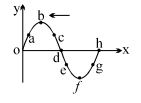
The figure represents the instantaneous picture of a transverse harmonic wave traveling along the negative $x$-axis. Choose the correct alternative $(s)$ related to the movement of the nine points shown in the figure.  The points moving with maximum velocity is/are
  • A
    $b$
  • B
    $h$
  • C
    $d$
  • both $(B)$ and $(C)$

Answer

Correct option: D.
both $(B)$ and $(C)$
d

Need a full question paper?

Generate a complete, print-ready paper with questions like this in minutes — across 16+ boards, with answer keys.

Start Generating Free

Similar questions

A fly wheel rotating about fixed axis has a kinetic energy of $360\; joule$ when its angular speed is $30\; radian/sec$. The moment of inertia of the wheel about the axis of rotation is ......$kg\,m^2$
Which condition is true for an ideal Carnot engine which have 100% efficiency?
A particle is thrown with a speed $u$ at an angle $\theta$ with the horizontal. When the particle makes an angle $\phi$ with the horizontal, its speed changes to $v$, where
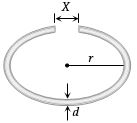
A cylindrical metal rod of length $L‌‌_0$ is shaped into a ring with a small gap as shown. On heating the system
If a particle moves from point $P (2,3,5)$ to point $Q (3,4,5)$. Its displacement vector be
The deceleration experienced by a moving motor boat, after its engine is cut-off is given by $\frac{{dv}}{{dt}} =  - k{v^3}$ , where $k$ is constant. If $v_0$ is the magnitude of the velocity at cut-off, the magnitude of the velocity at a time $t$ after the cut-off is
Two spheres made of same substance have diameters in the ratio $1 : 2.$ Their thermal capacities are in the ratio of
Heat is being supplied at a constant rate to a sphere of ice which is melting at the rate of $0.1 \,\,gm/sec$. It melts completely in $100\,\,sec$. The rate of rise of temperature thereafter will be ........$^oC/\sec$ (Assume no loss of heat.)
Unlike a laboratory sonometer, a stringed instrument is seldom plucked in the middle. Supposing a sitar string is plucked at about $\frac{1}{4}$th of its length from the end. The most prominent harmonic would be
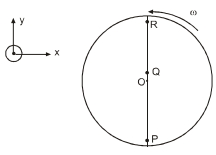
Consider a disc rotating in the horizontal plane with a constant angular speed $\omega$ about its centre $O$. The disc has a shaded region on one side of the diameter and an unshaded region on the other side as shown in the figure. When the disc is in the orientation as shown, two pebbles $P$ and $Q$ are simultaneously projected at an angle towards $R$. The velocity of projection is in the $y$-z plane and is same for both pebbles with respect to the disc. Assume that $(i)$ they land back on the disc before the disc completed $\frac{1}{8}$ rotation. $(ii)$ their range is less than half disc radius, and $(iii)$ $\omega$ remains constant throughout. Then