A block of mass $5\, kg$ is on a rough horizontal surface and is at rest. Now a force of $24\, N $is imparted to it with negligible impulse. If the coefficient of kinetic friction is $0.4$ and $g = 9.8\,m/{s^2}$, then the acceleration of the block is ........ $m/s^2$
Medium


Download our appand get started for free
Experience the future of education. Simply download our apps or reach out to us for more information. Let's shape the future of learning together!No signup needed.*
Similar Questions
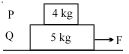
- 1The coefficient of friction between $4kg$ and $5\, kg$ blocks is $0.2$ and between $5kg$ block and ground is $0.1$ respectively. Choose the correct statementsView Solution
- 2A cyclist is travelling with velocity $v$ on a curved road of radius $R$. The angle $\theta$ through which the cyclist leans inwards is given byView Solution
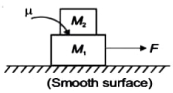
- 3The maximum value of $F$ which can be applied on the system shown in figure so that both blocks move together with same acceleration is ..........View Solution
- 4An unbanked curve has a radius of $60\,m$. The maximum speed at which a car can make a turn if the coefficient of static friction is $0.75$, is ...... $m/s$View Solution
- 5A box of mass $m\, kg$ is placed on the rear side of an open truck accelerating at $4\, m/s^2$. The coefficient of friction between the box and the surface below it is $0.4$. The net acceleration of the box with respect to the truck is zero. The value of $m$ is :- $[g = 10\,m/s^2]$View Solution
- 6A rod $(AB)$ is attached to a fixed point $(C)$ using a light rope $(AC)$. The other end of the rod $(B)$ is sitting on ice with negligible friction and the system is in stationary position. Which of the following can be the equilibrium configuration of this system?View Solution
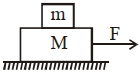
- 7Two blocks $( m =0.5\, kg$ and $M =4.5\, kg$ ) are arranged on a horizontal frictionless table as shown in figure. The coefficient of static friction between the two blocks is $\frac{3}{7} .$ Then the maximum horizontal force that can be applied on the larger block so that the blocks move together is ......... $N.$ (Round off to the Nearest Integer) [Take g as $9.8\, ms ^{-2}$ ]View Solution
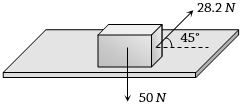
- 8A body of weight $50 \,N$ placed on a horizontal surface is just moved by a force of $28.2\, N$. The frictional force and the normal reaction areView Solution
- 9An army vehicle of mass $1000\, kg$ is moving with a velocity of $10 \,m/s$ and is acted upon by a forward force of $1000\, N$ due to the engine and a retarding force of $500 \,N$ due to friction. ........... $m/s$ will be its velocity after $10\, s$View Solution
- 10A conveyor belt is moving at a constant speed of $2\, ms^{-1}$. A box is gently dropped on it. The coefficient of friction between them is $\mu = 0.5$. The distance that the box will move relative to belt before coming to rest on it, (taking $g = 10\, ms^{-2}$) is ........ $m$.View Solution