MCQ
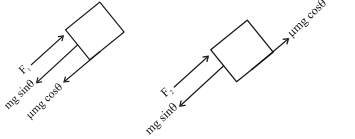
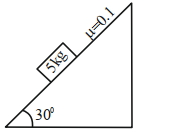
A block of mass $5 \mathrm{~kg}$ is placed on a rough inclined surface as shown in the figure.If $\vec{F}_1$ is the force required to just move the block up the inclined plane and $\vec{F}_2$ is the force required to just prevent the block from sliding down, then the value of $\left|\vec{F}_1\right|-\left|\vec{F}_2\right|$ is : [Use $g=10 \mathrm{~m} / \mathrm{s}^2$ ]
  • A
    $25 \sqrt{3} \mathrm{~N}$
  •  $5 \sqrt{3} \mathrm{~N}$
  • C
     $\frac{5 \sqrt{3}}{2} \mathrm{~N}$
  • D
    $10 \mathrm{~N}$

Answer

Correct option: B.
 $5 \sqrt{3} \mathrm{~N}$
b
$\mathrm{f}_{\mathrm{K}}=\mu \mathrm{mg} \cos \theta$

$=0.1 \times \frac{50 \times \sqrt{3}}{2}$

$=2.5 \sqrt{3} \mathrm{~N}$

${F}_1=\mathrm{mg} \sin \theta+\mathrm{f}_{\mathrm{K}} $

$=25+2.5 \sqrt{3}$

$\mathrm{F}_2=\mathrm{mg} \sin \theta-\mathrm{f}_{\mathrm{K}}$

$\quad=25-2.5 \sqrt{3}$

$\therefore \mathrm{F}_1-\mathrm{F}_2=5 \sqrt{3} \mathrm{~N}$

Need a full question paper?

Generate a complete, print-ready paper with questions like this in minutes — across 16+ boards, with answer keys.

Start Generating Free

Similar questions

Let $l$ be the moment of inertia of an uniform square plate about an axis $AB$ that passes through its centre and is parallel to two of its sides. $CD$ is a line in the plane of the plate that passes through the centre of the plate and makes an angle $\theta $ with $AB$. The moment of inertia of the plate about the axis $CD$ is then equal to 
A ring is rolling on an inclined plane. The ratio of the linear and rotational kinetic energies will be
If the earth suddenly shrinks to $\frac{1}{64}$ th of its original volume with its mass remaining the same, the period of rotation of earth becomes $\frac{24}{ x } h$. The value of $x$ is $.......$
Dimensions of pair are same. Identify the pair
If an ideal gas is compressed isothermally then
A wire is suspended from the ceiling and stretched under the action of a weight F suspended from its other end. The force exerted by the ceiling on it is equal and opposite to the weight.
  1. Tensile stress at any cross section $A$ of the wire is $F/ A.$
  2. Tensile stress at any cross section is zero.
  3. Tensile stress at any cross section $A$ of the wire is $2F/ A.$
  4. Tension at any cross section $A$ of the wire is $F.$
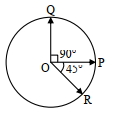
Three vectors $\overrightarrow{\mathrm{OP}}, \overrightarrow{\mathrm{OQ}}$ and $\overrightarrow{\mathrm{OR}}$ each of magnitude $A$ are acting as shown in figure. The resultant of the three vectors is $A \sqrt{x}$. The value of $x$ is. . . . . . . . .
In an experiment of determine the Young's modulus of wire of a length exactly $1\; m$, the extension in the length of the wire is measured as $0.4\,mm$ with an uncertainty of $\pm 0.02\,mm$ when a load of $1\,kg$ is applied. The diameter of the wire is measured as $0.4\,mm$ with an uncertainty of $\pm 0.01\,mm$. The error in the measurement of Young's modulus $(\Delta Y)$ is found to be $x \times 10^{10}\,Nm ^{-2}$. The value of $x$ is

$\left[\right.$ Take $\left.g =10\,m / s ^{2}\right]$

A person in a lift is holding a water jar, which has a small hole at the lower end of its side. When the lift is at rest, the water jet coming out of the hole hits the floor of the lift at a distance $d$ of $1.2 \ m$ from the person. In the following, state of the lift's motion is given in List - $I$ and the distance where the water jet hits the floor of the lift is given in List - $II$. Match the statements from List - $I$ with those in List- $II$ and select the correct answer using the code given below the lists.
 List - $I$  List - $II$
$P.\quad$ Lift is accelerating vertically up. $1.\quad$ $d=1.2 \ m$
$Q.\quad$ Lift is accelerating vertically down with an accelerating less than the gravitational acceleration. $2.\quad$ $d>1.2 \ m$
$R.\quad$ List is moving vertically up with constant Speed $3.\quad$ $d<1.2 \ m$
$S.\quad$ Lift is falling freely. $4.\quad$ No water leaks out of the jar
The product of resistivity and conductivity of a cylindrical conductor depends on: