MCQ
If an ideal gas is compressed isothermally then
  • A
    No work is done against gas
  • Heat is relased by the gas
  • C
    The internal energy of gas will increase
  • D
    Pressure does not change

Answer

Correct option: B.
Heat is relased by the gas
b
(b)In isothermal process, heat is released by the gas to maintain the constant temperature.

Need a full question paper?

Generate a complete, print-ready paper with questions like this in minutes — across 16+ boards, with answer keys.
Start Generating Free

Similar questions

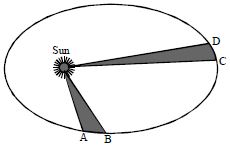
The fig. shows the motion of a planet around the un in an elliptical orbit with sun at the  focus. The shaded areas can be assumed to be equal. If $t_1$ and $t_2$ represent the  time taken for the planet to move from $A$ to $B$ and $C$ to $D$ respectively, then
A ball moving with velocity $2 \,m/s$ collides head on with another stationary ball of double the mass. If the coefficient of restitution is $0.5,$ then their velocities after collision will be
Given below are two statements :

$Statement$ $(I)$ :Viscosity of gases is greater than that of liquids.

$Statement$ $(II)$ : Surface tension of a liquid decreases due to the presence of insoluble impurities.

In the light of the above statements, choose the most appropriate answer from the options given below :
The angular velocity of a particle rotating in a circular orbit $100$ times per minute is
Who proposed the wave theory of light?
A particle is released from height $\mathrm{S}$ from the surface of the Earth. At a certain height its kinetic energy is three times its potential energy. The height from the surface of earth and the speed of the particle at that instant are respectively :
A ball projected from ground at an angle of $45^o$ just clears a wall in front. If point of projection is $4\,m$ from the foot of wall and ball strikes the ground at a distance of $6\,m$ on the other side of the wall, the height of the walI is  ........ $ m$
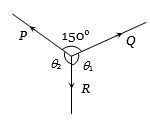
$P, Q$ and $R$ are three coplanar forces acting at a point and are in equilibrium. Given $P = 1.9318 \,kg \,wt$, $\sin {\theta _1} = 0.9659$, the value of $R$ is ( in kg wt)
Third harmonic frequency in open argonpipe:
The following bodies are made to roll up (without slipping) the same inclined plane from a horizontal place: $(i)$ a ring of radius $R,\,(ii)$ a solid cylinder of radius $\frac {R}{2}$  nd $(iii)$ a solid sphere of radius $\frac {R}{4}.$ If, in each case, the speed of the center of mass at bottom of the incline is same, the ratio of the maximum heights they climb is