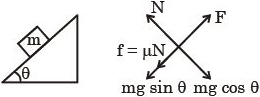
A block of mass $m$ is lying on an inclined plane. The coefficient of friction between the plane and the block is $\mu$. The force $(F_1)$ required to move the block up the inclined plane will be
Easy


Download our appand get started for free
Experience the future of education. Simply download our apps or reach out to us for more information. Let's shape the future of learning together!No signup needed.*
Similar Questions
- 1View SolutionWhen a bicycle is in motion, the force of friction exerted by the ground on the two wheels is such that it acts
- 2A uniform rope of length l lies on a table. If the coefficient of friction is $\mu $, then the maximum length ${l_1}$ of the part of this rope which can overhang from the edge of the table without sliding down isView Solution
- 3If for an inclined plane coefficient of static friction is ${\mu _s} = \frac{3}{4}$, then for the inclined plane angle of repose will be ........ $^o$View Solution
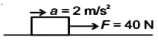
- 4A block of mass $10 \,kg$. moving with acceleration $2 \,m / s ^2$ on horizontal rough surface is shown in figure The value of coefficient of kinetic friction is ...........View Solution
- 5The upper half of an inclined plane of inclination $\theta$ is perfectly smooth while the lower half is rough. A body starting from the rest at top comes back to rest at the bottom if the coefficient of friction for the lower half is given byView Solution
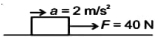
- 6A block of mass $10 \,kg$. moving with acceleration $2 \,m / s ^2$ on horizontal rough surface is shown in figure The value of coefficient of kinetic friction is ...........View Solution
- 7$Assertion$ : Angle of repose is equal to the angle of limiting friction.View Solution
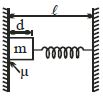
$Reason$ : When the body is just at the point of motion, the force of friction in this stage is called limiting friction. - 8A block of mass $m$ is pressed against a vertical surface by a spring of unstretched length $l$ . If the coefficient of friction between the block and the surface is $\mu $. Choose the correct statement.View Solution
- 9A body of weight $64\, N$ is pushed with just enough force to start it moving across a horizontal floor and the same force continues to act afterwards. If the coefficients of static and dynamic friction are $0.6$ and $0.4$ respectively, the acceleration of the body will be (Acceleration due to gravity $= g$)View Solution
- 10A car moves along a circular track of radius $R$ banked at an angle of $30^o$ to the horizontal. The coefficient of static friction between the wheels and the track is $\mu$ . The maximum speed with which the car can move without skidding out isView Solution