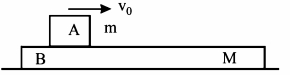
$A$ block of mass $M$ is placed on $a$ horizontal surface and it is tied with an inextensible string to $a$ block of mass, as shown in figure. A block of mass $m_0$ is also placed on $M$ If $\mu < \mu_{min}$ (the minimum friction required to keep the block $m$ stationary), then the downward acceleration of $m$ is

Advanced
Download our app for free and get started

Download our appand get started for free
Experience the future of education. Simply download our apps or reach out to us for more information. Let's shape the future of learning together!No signup needed.*
Similar Questions
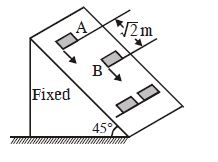
- 1Two blocks $A$ and $B$ of equal masses are sliding down along straight parallel lines on an inclined plane of $45^o$ . Their coefficients of kinetic friction are $\mu _A = 0.2$ and $\mu _B = 0.3$ respectively. At $t = 0$ , both the blocks are at rest and block $A$ is $\sqrt 2$ metre behind block $B$ . The time and distance from the initial position where the front faces of the blocks come in line on the inclined plane as shown in figure. (Use $g = 10\, ms^{-2}$ )View Solution
- 2View SolutionIt is easier to roll a barrel than pull it along the road. This statement is
- 3A $60\, kg$ body is pushed with just enough force to start it moving across a floor and the same force continues to act afterwards. The coefficient of static friction and sliding friction are $0.5$ and $0.4$ respectively. The acceleration of the body is ........ $m/{s^2}$View Solution
- 4$A$ block of mass $M$ is placed on $a$ horizontal surface and it is tied with an inextensible string to $a$ block of mass, as shown in figure. A block of mass $m_0$ is also placed on $M$ The minimum value of $\mu$ between the block $M$ and $m_0$ (taking horizontal surface frictionless) for which all the three blocks move together, isView Solution
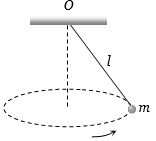
- 5A point mass $m$ is suspended from a light thread of length $l$, fixed at $O$, is whirled in a horizontal circle at constant speed as shown. From your point of view, stationary with respect to the mass, the forces on the mass areView Solution
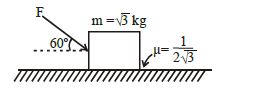
- 6What is the maximum value of the force $F$ such that the block shown in the arrangement does not move ....... $N$View Solution
- 7In the given figure the acceleration of $M$ is $(g = 10 \,ms^{-2})$View Solution
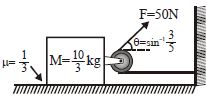
- 8View SolutionA body is revolving with a constant speed along a circle. If its direction of motion is reversed but the speed remains the same, then which of the following statement is true
- 9A car of mass $1000\, kg$ negotiates a banked curve of radius $90\, m$ on a frictionless road. If the banking angle is $45^o $, the speed of the car is ....... $ms^{-1}$View Solution
- 10The masses of blocks A and B are $m$ and $M$ respectively. Between $A$ and $B$, there is a constant frictional force $F$ and $B$ can slide on a smooth horizontal surface. A is set in motion with velocity while $B$ is at rest. What is the distance moved by A relative to $B$ before they move with the same velocity?View Solution