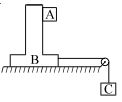
$A$ block of mass $M$ is placed on $a$ horizontal surface and it is tied with an inextensible string to $a$ block of mass, as shown in figure. A block of mass $m_0$ is also placed on $M$ The minimum value of $\mu$ between the block $M$ and $m_0$ (taking horizontal surface frictionless) for which all the three blocks move together, is

Difficult
Download our app for free and get started

Download our appand get started for free
Experience the future of education. Simply download our apps or reach out to us for more information. Let's shape the future of learning together!No signup needed.*
Similar Questions
- 1A $60\, kg$ body is pushed with just enough force to start it moving across a floor and the same force continues to act afterwards. The coefficient of static friction and sliding friction are $0.5$ and $0.4$ respectively. The acceleration of the body is ........ $m/{s^2}$View Solution
- 2In the arrangement shown in the figure, mass of the block $B$ and $A$ is $2m$ and $m$ respectively. Surface between $B$ and floor is smooth. The block $B$ is connected to the block $C$ by means of a string pulley system. If the whole system is released, then find the minimum value of mass of block $C$ so that block $A$ remains stationary $w.r.t. B$. Coefficient of friction between $A$ and $B$ is $\mu$View Solution
- 3$Assertion$ : Angle of repose is equal to the angle of limiting friction.View Solution
$Reason$ : When the body is just at the point of motion, the force of friction in this stage is called limiting friction. - 4A block of mass $M$ is sliding down the plane. Coefficient of static friction is $\mu _s$ and kinetic friction is $\mu _k.$ Then friction force acting on the block is :-View Solution
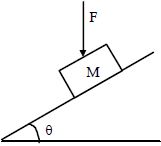
- 5A force of $750 \,N$ is applied to a block of mass $102\, kg$ to prevent it from sliding on a plane with an inclination angle $30°$ with the horizontal. If the coefficients of static friction and kinetic friction between the block and the plane are $0.4 $ and $0.3$ respectively, then the frictional force acting on the block is...... $N$View Solution
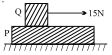
- 6$A$ long plank $P$ of the mass $5\, kg$ is placed on a smooth floor. On $P$ is placed a block $Q$ of mass $2\, kg$. The coefficient of friction between $P$ and $Q$ is $0.5$. If a horizontal force $15N$ is applied to $Q$, as shown, and you may take $g$ as $10N/kg.$View Solution
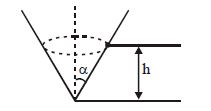
- 7A particle is describing circular motion in a horizontal plane in contact with the smooth inside surface of a fixed right circular cone with its axis vertical and vertex down. The height of the plane of motion above the vertex is $h$ and the semivertical angle of the cone is $\alpha $ . The period of revolution of the particleView Solution
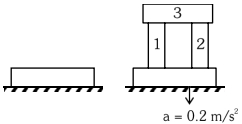
- 8A steel block of $10\, {kg}$ rests on a horizontal floor as shown. When three iron cylinders are placed on it as shown, the block and cylinders go down with an acceleration $0.2\, {m} / {s}^{2}$. The normal reaction ${R}$ by the floor if mass of the iron cylinders are equal and of $20\, {kg}$ each, is .....$N.$ [Take ${g}=10\, {m} / {s}^{2}$ and $\mu_{{s}}=0.2$ ]View Solution
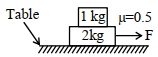
- 9The coefficient of static friction between two blocks is $0.5$ and the table is smooth. The maximum horizontal force that can be applied to move the blocks together is $\ldots \ldots . N$. (take $\left.g=10\, {ms}^{-2}\right)$View Solution
- 10A block of mass $m$ is placed on a surface with a vertical coss section given by $y = \frac{{{x^3}}}{6}$ . If the coefficient of friction is $0.5$, the maximum height above the ground at which the block can be placed without slipping isView Solution