MCQ
$A$ block of mass $M$ is placed on $a$ horizontal surface and it is tied with an inextensible string to $a$ block of mass, as shown in figure. A block of mass $m_0$ is also placed on $M$ If there is no friction between any two surfaces, then
  • A
    the downward acceleration of the block $m$ is $\frac{{mg}}{{m + {m_0} + M}}$
  • the acceleration of $m_0$ is zero
  • C
    If the tension in the string is $T$ then $Mg < T < mg$
  • D
    all the above

Answer

Correct option: B.
the acceleration of $m_0$ is zero
b

Need a full question paper?

Generate a complete, print-ready paper with questions like this in minutes — across 16+ boards, with answer keys.

Start Generating Free

Similar questions

A tuning fork $A$ of unknown frequency produces $5\, beats/s$ with a fork of known frequency $340\, Hz$. When fork $A$ is filed, the beat frequency decreases to $2\, beats/s.$ What is the frequency of fork $A$ ? (in $Hz$)
Internal energy of the working fluid after completing the Carnot cycle:
A force of $98\, N$ is required to just start moving a body of mass $100\, kg$ over ice. The coefficient of static friction is
Given that $\overrightarrow A + \overrightarrow B = \overrightarrow C $and that $\overrightarrow C $ is $ \bot $ to $\overrightarrow A $. Further if $|\overrightarrow A |\, = \,|\overrightarrow C |,$then what is the angle between $\overrightarrow A $ and $\overrightarrow B $
A block slides down a smooth inclined plane when released from the top, while another falls freely from the same point
A tunning fork produces $5\, beats/sec$ when the length of a sonometer wire is either $1\, m$ or $1.05\, m$. Calculate the frequency of tunning fork  .... $Hz$
The maximum height reached by a projectile is $64 \mathrm{~m}$. If the initial velocity is halved, the new maximum height of the projectile is_________.$\mathrm{m}$.
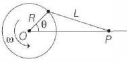
One end of a rod of length $L=1 \,m$ is fixed to a point on the circumference of a wheel of radius $R=1 / \sqrt{3} \,m$. The other end is sliding freely along a straight channel passing through the centre $O$ of the wheel as shown in the figure below. The wheel is rotating with a constant angular velocity $\omega$ about $O$. The speed of the sliding end $P$, when $\theta=60^{\circ}$ is
What is the shape of the graph between the speed and kinetic energy of a body
A bubble has surface tension $S$. The ideal gas inside the bubble has ratio of specific heats $\gamma=\frac{5}{3}$. The bubble is exposed to the atmosphere and it always retains its spherical shape. When the atmospheric pressure is $P_{a 1}$, the radius of the bubble is found to be $r_1$ and the temperature of the enclosed gas is $T_1$. When the atmospheric pressure is $P_{a 2}$, the radius of the bubble and the temperature of the enclosed gas are $r_2$ and $T_2$, respectively.

Which of the following statement($s$) is(are) correct?

$(A)$ If the surface of the bubble is a perfect heat insulator, then $\left(\frac{r_1}{r_2}\right)^5=\frac{P_{a 2}+\frac{2 S}{r_2}}{P_{a 1}+\frac{2 S}{r_1}}$

$(B)$ If the surface of the bubble is a perfect heat insulator, then the total internal energy of the bubble including its surface energy does not change with the external atmospheric pressure.

$(C)$ If the surface of the bubble is a perfect heat conductor and the change in atmospheric temperature is negligible, then $\left(\frac{r_1}{r_2}\right)^3=\frac{P_{a 2}+\frac{4 S}{r_2}}{P_{a 1}+\frac{4 S}{r_1}}$.

$(D)$ If the surface of the bubble is a perfect heat insulator, then $\left(\frac{T_2}{T_1}\right)^{\frac{5}{2}}=\frac{P_{a 2}+\frac{4 S}{r_2}}{P_{a 1}+\frac{4 S}{r_1}}$.