MCQ
A block slides down a smooth inclined plane when released from the top, while another falls freely from the same point
  • A
    sliding block will reach the ground first with greater speed
  • B
    freely falling block will reach the ground first with greater speed
  • C
    both the blocks will reach the ground at the same time but with different speeds
  • both the blocks will reach the ground with same speed but the freely falling block first

Answer

Correct option: D.
both the blocks will reach the ground with same speed but the freely falling block first
d
In case of sliding motion on an inclined plane,

${\mathrm{h}=\mathrm{s}=\frac{1}{2} \mathrm{g} \sin \theta \mathrm{t}^{2}}$

${\text { or } \mathrm{t}=\mathrm{t_s}=\frac{1}{\sin \theta} \sqrt{\frac{2 \mathrm{h}}{\mathrm{g}}}}$

${\text { and } \mathrm{u}_{\mathrm{s}}=\sqrt{2 \mathrm{gh}}=\sqrt{2(\mathrm{g} \sin \theta) \mathrm{s}}}$

while in case of free fall,

$\mathrm{t}_{\mathrm{F}}=\sqrt{\frac{2 \mathrm{h}}{\mathrm{g}}}$ and $\mathrm{u}_{\mathrm{F}}=\sqrt{2 \mathrm{gh}}$

$\frac{\mathrm{t}_{\mathrm{F}}}{\mathrm{t}_{\mathrm{s}}}=\sin \theta<1 \mathrm{i.e.}, \mathrm{t}_{\mathrm{F}}<\mathrm{t}_{\mathrm{s}}$

i.e., falling body reaches the ground first.

Also $\quad \frac{\mathrm{u}_{\mathrm{F}}}{\mathrm{u}_{\mathrm{s}}}=1,$ i.e., $\mathrm{u}_{\mathrm{F}}=\mathrm{u}_{\mathrm{s}}$

i.e., both reach the ground with same speed (not velocity as for falling body direction is vertical while for sliding body along the plane downwards).
Need a full question paper?

Generate a complete, print-ready paper with questions like this in minutes — across 16+ boards, with answer keys.

Start Generating Free

Similar questions

A bullet is fired with a speed of $1000\,\,m/\sec $ in order to hit a target 100 m away. If $g = 10\,\,m/{s^2}$, the gun should be aimed
A simple pendulum oscillates in air with time period $T$ and amplitude $A$. As the time passes
A satellite of mass $\mathrm{m}$ is launched vertically upwards with an initial speed $u$ from the surface of the earth. After it reaches height $\mathrm{R}$ ($R =$ radius of the earth), it ejects a rocket of mass $\frac{\mathrm{m}}{10}$ so that subsequently the satellite moves in a circular orbit. The kinetic energy of the rocket is

($G$ is the gravitational constant: $\mathrm{M}$ is the mass of the earth)

One mole of an ideal monoatomic gas at temperature $T_0$ expands slowly according to the law $P/V$ = constant. If the final temperature is $2 \,\,T_0$, heat supplied to the gas is :
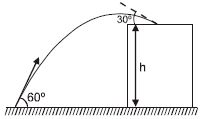
A stone projected at an angle of $60^o$ from the ground level strikes at an angle of $30^o$ on the roof of a building of height $‘h= 30\,m ’$ . Find the speed of projection(in $m/s$ ) of the stone
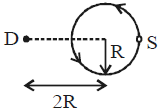
A whistle $S$ of frequency $f$ revolves in a circle of radius $R$ at a constant speed $v$. What is the ratio of largest and smallest frequency detected by a detector $D$ at rest at a distance $2R$ from the centre of circle as shown in figure ? (take $c$ as speed of sound)
Air of density $1.2\,kg\,m^{-3}$ is blowing across the horizontal Wings of an aeroplane in such a way that its speeds above and below the wings are $150\,ms^{-1}$ and $100\,ms^{-1}$, respectively. The pressure difference between the upper and lower sides of the Wings, is ........ $Nm^{-2}$
Two ideal polyatomic gases at temperatures $T _{1}$ and $T _{2}$ are mixed so that there is no loss of energy. If $F _{1}$ and $F _{2}, m _{1}$ and $m _{2}, n _{1}$ and $n _{2}$ be the degrees of freedom, masses, number of molecules of the first and second gas respectively, the temperature of mixture of these two gases is
A body $A$ starts from rest with an acceleration $a_1$ . After $2\ seconds$ , another body $B$ starts from rest with an acceleration $a_2$ . If they travel equal distance in the $5th\ second$ , after the start of $A$ , then the ratio $a_1$ : $a_2$ is equal to
When two sound waves with a phase difference of $\pi /2$, and each having amplitude $A$ and frequency $\omega $, are superimposed on each other, then the maximum amplitude and frequency of resultant wave is