MCQ
$A$ block of mass $M$ is placed on $a$ horizontal surface and it is tied with an inextensible string to $a$ block of mass, as shown in figure. A block of mass $m_0$ is also placed on $M$ The minimum value of $\mu$ between the block $M$ and $m_0$ (taking horizontal surface frictionless) for which all the three blocks move together, is
  • $\frac{m}{{m + {m_0} + M}}$
  • B
    $\frac{m}{{m + M}}$
  • C
    $\frac{{{m_0}}}{{m + {m_0} + M}}$
  • D
    none of these.

Answer

Correct option: A.
$\frac{m}{{m + {m_0} + M}}$
a

Need a full question paper?

Generate a complete, print-ready paper with questions like this in minutes — across 16+ boards, with answer keys.

Start Generating Free

Similar questions

The dimensional formula for the modulus of rigidity is
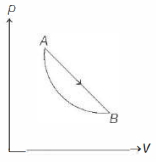
An ideal gas is made to undergo a cycle depicted by the $p-V$ diagram given below. The curved line from $A$ to $B$ is an adiabat.Then,
A rocket has a mass of $100 \,kg$. $90\%$ of this is fuel. It ejects fuel vapours at the rate of $1 \,kg/sec$ with a velocity of $500\, m/sec$ relative to the rocket. It is supposed that the rocket is outside the gravitational field. The initial upthrust on the rocket when it just starts moving upwards  is ......... $N$
The relation between position $( x )$ and time ( $t$ ) are given below for a particle moving along a straight line. Which of the following equation represents uniformly accelerated motion? [where $\alpha$ and $\beta$ are positive constants]
The unification of electromagnetism and optics leads to the:
What is the momentum of a $6.0\ kg$ bowling ball with a velocity of $2.2\ m/ s?$
A body is started from rest with acceleration $2\ m/ s^2$ till it attains the maximum velocity then retards to rest with $3\ m/ s^2$. If total time taken is $10$ second then maximum speed attained is:
Which of the four arrangements in the figure correctly shows the vector addition of two forces $\overrightarrow {{F_1}} $ and $\overrightarrow {{F_2}} $ to yield the third force $\overrightarrow {{F_3}} $
A driver takes $0.20s$ to apply the brakes after he sees a need for it. This is called the reaction time of the driver. If he is driving a car at a speed of $54km/ h$ and the brakes causes a deceleration of $6.0 m/ s^2$, find the distance traveled by the car after he sees the need to put the brakes on.
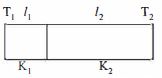
One end of a thermally insulated rod is kept at a temperature $T_1$ and the other at $T_2$ . The rod is composed of two sections of length $l_1$ and $l_2$ and thermal conductivities $K_1$ and $K_2$ respectively. The temperature at the interface of the two section is