MCQ
An ideal gas is made to undergo a cycle depicted by the $p-V$ diagram given below. The curved line from $A$ to $B$ is an adiabat.Then,
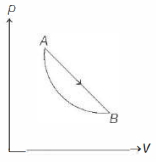
  • the efficiency of this cycle is given by unity as on heat is released during the cycle
  • B
    heat is absorbed in the upper part of the straight line path and released in the lower part
  • C
    if $T_1$ and $T_2$ are the maximum and minimum temperatures reached during the cycle, then the efficiency is given by $1-\frac{T_2}{T_1}$
  • D
    the cycle can only be carried out in the reverse of the direction shown in above figure
Answer

Correct option: A.
the efficiency of this cycle is given by unity as on heat is released during the cycle
a
(a)

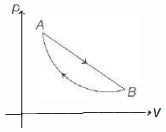
$A$ to $B$ is an expansion process and $B$ to $A$ is adiabatic compression.

So, heat is absorbed in process $A$ to $B$ and is released in process $B$ to $A$.

Need a full question paper?

Generate a complete, print-ready paper with questions like this in minutes — across 16+ boards, with answer keys.

Start Generating Free

Similar questions

Two identical circular loops are moving with same kinetic energy one rolls $\&$ other slides. The ratio of their speed is 
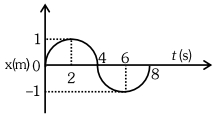
The $x-t$ graph of a particle performing simple harmonic motion is shown in the figure. The acceleration of the particle at $t=2 s$ is :
A plane wave $y=A\,\, sin\,\, \omega \left( {t - \frac{x}{v}} \right)$ undergo a normal incidence on a plane boundary separating medium $M_1$ and $M_2$ and splits into a reflected and transmitted wave having speeds $v_1$ and $v_2$ then
A bird flies for $4 \,s$ with a velocity of $|\;t - 2|\;m/s$ in a straight line, where $t$ is time in seconds. It covers a distance of .........$m$
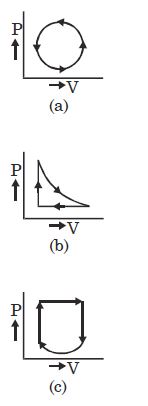
What is the nature of change in internal energy in the following three thermodynamical processes shown in figure
The velocity of sound in a gas. in which two wavelengths $4.08\,m$ and $4.16\,m$ produce $40$ beats in $12\,s$, will be ..............$ms ^{-1}$
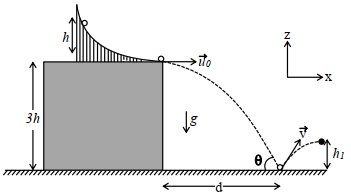
A slide with a frictionless curved surface, which becomes horizontal at its lower end,, is fixed on the terrace of a building of height $3 h$ from the ground, as shown in the figure. A spherical ball of mass $\mathrm{m}$ is released on the slide from rest at a height $h$ from the top of the terrace. The ball leaves the slide with a velocity $\vec{u}_0=u_0 \hat{x}$ and falls on the ground at a distance $d$ from the building making an angle $\theta$ with the horizontal. It bounces off with a velocity $\overrightarrow{\mathrm{v}}$ and reaches a maximum height $h_l$. The acceleration due to gravity is $g$ and the coefficient of restitution of the ground is $1 / \sqrt{3}$. Which of the following statement($s$) is(are) correct?

($AV$) $\vec{u}_0=\sqrt{2 g h} \hat{x}$ ($B$) $\vec{v}=\sqrt{2 g h}(\hat{x}-\hat{z})$  ($C$) $\theta=60^{\circ}$  ($D$) $d / h_1=2 \sqrt{3}$

If $\overrightarrow{ P }=3 \hat{ i }+\sqrt{3} \hat{ j }+2 \hat{ k }$ and $\overrightarrow{ Q }=4 \hat{ i }+\sqrt{3} \hat{ j }+2.5 \hat{ k }$ then, The unit vector in the direction of $\overrightarrow{ P } \times \overrightarrow{ Q }$ is $\frac{1}{x}(\sqrt{3} \hat{i}+\hat{j}-2 \sqrt{3} \hat{k})$. The value of $x$ is
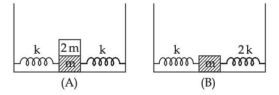
In figure $(A),$ mass ' $2 m$ ' is fixed on mass ' $m$ ' which is attached to two springs of spring constant $k$. In figure $(B),$ mass ' $m$ ' is attached to two spring of spring constant ' $k$ ' and ' $2 k$ '. If mass ' $m$ ' in $(A)$ and $(B)$ are displaced by distance ' $x$ ' horizontally and then released, then time period $T_{1}$ and $T_{2}$ corresponding to $(A)$ and $(B)$ respectively follow the relation.
One mole of an ideal monatomic gas requires $210 \,J$ heat to raise the temperature by $10\, K$, when heated at constant temperature. If the same gas is heated at constant volume to raise the temperature by $10\, K$ then heat required is  ....... $J$