MCQ
A block of mass $m$ is placed on a smooth horizontal surface. A force making an angle $\theta$ with the horizontal starts acting on the block. The magnitude of the force is constant but its direction with the horizontal changes as $\theta = a+ bs$, where $a$ and $b$ are constants and $s$ is the distance covered by the block. If $|F| = 2mb$, find the velocity of the block as function of the angle $\theta$ .
  • A
    $v = 4{(\cos \theta \, + \,\cos a)^{\frac{1}{2}}}$
  • $v = 2{(\sin \theta \, - \sin a)^{\frac{1}{2}}}$
  • C
    $v = 4{(\sin \theta \, - \sin a)^{\frac{1}{2}}}$
  • D
    $v = 2{(\cos \theta \, + \,\cos a)^{\frac{1}{2}}}$
Answer

Correct option: B.
$v = 2{(\sin \theta \, - \sin a)^{\frac{1}{2}}}$
b
By Newton's second law of motion.

$\mathrm{F} \cos \theta=\mathrm{ma}$

$\Rightarrow 2 \mathrm{mb} \cos (\mathrm{a}+\mathrm{bs})=\mathrm{m} \frac{\mathrm{dv}}{\mathrm{dt}}$

$\Rightarrow \frac{d v}{d t}=2 b \cos (a+b s)$

$\Rightarrow v \frac{d v}{d s}=2 b \cos (a+b s)$

$\Rightarrow \int_{0}^{v} v d v=2 b \int_{0}^{s} \cos (a+b s) d s$

$\Rightarrow\left[\frac{v^{2}}{2}\right]_{0}^{v}=\left[\frac{2 b \sin (a+b s)}{b}\right]_{0}^{s}$

$\Rightarrow v^{2}=u[\sin (a+b s)-\sin a]$

$\Rightarrow \mathrm{v}=2(\sin \theta-\sin \mathrm{a})^{1 / 2}(\because \theta=\mathrm{a}+\mathrm{bs})$

Need a full question paper?

Generate a complete, print-ready paper with questions like this in minutes — across 16+ boards, with answer keys.

Start Generating Free

Similar questions

Two free point charges $+q$ and $+4q$ are a distance $R$ apart. $A$ third charge is so  placed that the entire system is in equilibrium. Then the third charge is :-
Interference fringes are observed on a screen by illuminating two thin slits $1 \,mm$ apart with a light source $(\lambda=632.8\, nm )$. The distance between the screen and the slits is $100\, cm$. If a bright fringe is observed on a screen at a distance of $1.27\, mm$ from the central bright fringe, then the path difference between the waves, which are reaching this point from the slits is close to$....\mu m$
The period of oscillation of a mass $M$ suspended from a spring of negligible mass is $T$. If along with it another mass $M$ is also suspended , the period of oscillation will now be
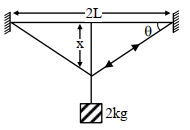
A wire of cross sectional area $A$, modulus of elasticity $2 \times 10^{11} \mathrm{Nm}^{-2}$ and length $2 \mathrm{~m}$ is stretched between two vertical rigid supports. When a mass of $2 \mathrm{~kg}$ is suspended at the middle it sags lower from its original position making angle $\theta=\frac{1}{100}$ radian on the points of support. The value of $A$ is. . . . . .  $\times 10^{-4} \mathrm{~m}^2$ (consider $\mathrm{x}<\mathrm{L}$ ).

(given: $\mathrm{g}=10 \mathrm{~m} / \mathrm{s}^2$ )

A bimetallic strip consists of metals $A$ and $B$. It is mounted rigidly as shown. The metal $A$ has higher coefficient of expansion compared to that of metal $B$. When the bimetallic strip is placed in a cold both, it will :
The region of the atmosphere above troposphere is known as
The top of a water tank is open to air and its water level is maintained. It is giving out $0.74\,m^3$ water per minute through a circular opening of $2\,cm$ radius in its wall. The depth of the centre of the opening from the level of water in the tank is close to........ $m$
When a satellite going round the earth in a circular orbit of radius $r$ and speed $v$ loses some of its energy, then $r$ and $v$ change as
There are four light-weight-rod samples $A, B, C, D$ separately suspended by threads. A bar magnet is slowly brought near each sample and the following observations are noted

$(i)$  $A$ is feebly repelled

$(ii)$ $B$ is feebly attracted

$(iii)$ $C$ is strongly attracted

$(iv)$ $D$ remains unaffected

Which one of the following is true?

A mass $m$ is suspended by means of two coiled spring which have the same length in unstretched condition as in figure. Their force constant are $k_1$ and $k_2$ respectively. When set into vertical vibrations, the period will be