A wire of cross sectional area $A$, modulus of elasticity $2 \times 10^{11} \mathrm{Nm}^{-2}$ and length $2 \mathrm{~m}$ is stretched between two vertical rigid supports. When a mass of $2 \mathrm{~kg}$ is suspended at the middle it sags lower from its original position making angle $\theta=\frac{1}{100}$ radian on the points of support. The value of $A$ is. . . . . . $\times 10^{-4} \mathrm{~m}^2$ (consider $\mathrm{x}<\mathrm{L}$ ).
(given: $\mathrm{g}=10 \mathrm{~m} / \mathrm{s}^2$ )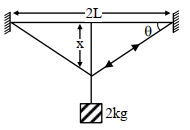
JEE MAIN 2024, Diffcult
Download our app for free and get started
In vertical derection $2 \mathrm{~T} \sin \theta=20$
using small angle approximation $\sin \theta=\theta$
$\theta=\frac{1}{100}$
$\therefore \quad \mathrm{T}=\frac{10}{\theta}$
$T=1000 \mathrm{~N}$
Change in length $\Delta \mathrm{L} \quad=2 \sqrt{\mathrm{x}^2+\mathrm{L}^2}-2 \mathrm{~L}$
$=2 \mathrm{~L}\left[1+\frac{\mathrm{x}^2}{2 \mathrm{~L}^2}-1\right]$
$\Delta \mathrm{L} =\frac{\mathrm{x}^2}{\mathrm{~L}}$
$\therefore$ Modulus of elasticity $=\frac{\text { stress }}{\text { strain }}$
$2 \times 10^{11}=\frac{10^3}{\mathrm{~A} \times \frac{\mathrm{x}^2}{\mathrm{~L}}} \times 2 \mathrm{~L}$
$\therefore \quad \mathrm{A}=1 \times 10^{-4} \mathrm{~m}^2$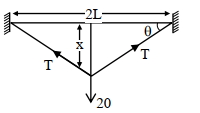

Download our appand get started for free
Experience the future of education. Simply download our apps or reach out to us for more information. Let's shape the future of learning together!No signup needed.*
Similar Questions
- 1What must be the lengths of steel and copper rods at $0^o C$ for the difference in their lengths to be $10\,cm$ at any common temperature? $(\alpha_{steel}=1.2 \times {10^{-5}} \;^o C^{-1})$ and $(\alpha_{copper} = 1.8 \times 10^{-5} \;^o C^{-1})$View Solution
- 2Which of the following curve represents the correctly distribution of elongation $(y)$ along heavy rod under its own weight $L \rightarrow$ length of rod, $x \rightarrow$ distance of point from lower end?View Solution
- 3The Young's modulus of a steel wire of length $6\,m$ and cross-sectional area $3\,mm ^2$, is $2 \times 11^{11}\,N / m ^2$. The wire is suspended from its support on a given planet. A block of mass $4\,kg$ is attached to the free end of the wire. The acceleration due to gravity on the planet is $\frac{1}{4}$ of its value on the earth. The elongation of wire is (Take $g$ on the earth $=10$ $\left.m / s ^2\right):$View Solution
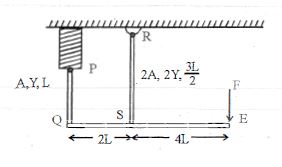
- 4A rigid massless rod of length $6\ L$ is suspended horizontally by means of two elasticrods $PQ$ and $RS$ as given figure. Their area of cross section, young's modulus and lengths are mentioned in figure. Find deflection of end $S$ in equilibrium state. Free end of rigid rod is pushed down by a constant force . $A$ is area of cross section, $Y$ is young's modulus of elasticityView Solution
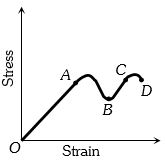
- 5In the below graph, point $B$ indicatesView Solution
- 6A wire is loaded by $6\, kg$ at its one end, the increase in length is $12\, mm.$ If the radius of the wire is doubled and all other magnitudes are unchanged, then increase in length will be ......... $mm$View Solution
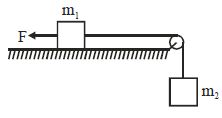
- 7Consider the situation shown in figure. The force $F$ is equal to the $m_2g/2.$ If the area of cross-section of the string is $A$ and its Young's modulus $Y$, find the strain developed in it. The string is light and there is no friction anywhereView Solution
- 8One end of a metal wire is fixed to a ceiling and a load of $2 \mathrm{~kg}$ hangs from the other end. A similar wire is attached to the bottom of the load and another load of $1 \mathrm{~kg}$ hangs from this lower wire. Then the ratio of longitudinal strain of upper wire to that of the lower wire will be____________.View Solution
[Area of cross section of wire $=0.005 \mathrm{~cm}^2$, $\mathrm{Y}=2 \times 10^{11}\ \mathrm{Nm}^{-2}$ and $\left.\mathrm{g}=10 \mathrm{~ms}^{-2}\right]$
- 9A weight of $200 \,kg$ is suspended by vertical wire of length $600.5\, cm$. The area of cross-section of wire is $1\,m{m^2}$. When the load is removed, the wire contracts by $0.5 \,cm$. The Young's modulus of the material of wire will beView Solution
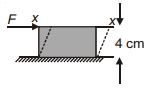
- 10A steel plate of face area $1 \,cm ^2$ and thickness $4 \,cm$ is fixed rigidly at the lower surface. A tangential force $F=10 \,kN$ is applied on the upper surface as shown in the figure. The lateral displacement $x$ of upper surface w.r.t. the lower surface is .............. $m$ (Modulus of rigidity for steel is $8 \times 10^{11} \,N / m ^2$ )View Solution