Question
A block of mass M is pulled along a horizontal surface by applying a force at an angle with horizontal. Coefficient of friction between block and surface is u. If the block travels with uniform velocity, find the work done by this applied force during ú displacement d of the block.
Answer

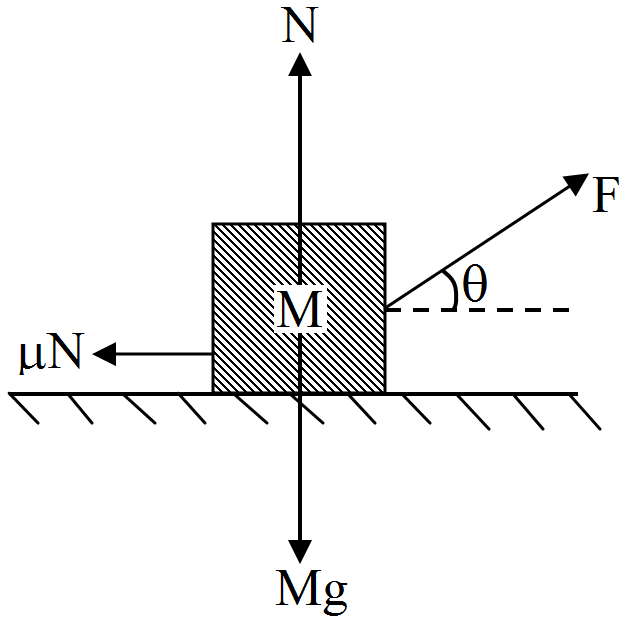
The forces acting on the block are shown in Figure. As the block moves with uniform velocity the forces add up to zero.
$\therefore\text{F}\cos\theta=\mu\text{N}\cdots\text{(i)}$ $\text{F}\sin\theta+\text{N}=\text{mg}\cdots\text{(ii)}$ Eliminating N from equation (i) and (ii), $\text{F}\cos\theta=\mu(\text{Mg}-\text{F}\sin\theta)$ $\text{F}=\frac{\mu\text{Mg}}{\cos\theta+\mu\sin\theta}$ Work done by this force during a displacement d $\text{W}=\text{F}.\text{d}\cos\theta=\frac{\mu\text{Mgd}\cos\theta}{\cos\theta+\mu\sin\theta}$

Need a full question paper?

Generate a complete, print-ready paper with questions like this in minutes — across 16+ boards, with answer keys.

Start Generating Free

Similar questions

It is sometimes heard that inertial frame of reference is only an ideal concept and no such inertial frame actually exists. Comment.
Give the magnitude and direction of the net force acting on a stone of mass 0.1 kg ,
a. just after it is dropped from the window of a stationary train,
b. just after it is dropped from the window of a train running at a constant velocity of $36 km / h$.
c. just after it is dropped from the window of a train accelerating with $1 ms^{-2}$,
d. lying on the floor of a train which is accelerating with $1 ms^{-2}$, the stone being at rest relative to the train.
Neglect air resistance throughout.
A metre stick is held vertically with one end on a rough horizontal floor. It is gently allowed to fall on the floor. Assuming that the end at the floor does not slip, find the angular speed of the rod when it hits the floor.
A player throws a ball upwards with an initial speed of $29.4 \mathrm{~m} \mathrm{~s}^{-1}$. To what height does the ball rise and after how long does the ball return to the player's hands? (Take $\mathrm{g}=9.8 \mathrm{~m}^{\mathrm{s}-2}$ and neglect air resistance).
Consider a sunlike star at a distance of 2 parsecs. When it is seen through a telescope with 100 magnification, what should be the angular size of the star? Sun appears to be $\Big(\frac{1}{2}\Big)^0$ from the earth. Due to atmospheric fluctuations, eye can’t resolve objects smaller than 1 arc minute.
For ordinary terrestrial experiments, which of the observers below are inertial and which are non-inertial:
  1. A child revolving in a giant wheel.
  2. A driver in a sports car moving with a constant high speed of $200kmh^{-1}$ on a straight road.
  3. The pilot of an aeroplane which is taking off.
  4. A cyclist negotiating a sharp turn.
  5. The guard of a train which is slowing down to stop at a station.
When you lift a box from the floor and put it on an almirah the potential energy of the box increases, but there is no change in its kinetic energy. Is it a violation of conservation of energy?
A steel wire has a length of $12 m$ and a mass of $2.10 kg$ . What will be the speed of a transverse wave on this wire when a tension of $2.06 \times 10^4 N$ is applied?
The weight of a body at the poles is greater than the weight at the equator. Is it the actual weight or the apparent weight we are talking about? Does your answer depend on whether only the earth's rotation is taken into account or the flattening of the earth at the poles is also taken into account?​​​​​
A spy report about a suspected car reads as follows. "The car moved 2.00km towards east, made a perpendicular left turn, ran for 500m, made a perpendicular right turn, ran for 4.00km and stopped". Find the displacement of the car.