Question
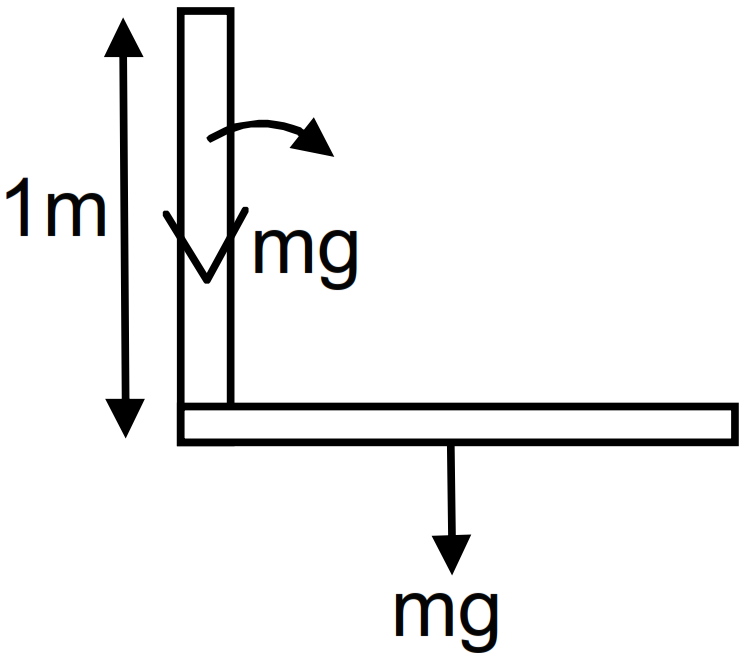
A metre stick is held vertically with one end on a rough horizontal floor. It is gently allowed to fall on the floor. Assuming that the end at the floor does not slip, find the angular speed of the rod when it hits the floor.
Answer

Let the mass of the rod = m Therefore applying laws of conservation of energy $\frac{1}{2}\text{l}\omega^2=\text{mg}\frac{\text{l}}2{}$ $\Rightarrow\frac{1}{2}\times\text{M}\frac{\text{l}^2}{3}\times\omega^2=\text{mg}\frac{1}{2}$ $\Rightarrow\omega^2=\frac{\text{3g}}{\text{l}}$ $\Rightarrow\omega=\sqrt{\frac{\text{3g}}{\text{l}}}=5.42\text{rad/s.}$

Need a full question paper?

Generate a complete, print-ready paper with questions like this in minutes — across 16+ boards, with answer keys.
Start Generating Free

Similar questions

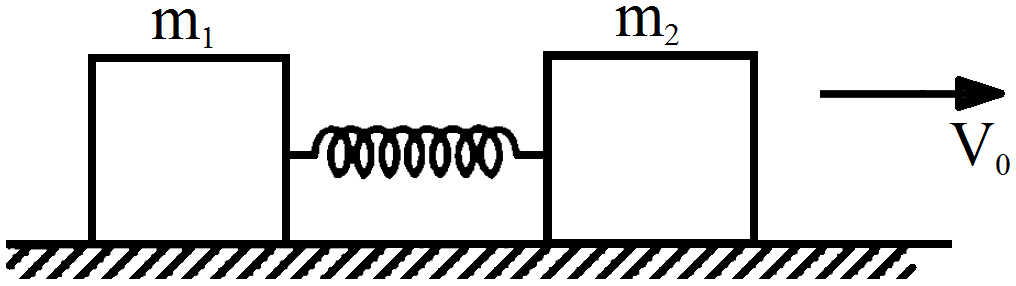
Two blocks of masses $m_1$ and $m_2$ are connected by a spring of spring constant $k.$ The block of mass $m_2$ is given a sharp impulse so that it acquires a velocity $v_0$ towards right. Find
  1. The velocity of the centre of mass.
  2. The maximum elongation that the spring will suffer.
A uniform rod of mass $300g$ and length $50\ cm$ rotates at a uniform angular speed of $2\text{rad/s}$ about an axis perpendicular to the rod through an end. Calculate:
  1. The angular momentum of the rod about the axis of rotation.
  2. The speed of the centre of the rod.
  3. Its kinetic energy.
Suppose an attractive nuclear force acts between two protons which may be written as $\text{F}=\text{Ce}^{-\text{kr}}/\text{r}^2.$
  1. Write down the dimensional formulae and appropriate $SI$ units of $C$ and $k.$
  2. Suppose that $k = 1\ \text{fermi}^{-1}$ and that the repulsive electric force between the protons is just balanced by the attractive nuclear force when the separation is $5$ fermi. Find the value of $C.$
The magnetic intensity Hat the centre of a long solenoid carrying a current of 2.0A, is found to be 1500A/m. Find the number of turns per centimetre of the solenoid.
Consider a non$-$conducting ring of radius $r$ and mass $m$ that has a total charge $q$ distributed uniformly on it. The ring is rotated about its axis with an angular speed $\omega.$
  1. Find the equivalent electric current in the ring.
  2. Find the magnetic moment $\mu$ of the ring.
  3. Show that $\mu=\frac{\text{q}}{2\text{m}}\text{l}$ where $l$ is the angular momentum of the ring about its axis of rotation.
A gas cylinder has walls that can bear a maximum pressure of $1.0 \times 10^6Pa$. It contains a gas at $8.0 \times 10^5Pa$ and $300K$. The cylinder is steadily heated. Neglecting any change in the volume, calculate the temperature at which the cylinder will break.
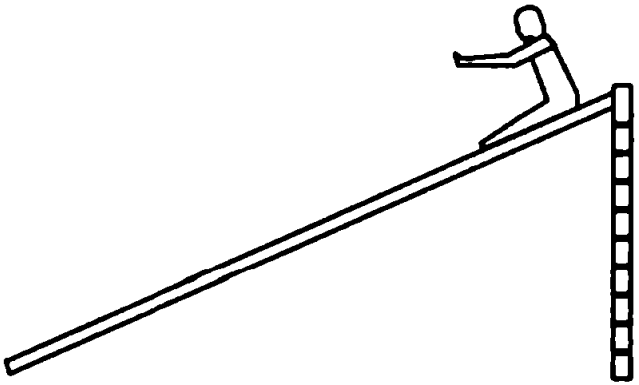
In a children's park, there is a slide which has a total length of $10m$ and a height of $8.0m ($figure$).$ Vertical ladder are provided to reach the top. A boy weighing $200N$ climbs up the ladder to the top of the slide and slides down to the ground. The average friction offered by the slide is three tenth of his weight. Find
  1. The work done by the ladder on the boy as he goes up.
  2. The work done by the slide on the boy as he comes down. Neglect any work done by forces inside the body of the boy.
A wheel of moment of inertia $0.500kg-m^2$ and radius $20.0cm$ is rotating about its axis at an angular speed of $20.0rad/s$. It picks up a stationary particle of mass $200g$ at its edge. Find the new angular speed of the wheel.
A body rotating at 20rad/s is acted upon by a constant torque providing it a deceleration of $2rad/s^2$. At what time will the body have kinetic energy same as the initial value if the torque continues to act?
A force of 400N acting horizontal pushes up a $20kg$ block placed on a rough inclined plane which makes an angle of $45^\circ$ with the horizontal. The acceleration experienced by the block is $0.6m/ s^2$. Find the coefficient of sliding friction between the box and incline.