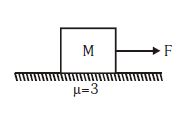
A block of mass $M$ placed on rough surface of coefficient of friction equal to $3$ . If $F$ is the $(4/5)$ of the minimum force required to just move. Find out the force exerted by ground on the block
Diffcult


Download our appand get started for free
Experience the future of education. Simply download our apps or reach out to us for more information. Let's shape the future of learning together!No signup needed.*
Similar Questions
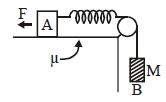
- 1Block $A$ of mass $m$ and block $B$ of mass $M$ are connected by a massless spring over a pulley on a rough plane with coefficient of friction as $μ$. A force $F$ is applied on block $A$ to the left. Find the minimum value of $M$ to move the block $A$ towards rightView Solution
- 2A cyclist goes round a circular path of circumference $34.3\, m$ in $\sqrt {22} $ sec. the angle made by him, with the vertical, will be ....... $^o$View Solution
- 3A string breaks if its tension exceeds $10$ newtons. A stone of mass $250\, gm$ tied to this string of length $10 \,cm$ is rotated in a horizontal circle. The maximum angular velocity of rotation can be .......... $rad/s$View Solution
- 4If the radius of curvature of the path of two particles of same mass are in the ratio $3:4,$ then in order to have constant centripetal force, their velocities will be in the ratio of:View Solution
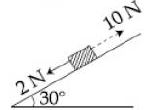
- 5A block kept on a rough inclined plane, as shown in the figure, remains at rest upto a maximum force $2\,N$ down the inclined plane. The maximum external force up the inclined plane that does not move the block is $10\,N.$ The coefficient of static friction between the block and the plane is : [Take $g = 10\,m/s^2$ ]View Solution
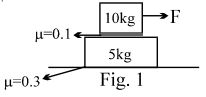
- 6The maximum acceleration of $5\, kg$ block ...... $m/s^2$View Solution
- 7View SolutionTo avoid slipping while walking on ice, one should take smaller steps because of the
- 8$A$ block of mass $M$ is placed on $a$ horizontal surface and it is tied with an inextensible string to $a$ block of mass, as shown in figure. A block of mass $m_0$ is also placed on $M$ If friction force exists between the block $M$ and the block $m_0$ and not between the block $M$ and the horizontal surface, then the minimum value of $\mu$ for which the block m remains stationary isView Solution

- 9A given object takes $n$ times the time to slide down $45^{\circ}$ rough inclined plane as it takes the time to slide down an identical perfectly smooth $45^{\circ}$ inclined plane. The coefficient of kinetic friction between the object and the surface of inclined plane is :View Solution
- 10$A$ block of mass $M$ is placed on $a$ horizontal surface and it is tied with an inextensible string to $a$ block of mass, as shown in figure. A block of mass $m_0$ is also placed on $M$ In previous problem, the tension in the string will beView Solution
