MCQ
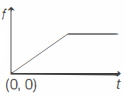
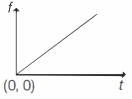
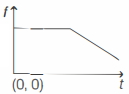
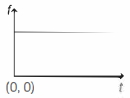
A block of mass $M$ rests on a rough horizontal table. A steadily increasing horizontal force is applied such that the block starts to slide on the table without toppling. The force is continued even after sliding has started. Assume the coefficients of static and kinetic friction between the table and the block to be equal. The correct representation of the variation of the frictional force $f$, exerted by the table on the block with time $t$ is given by

  • B

  • C

  • D

Answer

Correct option: A.

a
(a)

Force of friction is self adjusting. When applied force is increased friction, first increases till it reaches a maximum value called limiting friction.

If applied force is further increased, then friction does not increases further and body begins to move.

Force of friction then remains constant and its value is given by

$f=\mu N$

Need a full question paper?

Generate a complete, print-ready paper with questions like this in minutes — across 16+ boards, with answer keys.

Start Generating Free

Similar questions

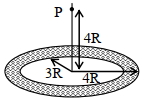
A thin uniform annular disc (see figure) of mass $M$ has outer radius $4 R$ and inner radius $3 R$. The work required to take a unit mass from point $P$ on its axis to infinity is
A $140\, g$ ball, in horizontal flight with a speed $v_1$ of $39.0\, m/s$, is struck by a bat. After leaving the bat, the ball travel in the opposite direction with speed $v_2 = 39.0\, m/s$. If the impact time $\Delta t$ for the ball-bat collision is $1.20\, ms$, what average net force acts on the ball ......... $N$
A man fires a bullet of mass $200 \,g$ at a speed of $5 \,m/s$. The gun is of one $kg$ mass. by what velocity the gun rebounds backwards ........ $m/s$
A ball is projected upwards from the top of tower with a velocity $50\,\,m{s^{ - 1}}$ making an angle ${30^o}$ with the horizontal. The height of tower is $ 70 \,m$. After how many seconds from the instant of throwing will the ball reach the ground  ........ $\sec$
If the liquid in a U-tube of cross-section A rises to a height $h$. Then the period of oscillatory motion of the fluid is T. Liquid in a U-tube of cross section $\frac{A}{2}$ If you fill up to the height and make it oscillate then the time period will be :
Two particles having position vectors $\overrightarrow {{r_1}} = (3\hat i + 5\hat j)$ metres and $\overrightarrow {{r_2}} = ( - 5\hat i - 3\hat j)$ metres are moving with velocities ${\overrightarrow v _1} = (4\hat i + 3\hat j)\,m/s$ and ${\overrightarrow v _2} = (\alpha \,\hat i + 7\hat j)$ $m/s.$ If they collide after $2$  seconds, the value of $'\alpha '$ is
$A$ body kept on a smooth horizontal surface is pulled by a constant horizontal force applied at the top point of the body. If the body rolls purely on the surface, its shape can be : 
A particle moves in the $xy$ plane with a constant acceleration $'g'$ in the negative $y$-direction. Its equation of motion is $y = ax-bx^2$, where $a$ and $b$ are constants. Which of the following are correct?
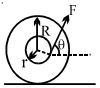
The spool shown in figure is placed on rough horizontal surface and has inner radius $r$ and outer radius $R$. The angle $\theta$ between the applied force and the horizontal can be varied. The critical angle $(\theta )$ for which the spool does not roll and remains stationary is given by 
$A$ ball of mass $m$ is attached to the lower end of light vertical spring of force constant $k$. The upper end of the spring is fixed. The ball is released from rest with the spring at its normal (unstretched) length, comes to rest again after descending through a distance $x.$