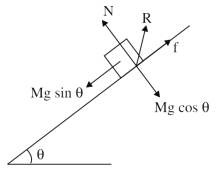
A block of mass $M$ slides down on a rough inclined plane with constant velocity. The angle made by the incline plane with horizontal is $\theta$. The magnitude of the contact force will be.
JEE MAIN 2022, Medium


Download our appand get started for free
Experience the future of education. Simply download our apps or reach out to us for more information. Let's shape the future of learning together!No signup needed.*
Similar Questions
- 1A lift is moving downwards with an acceleration equal to acceleration due to gravity. A body of mass $m$ kept on the floor of the lift is pulled horizontally. If the coefficient of friction is $\,\mu $, then the frictional resistance offered by the body isView Solution
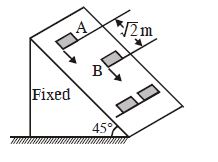
- 2Two blocks $A$ and $B$ of equal masses are sliding down along straight parallel lines on an inclined plane of $45^o$ . Their coefficients of kinetic friction are $\mu _A = 0.2$ and $\mu _B = 0.3$ respectively. At $t = 0$ , both the blocks are at rest and block $A$ is $\sqrt 2$ metre behind block $B$ . The time and distance from the initial position where the front faces of the blocks come in line on the inclined plane as shown in figure. (Use $g = 10\, ms^{-2}$ )View Solution
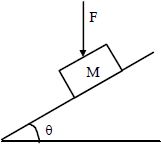
- 3A block of mass $M$ is sliding down the plane. Coefficient of static friction is $\mu _s$ and kinetic friction is $\mu _k.$ Then friction force acting on the block is :-View Solution
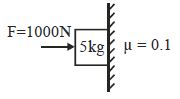
- 4For the given figure, if block remains in equilibrium position then find frictional force between block and wall ........ $N$View Solution
- 5A heavy box of mass $50 \mathrm{~kg}$ is moving on a horizontal surface. If co-efficient of kinetic friction between the box and horizontal surface is $0.3$ then force of kinetic friction is :View Solution
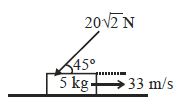
- 6A block of mass $5\, kg$ is kept on a rough horizontal floor. It is given a velocity $33\, m/s$ towards right. A force of $20\sqrt {2\,} \,N$ continuously acts on the block as shown in the figure. If the coefficient of friction between block and floor is $0.5$ the velocity of block after $3\, seconds$ is ........ $m/s$ ($g = 10\, m/s^2$)View Solution
- 7The retarding acceleration of $7.35\, ms^{-2}$ due to frictional force stops the car of mass $400\, kg$ travelling on a road. The coefficient of friction between the tyre of the car and the road isView Solution
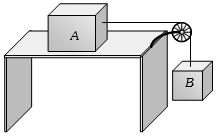
- 8The blocks $A$ and $B$ are arranged as shown in the figure. The pulley is frictionless. The mass of $A$ is $10 \,kg$. The coefficient of friction of $A$ with the horizontal surface is $0.20$. The minimum mass of $B $ to start the motion will be...... $kg$View Solution
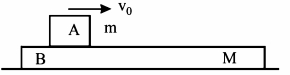
- 9The masses of blocks A and B are $m$ and $M$ respectively. Between $A$ and $B$, there is a constant frictional force $F$ and $B$ can slide on a smooth horizontal surface. A is set in motion with velocity while $B$ is at rest. What is the distance moved by A relative to $B$ before they move with the same velocity?View Solution
- 10A block $A$ of mass $4\, kg$ is placed on another block $B$ of mass $5\, kg$, and the block $B$ rests on a smooth horizontal table. If the minimum force that can be applied on $A$ so that both the blocks move together is $12\, N$, the maximum force that can be applied to $B$ for the blocks to move together will be $..... N$View Solution